Content Menu
● What Does Aluminum Extrusion Press Tonnage Mean?
● Which Factors Determine Aluminum Extrusion Press Tonnage?
>> Billet Diameter and Container Size
>> Alloy and Processing Temperature
>> Profile Geometry and Die Design
>> Extrusion Ratio
● How to Calculate Preliminary Extrusion Press Force
>> Worked Example: Why Billet Diameter Changes Tonnage
● Why a Standard Tonnage Chart Is Not Enough
● Three Engineering Checks That Prevent Costly Oversizing
>> 1. Check Peak Force, Not Only Steady Extrusion
>> 2. Separate Extrudability from Saleable Output
>> 3. Challenge Blanket Safety-Margin Rules
● How to Specify the Right Press with Yejing
● Frequently Asked Questions
>> 1. Can profile width alone determine extrusion press tonnage?
>> 2. Does a larger press always produce more aluminum?
>> 3. Is a 2,000-tonne press sufficient for every 178 mm billet application?
>> 4. Should hydraulic pressure be used in the extrusion-force formula?
>> 5. Can one press produce both architectural and industrial profiles?
>> 6. What is the best starting point for a tonnage recommendation?
● References
The right aluminum extrusion press tonnage depends on billet diameter, alloy, profile geometry, die design, and production targets—not profile width alone. A reliable selection starts with the force required for your most demanding planned products, then checks whether the complete extrusion line can deliver them consistently.
At Foshan Yejing Machinery Manufacturing Co., Ltd., our equipment-selection philosophy is straightforward: define the products first, then specify the press. Drawing on 36 years of manufacturing experience, we help customers evaluate extrusion presses alongside auxiliary equipment and intelligent production-line requirements.
This guide explains how to calculate preliminary force requirements, identify hidden constraints, and prepare a practical specification.
What Does Aluminum Extrusion Press Tonnage Mean?
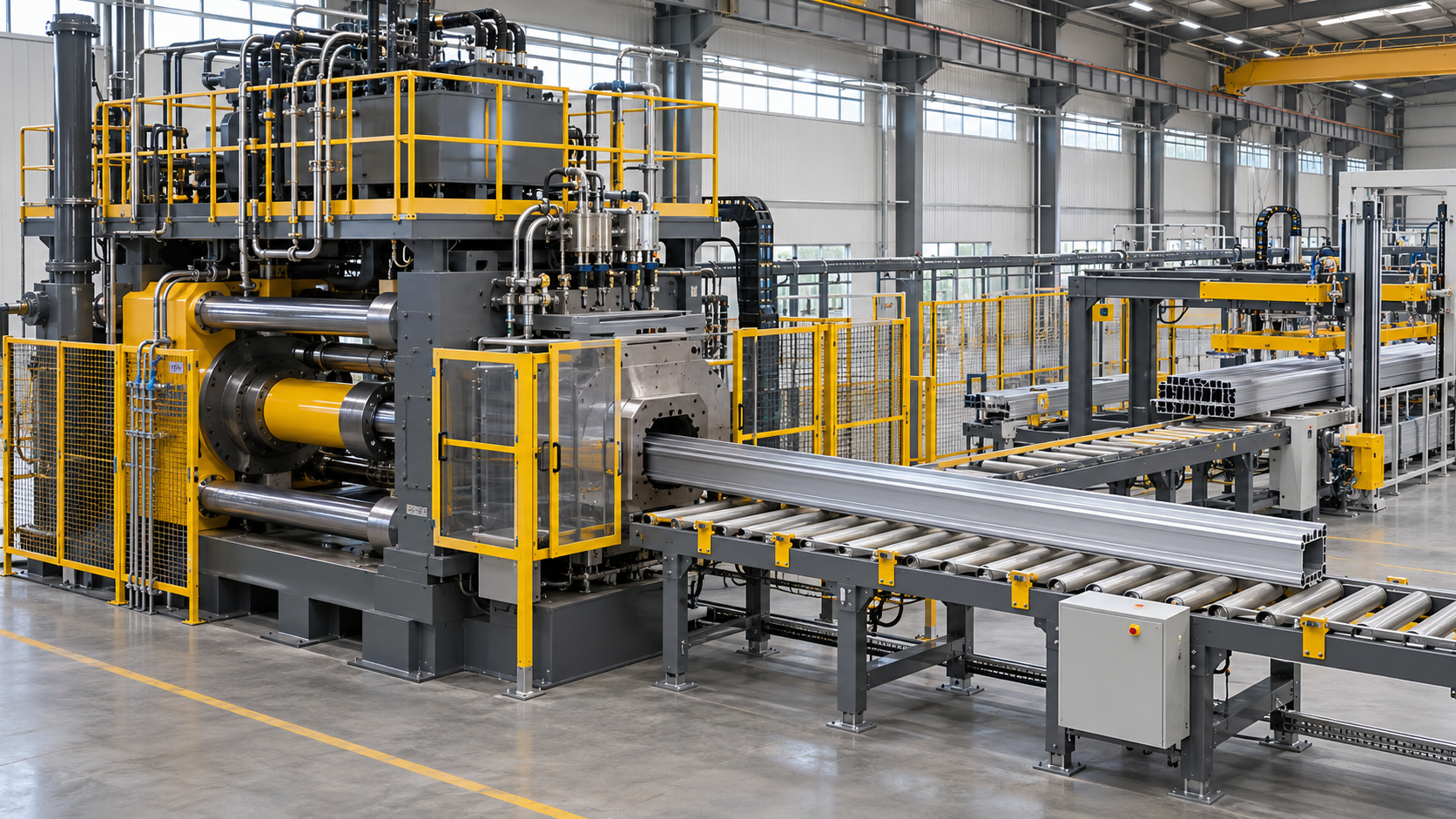
Press tonnage describes pushing force, not machine weight or hourly production.
Buyers should distinguish metric tonne-force, US short ton-force, and meganewtons. One metric tonne-force equals approximately 9.807 kN; a 2,000-metric-tonne-force press therefore delivers approximately 19.61 MN.
Also distinguish hydraulic system pressure from specific extrusion pressure:
- Hydraulic pressure acts inside the press cylinders.
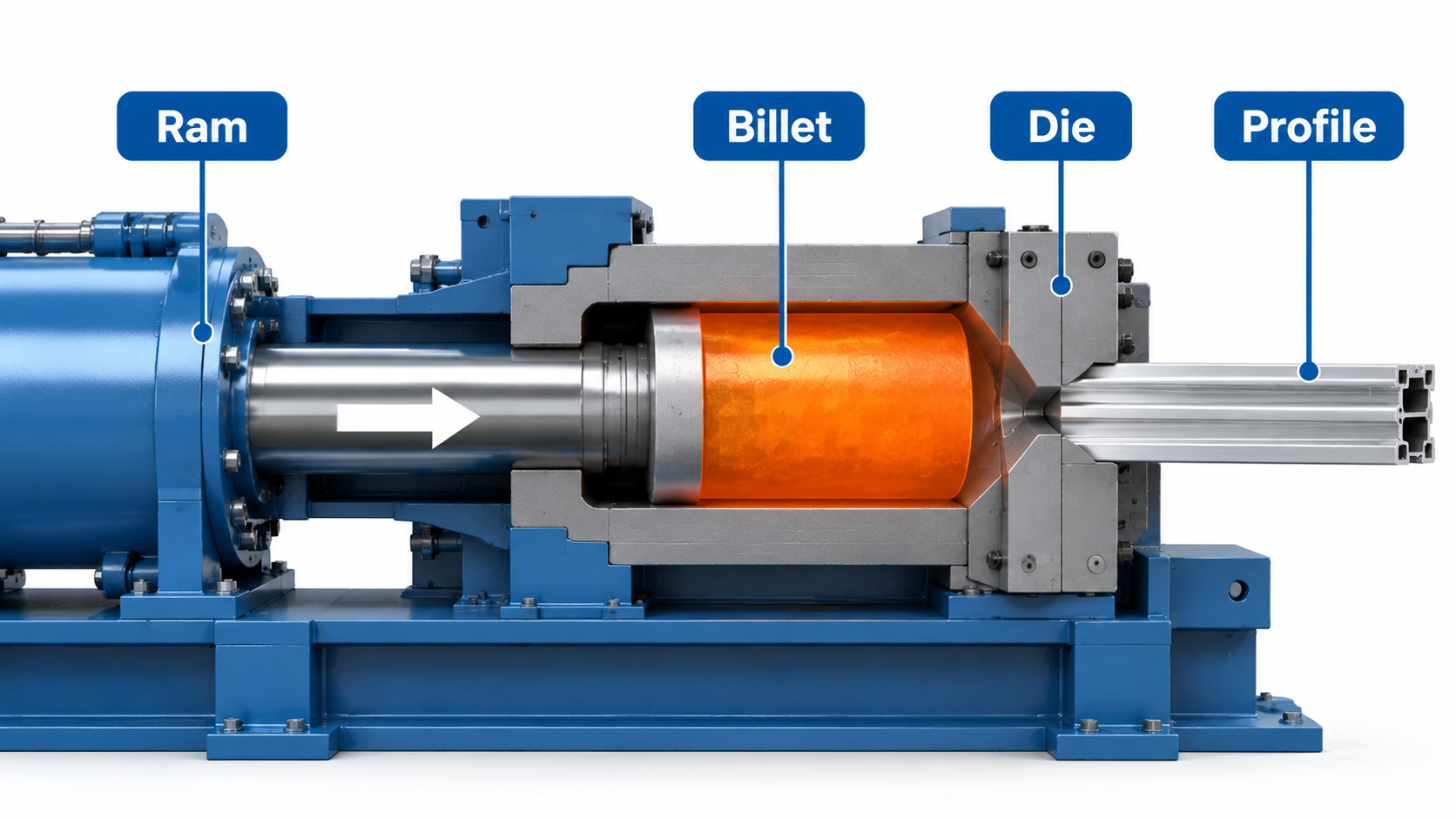
- Specific extrusion pressure is the force applied divided by the container bore area.
Comparing hydraulic pressure ratings alone will not tell you which press can extrude your products.
Which Factors Determine Aluminum Extrusion Press Tonnage?
Billet Diameter and Container Size
A larger container requires more force to achieve the same specific pressure. Because cross-sectional area increases with diameter squared, a modest diameter increase can substantially change the required tonnage.
Use the actual container bore for engineering calculations. Nominal billet diameter provides only a preliminary approximation because the heated billet expands to fill the container.
Alloy and Processing Temperature
Different alloys resist deformation differently. A setting suitable for one alloy may not deliver acceptable speed or quality with another.
Temperature matters too: lower billet temperatures generally increase pressure requirements. However, raising temperature is not a universal solution because allowable temperatures depend on alloy, profile geometry, and quality requirements.
Profile Geometry and Die Design
A lightweight profile is not automatically easy to extrude. Thin walls, complex hollow sections, and difficult metal-flow paths can require substantial force.
Evaluate:
- Minimum wall thickness and wall-thickness variation.
- Solid, semi-hollow, or hollow construction.
- Die openings, ports, and bearing arrangement.
- Surface finish and dimensional tolerances.
Profile fit and force capacity are separate checks. A section may fit the tooling envelope yet remain impractical at the required production speed.
Extrusion Ratio
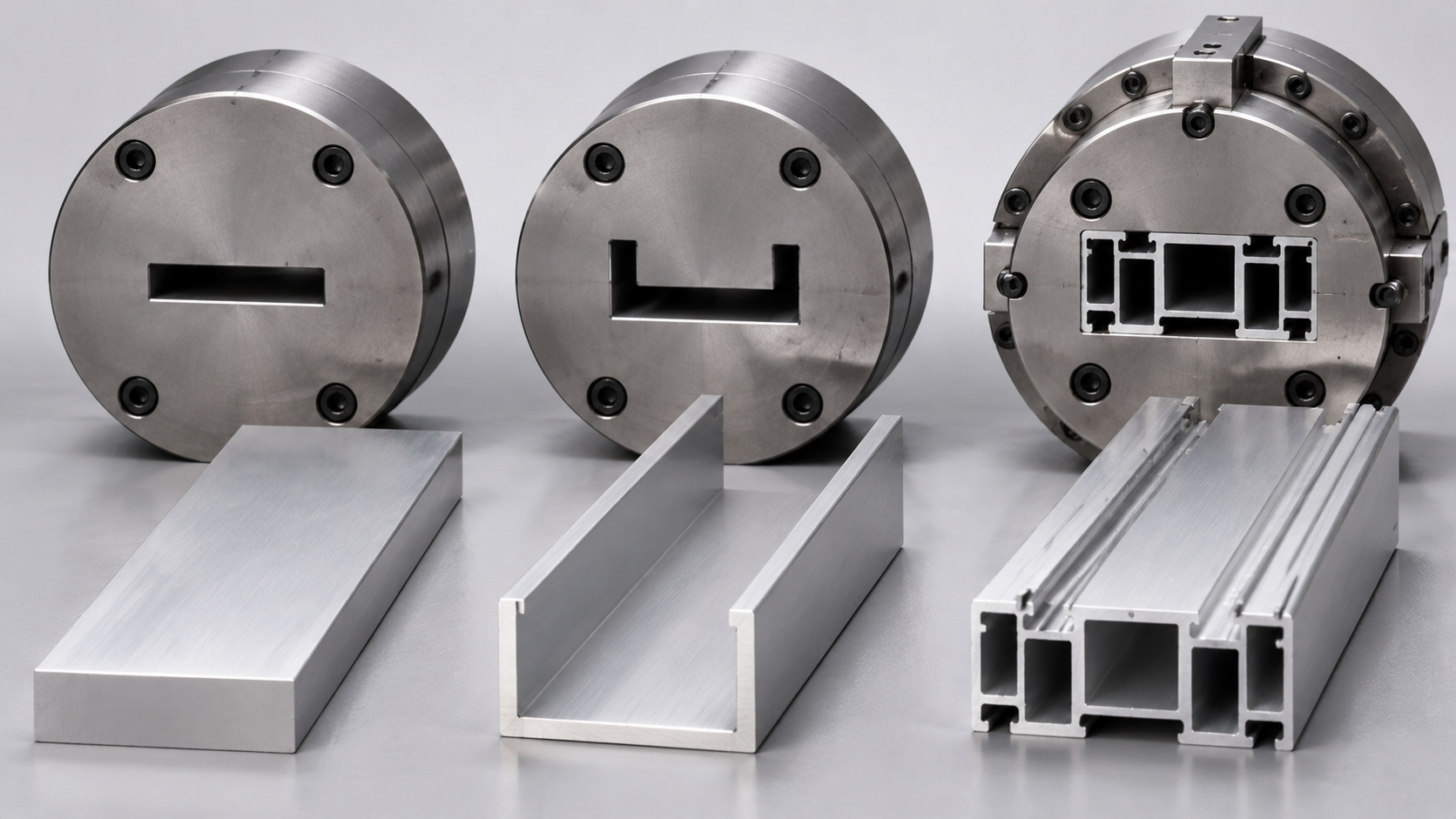
Extrusion ratio compares container area with the total metal cross-sectional area leaving the die:
R=Ac/Ae
For multi-hole dies, Ae includes every opening's metal area. For hollow profiles, do not include the internal void as aluminum area.
Higher ratios generally increase resistance to metal flow. However, no single ratio guarantees success across all alloys, dies, and operating conditions.
How to Calculate Preliminary Extrusion Press Force
A useful starting relationship is:
F=ps×Ac
For a circular container:
Ac=πD2/4
With pressure in MPa and dimensions in millimeters:
Tmetric=ps×Ac/9,806.65
Here, ps means required specific extrusion pressure—not hydraulic system pressure.
The formula is straightforward; establishing a defensible pressure requirement is the difficult part. Obtain it from comparable production records, validated simulation, trials, or an engineering assessment.
Worked Example: Why Billet Diameter Changes Tonnage
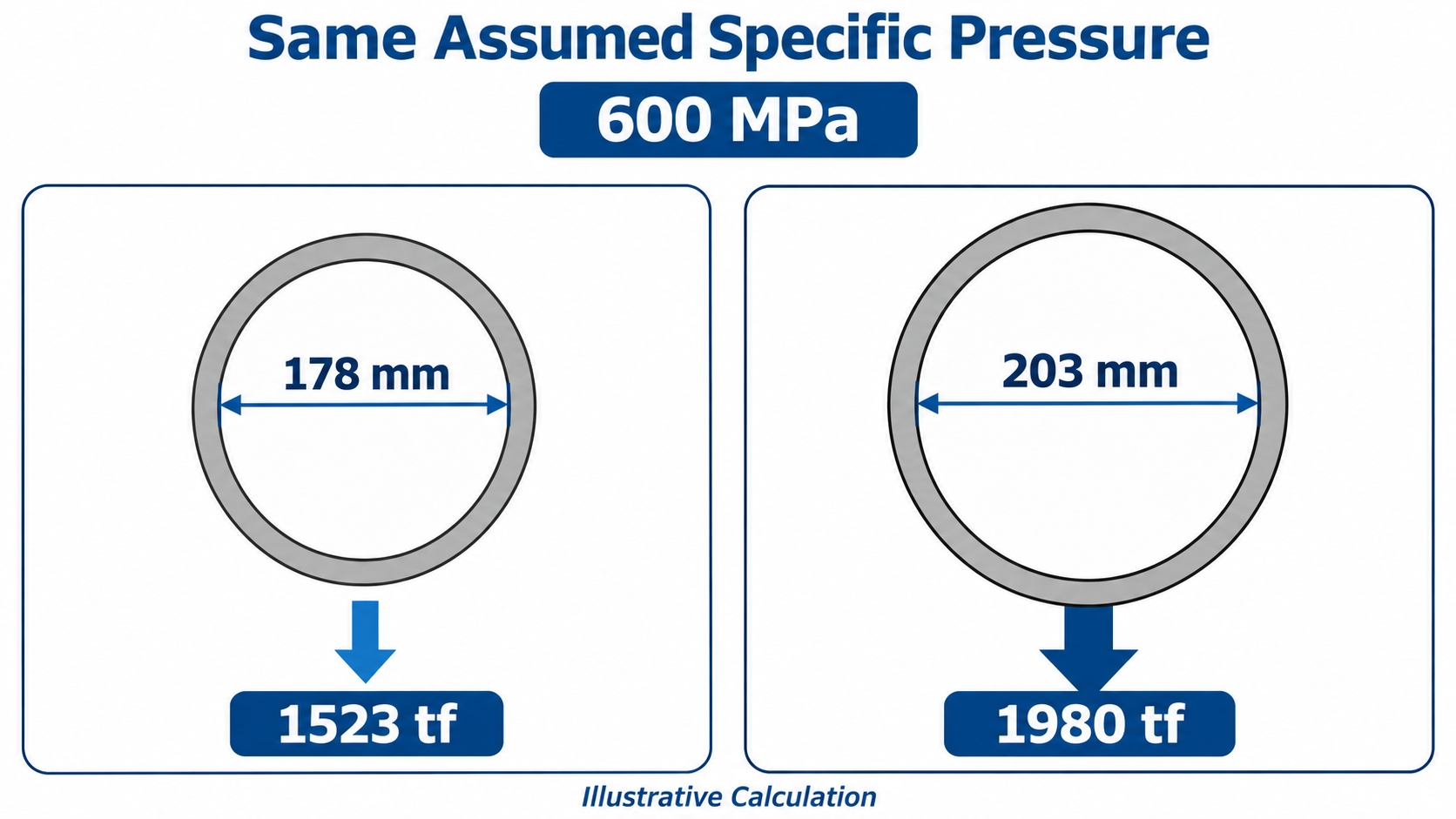
Assume a hypothetical container bore of 178 mm and an engineering-established specific pressure requirement of 600 MPa.
The estimated values are:
| Calculation | Approximate result |
| Container cross-sectional area | 24,885 mm² |
| Required extrusion force | 14.93 MN |
| Equivalent metric tonne-force | 1,523 tonnes |
If the bore increases to 203 mm at the same assumed pressure, the requirement rises to approximately 1,980 metric tonnes-force.
These figures illustrate the calculation; 600 MPa is not a universal recommendation. Final selection must address peak force, usable operating capacity, tooling limitations, and an agreed operating reserve.
Why a Standard Tonnage Chart Is Not Enough
A chart linking press tonnage to billet diameter can help shortlist equipment, but it cannot confirm suitability.
Two profiles with similar external dimensions may differ substantially in wall thickness, metal area, hollow geometry, and permissible speed. Equally, two presses with the same nominal tonnage may have different tooling envelopes and production capabilities.
Use this decision matrix instead:
| Selection check | Information required | Decision supported |
| Geometric fit | Profile drawing, circumscribing circle, tooling dimensions | Whether the section and die fit |
| Force requirement | Alloy, container bore, extrusion ratio, process conditions | Whether extrusion is feasible |
| Productivity | Billet length, cycle time, speed, yield | Whether output targets are realistic |
| Line compatibility | Quench, puller, handling, saw, aging capacity | Whether downstream equipment can keep pace |
Three Engineering Checks That Prevent Costly Oversizing
1. Check Peak Force, Not Only Steady Extrusion
In direct extrusion, force rises during initial billet upsetting and breakthrough, then generally decreases as the stroke progresses.
A selection based only on average running force can overlook the initial peak. Ask the supplier to explain how the proposed configuration handles the expected force curve.
2. Separate Extrudability from Saleable Output
Producing one acceptable profile does not prove that a line will meet a monthly delivery commitment.
Estimate saleable output using:
Saleable output=Gross throughput×Operating availability×Saleable yield
Require assumptions for billet changes, die changes, scrap, planned maintenance, and downstream interruptions. More tonnage alone does not resolve a cooling or handling bottleneck.
3. Challenge Blanket Safety-Margin Rules
An automatic percentage added to every calculation is not a substitute for engineering.
Discuss reserve capacity against specific uncertainties: colder billets, more demanding alloys, die variation, or a defined future product family. The objective is a justified operating window—not simply the largest affordable machine.
How to Specify the Right Press with Yejing
Start with a product specification rather than a preferred tonnage. Send:
1. Drawings of representative and most demanding profiles.
2. Alloy grades, temper requirements, and surface expectations.
3. Minimum walls, tolerances, and profile weight per meter.
4. Available billet diameters and lengths.
5. Monthly saleable-output targets and shift schedules.
6. Plant layout, utilities, and automation requirements.
Yejing's company-provided background includes more than 3,000 presses manufactured, a 66,000 m² production base, and processing, assembly, and commissioning capabilities covering 600- to 9,000-tonne-class presses. Our scope includes presses, auxiliary equipment, and integrated intelligent extrusion lines.
Send Yejing your profile drawings, alloy list, billet specifications, and output targets to request a matched press-and-line proposal. Ask the proposal to state the recommended tonnage, tooling envelope, production assumptions, and validation requirements.
Frequently Asked Questions
1. Can profile width alone determine extrusion press tonnage?
No. Width helps assess geometric fit, but alloy, wall thickness, extrusion ratio, die design, and processing conditions determine force requirements.
2. Does a larger press always produce more aluminum?
No. Output also depends on billet volume, extrusion speed, cycle time, availability, yield, and downstream capacity.
3. Is a 2,000-tonne press sufficient for every 178 mm billet application?
No. Container size alone cannot confirm suitability. The alloy, die, geometry, peak pressure requirement, and target speed must also be evaluated.
4. Should hydraulic pressure be used in the extrusion-force formula?
Not directly. Extrusion force equals specific billet pressure multiplied by container area. Hydraulic force calculations instead use cylinder pressure and effective piston area.
5. Can one press produce both architectural and industrial profiles?
Potentially. Confirm that the proposed alloy range, tooling, thermal control, quenching, handling, and productivity requirements are compatible.
6. What is the best starting point for a tonnage recommendation?
Provide actual profile drawings and production targets. They allow the supplier to assess both the hardest product to extrude and the product mix that drives everyday economics.
References
1. - [SME — Extrusion Processes: Manufacturing Processes Study Guide]. Supports press-force terminology, breakthrough behavior, and the influence of material, geometry, temperature, and extrusion ratio. [sme]
2. - [Bonnell Aluminum — Aluminum Extrusion Process]. Supports the relationships among temperature, pressure, alloy, extrusion ratio, and profile complexity. [bonnellaluminum]
3. - [Gia Clecim Press — The Principle of Extrusion Technology]. Provides the specific-pressure and extrusion-ratio relationships and explains the direct-extrusion force curve. [giaet]
4. - [Castool — Extrusion Productivity: Billet Geometry/Container/Dummy Block]. Discusses billet geometry, breakthrough pressure, and productivity considerations. [castool]
5. - Company information: supplied by Foshan Yejing Machinery Manufacturing Co., Ltd. for this article; not independently audited. The numerical example is illustrative, not a documented customer installation. Selection recommendations synthesize the technical sources above rather than represent a universal sizing standard.


