Content Menu
● What Makes an Aluminum Extrusion Press Manufacturer Worth Shortlisting?
>> Why Source an Aluminum Extrusion Press from China?
● How We Selected the 10 Manufacturers
● Top 10 Aluminum Extrusion Press Machine Manufacturers in China
>> 1. Foshan Yejing Machinery Manufacturing Co., Ltd. — Established Press Production and Line Integration
>> 2. Wuxi Weite Machinery Co., Ltd. — Direct, Indirect, and Multi-Metal Presses
>> 3. Foshan Sailixin Machinery Manufacturing Co., Ltd. — Configurable Presses and Complete Lines
>> 4. Taiyuan Heavy Industry Co., Ltd. — Large Engineered Extrusion Press Projects
>> 5. Foshan Nanhai Xinxinke Extrusion Machinery — Aluminum and Copper Presses Across Multiple Force Classes
>> 6. HLT Industry Co., Ltd. — Extrusion Press Platforms for Configured Lines
>> 7. Wuxi Yuanchang Machinery Co., Ltd. — Standard Aluminum Presses and OEM Projects
>> 8. Foshan Jingneng Machinery Company Limited — A Foshan Press Supplier to Qualify by Factory Audit
>> 9. Foshan Dynamax Industry Co., Ltd. — Press and Auxiliary Packages with Integration to Verify
>> 10. Foshan Nanhai Jinli Machinery Manufacture Co., Ltd. — Conventional Profile Presses and Auxiliaries
● Manufacturer Comparison: Press Force, Production Capacity, MOQ, and Certification
● Buyer's Guide: How to Specify, Inspect, and Accept an Extrusion Press
>> 1. Size the Press Around Your Product Mix
>> 2. Separate Press Performance from Whole-Line Performance
>> 3. Check Critical Materials and Control Substitutions
>> 4. Insider Check: Do Not Buy Dry-Cycle Speed as Production Output
>> 5. Make Compliance and Shipping Part of the Technical Tender
● Conclusion: Buy the Output, Not Just the Press
● FAQ
>> 1. How can I verify an aluminum extrusion press manufacturer's ISO 9001 certificate?
>> 2. Should I buy a higher-force press for future profiles?
>> 3. What if the manufacturer cannot run my production die at the factory?
>> 4. Who takes responsibility for CE conformity when the press and auxiliaries come from different suppliers?
>> 5. How do I compare energy claims between two hydraulic extrusion presses?
● References
What Makes an Aluminum Extrusion Press Manufacturer Worth Shortlisting?
The right aluminum extrusion press machine manufacturer is the one that can build a press around your billet, alloy, and profile mix—and demonstrate that it can turn those inputs into saleable output. Start with four checks: confirm which factory builds and tests the press; ask engineering to explain its press selection against your hardest profiles; review actual quality-control records; and verify the production, testing, and commissioning schedule. A supplier that cannot answer these questions before you pay a deposit is difficult to qualify, regardless of the force rating on its quotation.
This guide focuses on manufacturers that offer the extrusion press itself. Furnaces, pullers, quench systems, and cooling tables matter because they affect what the press can deliver in production, but an auxiliary equipment catalog alone does not qualify a supplier. Likewise, a company that makes aluminum profiles is a press user, not necessarily a press manufacturer.
Why Source an Aluminum Extrusion Press from China?
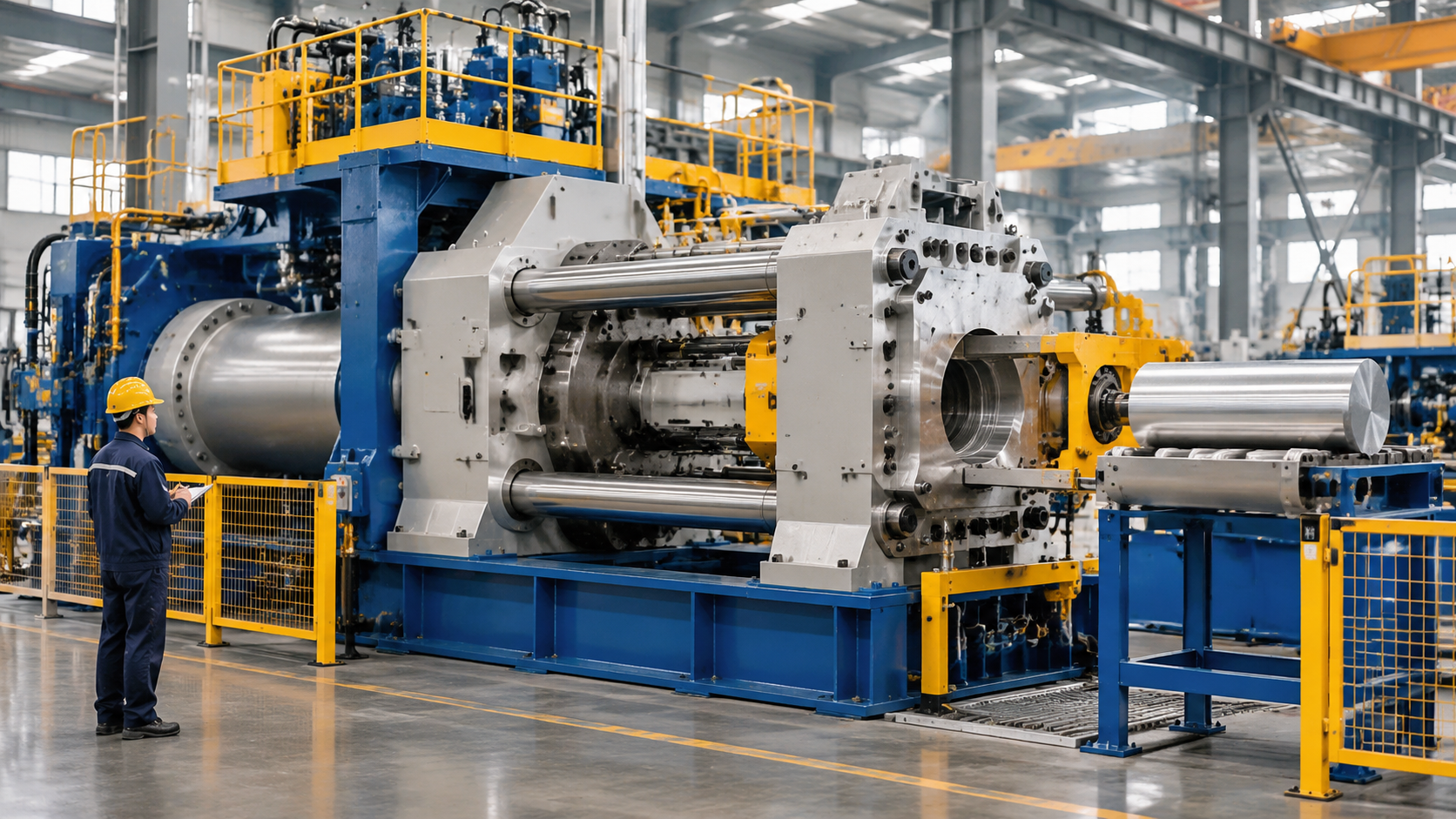
Foshan, Guangdong, gives buyers access to several press builders in the same region as major aluminum profile producers. The cluster is useful for scheduling factory visits, comparing line layouts, and checking whether a proposed commissioning team has worked on a similar installation. Wuxi, Jiangsu, adds manufacturers with portfolios spanning aluminum and other nonferrous metals. Taiyuan, Shanxi, provides a reference point for large engineered presses where infrastructure and installation can be as consequential as the machine itself.
For market context, an Orion Market Research outlook for 2025–2035 values China's aluminum extrusion market at US$25.5 billion in 2024 and forecasts US$69.5 billion by 2035. That is an estimate for the aluminum extrusion market, not for extrusion press machinery. It gives context for downstream demand but does not tell buyers how many presses are built, what they cost, or whether any supplier has an open production slot.
How We Selected the 10 Manufacturers
This is a shortlist for different buying scenarios, not a ranking by sales, market share, or independently audited output. Manufacturer claims are identified as such. Where a founding date, export market, MOQ, or certificate could not be verified from the available information, it is marked for confirmation rather than assumed.
| Selection criterion |
Suggested weight |
Evidence to request |
| Press engineering and application fit |
30% |
Force rating in MN, billet and container sizes, press architecture, and a written selection for representative profiles |
| Manufacturing and quality control |
25% |
Factory audit, material records for critical parts, machining and alignment reports, and a sample test report |
| Line integration and after-sales support |
20% |
Equipment interface drawings, controls responsibilities, comparable installations, and commissioning scope |
| Capacity and delivery reliability |
15% |
Recent shipments of comparable presses, major-component lead times, and a reserved assembly and test slot |
| Compliance and documentation |
10% |
Current site-level quality certificates, machine-specific conformity documents, risk assessment, and safety validation records as applicable |
Use the scorecard only after screening out any supplier that cannot meet mandatory production, safety, or destination-market requirements. An inexpensive press with no credible acceptance plan is not a comparable bid.
Top 10 Aluminum Extrusion Press Machine Manufacturers in China
1. Foshan Yejing Machinery Manufacturing Co., Ltd. — Established Press Production and Line Integration
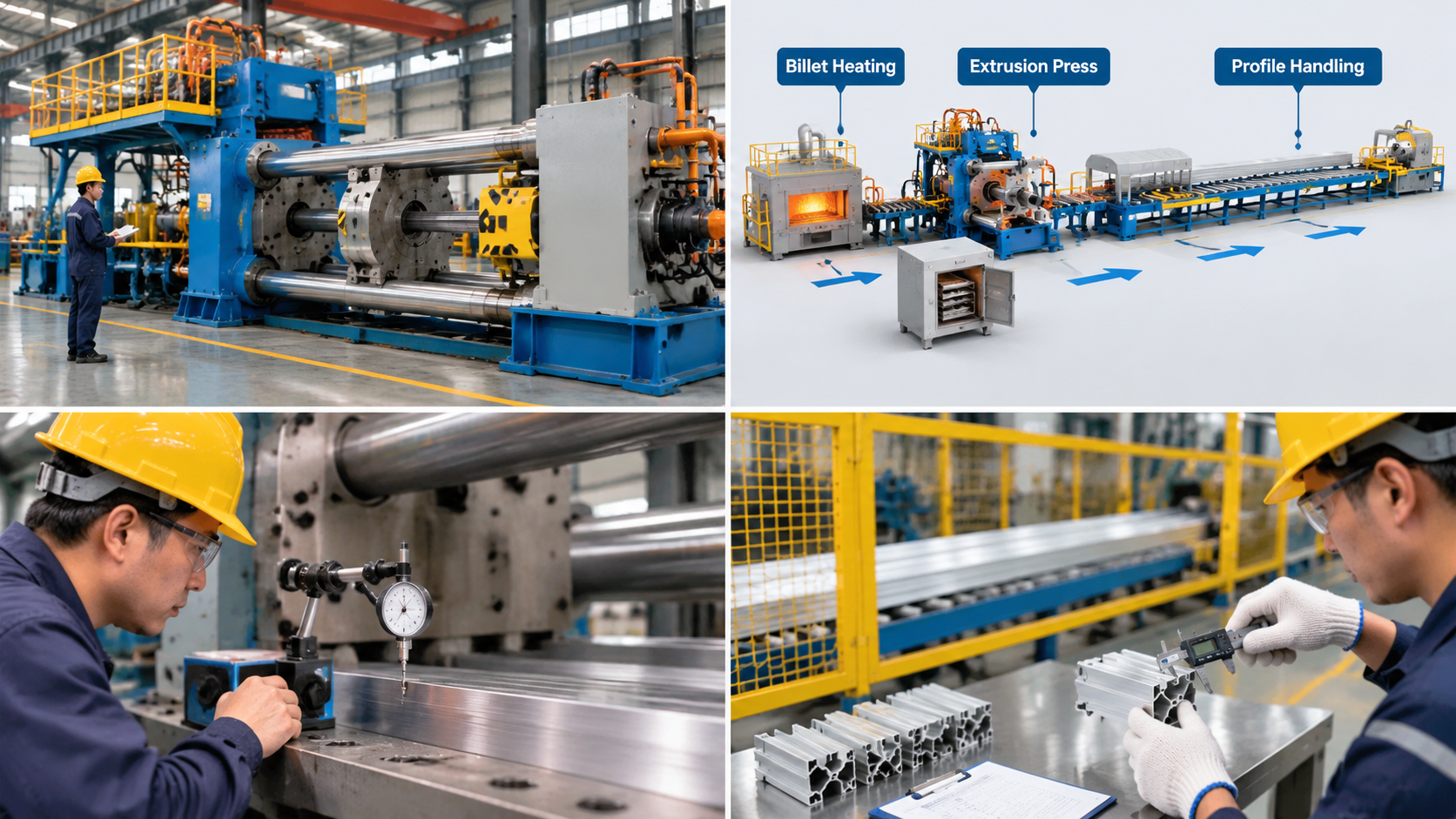
Yejing traces its extrusion machinery operations to 1990. The company says it has built more than 3,000 aluminum profile extruders and can process, assemble, and commission presses in the 600–9,000 metric-ton range. It also reports a maximum annual output of 300 sets. That is a manufacturer-reported ceiling, not verified shipments for the most recent year or proof that the relevant assembly bay is available. Yejing serves customers in China and overseas and offers complete production solutions.
Yejing is a useful comparison for a plant seeking press and line support from one supplier. Request a reference that matches your billet diameter, product category, and degree of downstream automation. If the contract covers several machines, identify who owns the controls integration and who must correct a fault that only appears when the press, puller, and saw run together.
2. Wuxi Weite Machinery Co., Ltd. — Direct, Indirect, and Multi-Metal Presses
Founded in 1989 in Wuxi, Jiangsu, Weite lists extrusion presses from 500 to 10,000 tons, including direct and indirect, single- and double-action, and short-stroke configurations. Its equipment serves aluminum and other nonferrous-metal applications across construction, aviation, and rail transit. Its public material supports a domestic and foreign-trade business, but not a country-by-country sales breakdown. The breadth of configurations supports engineered orders; branding rights and proprietary drawing ownership should be negotiated separately.
Shortlist Weite if you need to compare two press architectures or want a machine selected for a difficult section rather than a catalog tonnage alone. Ask engineering to explain why it recommends a given loading arrangement, what auxiliaries it assumes, and whether capacity or product quality would change under the alternative design.
3. Foshan Sailixin Machinery Manufacturing Co., Ltd. — Configurable Presses and Complete Lines
Founded in 2011 in Shishan, Foshan, Sailixin develops aluminum extrusion presses and supplies associated line equipment. Its current product catalog states a self-developed range of 700T–7,500T and lists billet furnaces, die ovens, quench equipment, and cooling tables. The company markets to domestic and overseas buyers, but the cited material does not establish its largest destination markets or annual output by press class. Its public offer supports project-specific press and factory layouts; separate private-label terms should be confirmed if required.
Sailixin is a useful candidate for a small or midsize extruder that needs to configure a line around an existing building or plans to add capacity in stages. Ask it to quote both a press-only package and an integrated line against the same production brief. Compare where equipment interfaces, testing obligations, and commissioning labor move from the supplier to your team. That makes it easier to judge whether the complete package offers better value than buying equipment separately.
4. Taiyuan Heavy Industry Co., Ltd. — Large Engineered Extrusion Press Projects
Taiyuan Heavy Industry, or TYHI, is relevant when a project calls for a very large press or a nonstandard arrangement. A supplier-published machinery listing describes direct and indirect, single- and double-action, and short-stroke systems and gives a range of 8–360 MN. Other public summaries report a narrower range, so buyers should confirm the active product envelope and request installed references for the specific force and configuration. The literature describes installations in China and abroad. The year 1962 is reported in connection with its extrusion press business; verify the legal contracting entity's establishment date separately.
TYHI is a better starting point for large sections, tubes, bars, or major industrial investment than for a straightforward architectural-profile line. Ask for preliminary foundation loads, the shipping split of major assemblies, the required crane capacity, and the boundary between the equipment contract and civil works. Those details determine whether the proposed press is feasible at your site.
5. Foshan Nanhai Xinxinke Extrusion Machinery — Aluminum and Copper Presses Across Multiple Force Classes
Xinxinke dates to 1991 and specializes in presses for aluminum and copper. Its English-language material names Southeast Asia, Europe, and the United States as export markets and reports annual output of around 200 units across its portfolio. It advertises a range of 600T–20,000T on one site, while another site states ranges in U.S. short tons and gives different upper bounds. Obtain the exact guaranteed force in MN and an operating reference for the specific machine, rather than treating those ranges as interchangeable.
Xinxinke is worth evaluating when the buyer needs a customized press or is comparing midrange and higher-force configurations. Request an equipment list showing which major assemblies the factory machines and tests itself and which it sources externally. Ask for the controls and hydraulic component lists before agreeing to substitutions.
6. HLT Industry Co., Ltd. — Extrusion Press Platforms for Configured Lines
HLT's company site traces its history to 1957. That is company heritage, not the launch date of its aluminum extrusion press business. Its current catalog lists aluminum extrusion presses including the YPL3300, YPL4500, and YPL6000, alongside line-oriented offerings. The cited catalog does not establish current output, principal export destinations, or standard private-label terms.
For a new plant or an added line, ask HLT to quote a specific press platform with the required billet handling, controls, and guarding interfaces. Request the performance envelope for the selected configuration rather than treating a model suffix as a contractual force specification. If your tender requires a particular control system or integration with existing equipment, ask the engineering team to sign off on the interface before order release.
7. Wuxi Yuanchang Machinery Co., Ltd. — Standard Aluminum Presses and OEM Projects
Yuanchang's marketplace profile gives an establishment date of 1996 and identifies both manufacturer and trading activities. Its listings cover aluminum extrusion presses for windows and doors, back-loading models, and machinery for other nonferrous metals. The profile advertises OEM and ODM services, and some listings show a one-piece MOQ. Neither claim establishes the actual commercial terms for a custom aluminum press, and the cited material does not establish its principal export countries.
Yuanchang is a candidate for a standard architectural-profile press or a configuration that builds on an existing model. Before shortlisting, verify which Wuxi facility manufactures the press, who writes the controls software, and which company warrants the finished machine. Do not use the advertised tonnage of a copper press to infer the force range available for the aluminum model you need.
8. Foshan Jingneng Machinery Company Limited — A Foshan Press Supplier to Qualify by Factory Audit
Jingneng's marketplace profile identifies a factory address in Shishan, Foshan, and lists aluminum extrusion presses and related machinery. The available evidence is thinner than for other entries: it does not establish a reliable founding year, verified press-family output, principal export markets, or a defined OEM service scope. Treat Jingneng as a candidate to qualify, not as a preapproved supplier.
The practical next step is to ask for a dated manufacturing record for a similar press, arrange a live or on-site view of the assembly and test areas, and obtain a detailed offer showing what can change from the standard configuration. If the proposed customization involves a different billet diameter, control platform, or loading arrangement, request revised drawings rather than an assurance that it can be done.
9. Foshan Dynamax Industry Co., Ltd. — Press and Auxiliary Packages with Integration to Verify
Supplier-industry profiles date Dynamax to 2008 and describe an offer spanning extrusion presses, furnaces, line handling, and automation. That makes it a potential candidate for a new line or retrofit. However, the cited material does not independently establish which presses it builds in-house, its main geographic markets, or the extent of private-label work. Include it in a press-manufacturer tender only after confirming the actual manufacturing site and warranty responsibility.
Ask Dynamax to separate own-built, subcontracted, and third-party equipment in its quotation. For a retrofit, request an interface review showing how the new press will communicate with the existing puller, saw, and line safety controls. That is more useful than a generic promise of turnkey delivery.
10. Foshan Nanhai Jinli Machinery Manufacture Co., Ltd. — Conventional Profile Presses and Auxiliaries
Industry directories and supplier comparisons date Jinli to 1995 and identify aluminum and copper extrusion presses and auxiliary equipment. Published comparisons place the portfolio at roughly 660T to 4,000T or 5,000T, depending on the source and configuration. Those figures should not be carried into a tender without a model-specific quotation. Comparable annual output, principal export markets, and custom-engineering limits are not substantiated in the cited material.
Jinli is a candidate for a conventional architectural or general industrial profile line. Use a representative profile drawing to ask what is built to order and what stays standard. If the press will run a broad product mix, request evidence from jobs at both ends of the mix rather than qualifying the machine on an easy profile alone.
Manufacturer Comparison: Press Force, Production Capacity, MOQ, and Certification
Press force and factory production capacity are different. The first describes what a machine can exert; the second describes how many machines the factory can build in a defined period. Likewise, MOQ means minimum order quantity, not the minimum line scope the supplier will accept. For an engineered press, ask whether the supplier will quote one standalone machine, and whether custom design, FAT, or field commissioning adds a separate minimum charge.
| Manufacturer |
Published press range or examples |
Public production-scale evidence |
MOQ and compliance checks |
| Sailixin |
700T–7,500T, company-stated |
Reports more than 1,400 sets supplied cumulatively; annual model output not shown |
Ask for one standalone press versus one line package. Verify the current ISO 9001 claim and exact project documents. slxextrusionpress |
| Wuxi Weite |
500–10,000 tons, multi-metal portfolio |
Reports more than 15,000 m² of plant area; current annual press output not shown |
Confirm single-project terms, current certificate scope, and traceability for critical parts. en.weitpress |
| Foshan Yejing |
600–9,000 metric tons |
Reports up to 300 sets annually and more than 3,000 built cumulatively |
Confirm one-unit terms. Verify reported ISO and CE claims against the legal entity and machine scope. yjing-extrusion |
| TYHI |
8–360 MN in one published listing; confirm active range |
Supplier listing reports more than 240 medium and large presses supplied cumulatively |
Project quotation. Verify scope, inspection milestones, and destination documentation. slxextrusionpress |
| Xinxinke |
600T–20,000T on one company site; other ranges use U.S. short tons |
Reports around 200 units annually across its portfolio |
Confirm single custom press terms, force in MN, current site certificates, and machine-specific records. xxkextrusion |
| HLT |
YPL3300, YPL4500, and YPL6000 catalog examples |
Comparable annual press output not established |
Confirm single-unit terms, actual force rating, and final line conformity responsibility. hltextrusion |
| Wuxi Yuanchang |
Aluminum examples include 880T and 1,000T listings |
Annual output not established |
Selected listings show one-piece MOQ. Verify custom-order terms and manufacturing-site documentation. made-in-china |
| Foshan Jingneng |
Model-specific aluminum press quotation needed |
Output not established |
Confirm MOQ, factory identity, certificate scope, and test capability before approval. made-in-china |
| Foshan Dynamax |
Project-dependent press and line package |
Own-built press output not established |
Confirm one-project scope, actual manufacturer, and responsibility for integrated safety. slxextrusionpress |
| Foshan Nanhai Jinli |
Roughly 660T–4,000T or 5,000T in published comparisons |
Annual output not established |
Confirm one-unit terms and current site and machine documentation. slxextrusionpress |
Buyer's Guide: How to Specify, Inspect, and Accept an Extrusion Press
1. Size the Press Around Your Product Mix
Give bidders the alloy, billet diameter and length range, die type, and three representative profiles: a high-volume section, the most demanding hollow or thin-wall section, and the largest or most force-intensive section you expect to run. Include tolerances, finished lengths, planned shift pattern, and the required output of acceptable product. If product drawings are confidential, send them under an NDA rather than asking suppliers to size the press from estimated tonnage alone.
Require each bidder to explain its recommended force, container size, feeding arrangement, and press architecture. Put force in MN in the contract and identify whether any accompanying "ton" figure means metric tonne-force or U.S. short ton-force. A nominal 2,500 metric-ton-force rating is approximately 24.5 MN; a nominal 2,500 U.S. short-ton-force rating is approximately 22.2 MN. That difference is large enough to matter when comparing otherwise similar quotations. Published supplier ranges do not consistently use the same unit convention.
2. Separate Press Performance from Whole-Line Performance
List who supplies the billet furnace, hot shear or saw, die oven, quench, puller, cooling table, stretcher, finishing saw, and controls interfaces. For each item, identify who designs it, who installs it, and who must make it work with the neighboring equipment. Suppliers such as Sailixin, Yejing, and HLT offer line-oriented packages, but the scope of any specific installation still needs to be defined in the contract.
A useful comparison is not simply "press only" versus "turnkey." Ask both bidders to show the same battery limits—the physical and contractual points where their responsibilities start and end. For example, if your team keeps the existing puller, specify who supplies the handshake signals, who validates the shared safety functions, and who is responsible if the press cycles correctly on its own but cannot sustain rate with the puller connected.
3. Check Critical Materials and Control Substitutions
Avoid a purchase specification that says only "high-strength steel" or "international-brand hydraulics." Ask for the grade, applicable material standard, heat-treatment condition, and traceability requirements for the critical components identified in the design. For pumps, valves, seals, and controls, specify the approved manufacturer and exact model or agree to a documented equivalency process. A brand name alone will not prevent a substitution to a different series.
During the factory audit, trace a selected component from the installed part or assembly record back to its material or supplier documentation. Ask for agreed alignment and dimensional records at the relevant inspection points. Where the design or contract calls for nondestructive examination, specify the part, method, acceptance criteria, and report required. Tie deviations to a written approval process so that cost-saving substitutions do not silently become part of the production build.
4. Insider Check: Do Not Buy Dry-Cycle Speed as Production Output
A press can move quickly without a billet and still produce fewer acceptable profiles per hour than the competing machine. The distinction matters when loading time, butt shearing, die changes, hot-oil performance, puller synchronization, or downstream handling limits the full cycle. Do not let a dry-cycle demonstration substitute for a production test.
Define a timed hot-run protocol using your representative alloy, billet, and die, or agree on a technically justified substitute in writing. Record the number and mass of billets charged, accepted profile mass, scrap, stoppages, and elapsed production time under the agreed conditions. Define which auxiliaries are included when measuring electricity. For example, 4,000 kg of accepted profile produced over five agreed test hours is 800 kg/h. If the target is 900 kg/h, a quote promising 1,000 kg/h of billet throughput does not show that the press passed.
Use a factory acceptance test (FAT) to verify what can reasonably be tested before shipment. Use a site acceptance test (SAT) for sustained production, integrated line performance, and other conditions the supplier's factory cannot reproduce. Agree on tolerances, remedies, and payment milestones before the purchase order is signed.
5. Make Compliance and Shipping Part of the Technical Tender
For EU projects, the European Commission states that the Machinery Directive 2006/42/EC applies to machinery placed on the market before 20 January 2027 and that Machinery Regulation (EU) 2023/1230 applies on a mandatory basis from that date. If your project crosses that boundary, determine the applicable regime based on when the machinery is placed on the market, not when the quote is issued. Ask the bidder to identify who is responsible for conformity of the complete machine or integrated line. A general CE claim or a declaration for an individual component does not answer that question.
Before approving the layout, request transport dimensions and weights for major assemblies, lifting points, foundation loads, and crane and access requirements. Ask the forwarder and rigging contractor to review the largest indivisible assembly—not just the combined shipment weight. State explicitly who pays for unloading, positioning, hydraulic oil and other site consumables, local labor, and commissioning travel. These are costs the buyer can price before award rather than discover after the press arrives.
Conclusion: Buy the Output, Not Just the Press
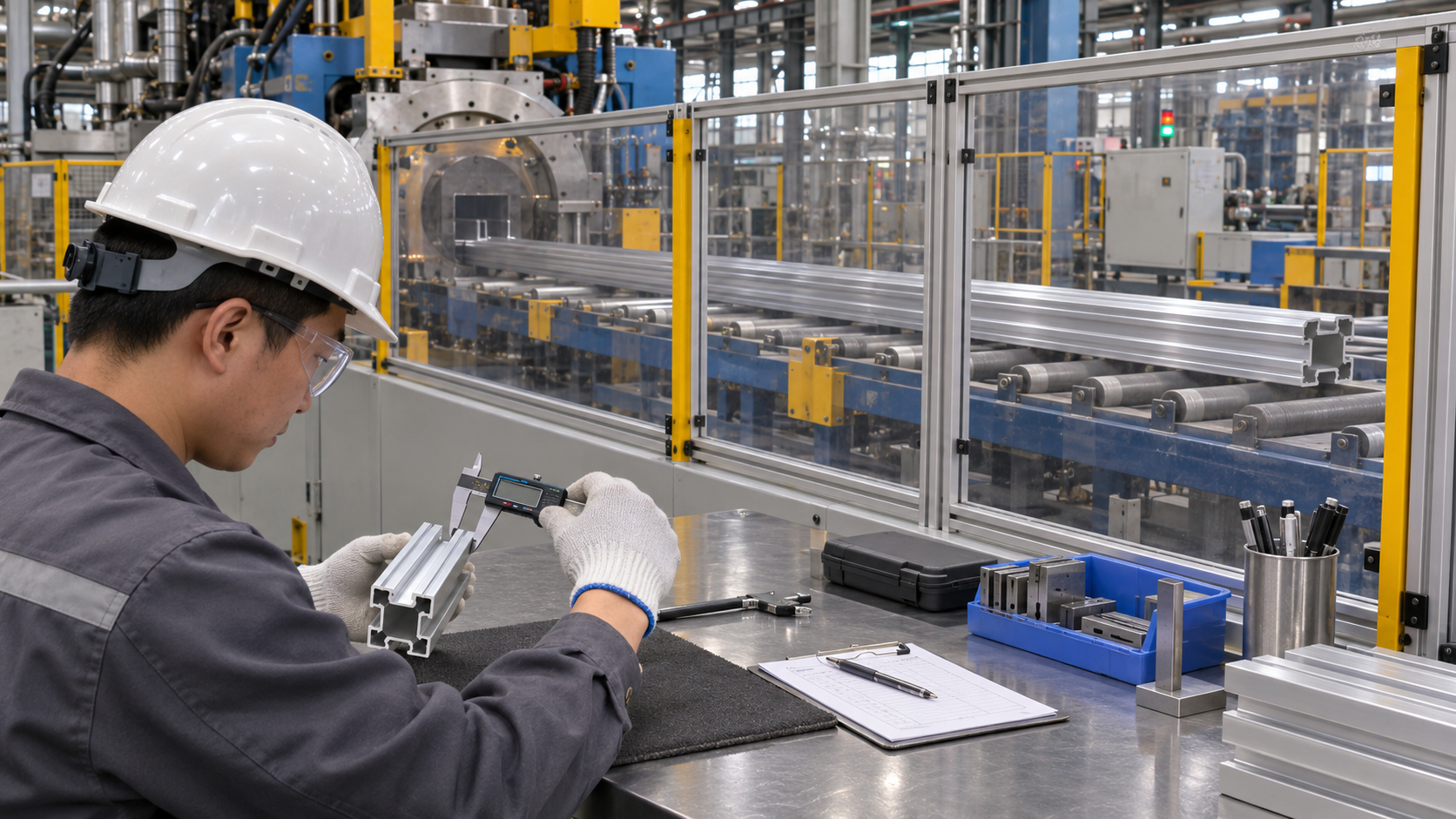
For a conventional architectural-profile line, compare suppliers on repeatable output, serviceability, and the cost of a complete installation. For a broad alloy mix, difficult hollows, or large industrial sections, prioritize a documented press selection and references for comparable work. For an integrated line, make one party accountable for coordinating the agreed equipment interfaces and proving performance.
Send the same RFQ to three finalists: your billet range, representative profile drawings, target kilograms per hour of accepted product, site constraints, destination, and required commissioning date. Ask each supplier for a model-specific selection, equipment scope, written FAT and SAT proposal, and schedule. Advance the bidders that explain their assumptions and put their guarantees in writing.
FAQ
1. How can I verify an aluminum extrusion press manufacturer's ISO 9001 certificate?
Check the legal entity, site address, scope, certificate number, validity dates, and issuing body. Verify status through the issuer or its public verification service. Check that the certificate covers the factory and activities relevant to the order, not merely a trading office. Then review machine-specific documentation separately: a current quality management certificate does not establish that the offered press complies with destination-market machinery requirements.
2. Should I buy a higher-force press for future profiles?
Have suppliers size both options against a defined list of future profiles, not unspecified growth. Compare billet and die compatibility, minimum practical lot sizes, utility needs, foundation costs, and installed cost. Ask each supplier to identify which candidate profiles the smaller press cannot make at the required rate or quality. The additional force has commercial value only if it solves a real production constraint.
3. What if the manufacturer cannot run my production die at the factory?
Agree on a substitute alloy and die only if their limitations are documented. Use the FAT to verify machine functions and any hot-run performance the test can genuinely demonstrate. Keep profile dimensions, finish, and sustained output with your actual production die as SAT criteria, and link the final acceptance milestone to those results.
4. Who takes responsibility for CE conformity when the press and auxiliaries come from different suppliers?
Name the party responsible for assessing the final configuration in the contract. Require each equipment supplier to provide its relevant documents and interface information, and ask how shared guarding, emergency stops, interlocks, and other safety functions will be validated once the equipment is connected. For EU-bound projects, confirm the applicable machinery regime and corresponding responsibilities before purchase. Do not assume separate machine declarations cover the integrated line.
5. How do I compare energy claims between two hydraulic extrusion presses?
Require the same alloy, billet, profile, run duration, and measurement boundary. Ask whether the number includes only the press or also billet heating, quenching, and handling. Specify energy per kilogram of accepted product, then record how the test treats idle time and scrap. A low press-only reading and a higher whole-line reading are not directly comparable.
References
1. Shanghai Metals Market — historical overview of China’s aluminum extrusion industry and major production locations. [news.metal]
2. Orion Market Research — China Aluminum Extrusion Market, 2025–2035 outlook for the downstream extrusion market. [omrglobal]
3. European Commission — official machinery guidance and the transition from Directive 2006/42/EC to Regulation (EU) 2023/1230. [single-market-economy.ec.europa]
4. Manufacturer catalogs and corporate materials — Sailixin, Wuxi Weite, Yejing, Xinxinke, and HLT. [en.weitpress]
5. Supplier listings and industry comparisons — TYHI, Wuxi Yuanchang, Foshan Jingneng, Foshan Dynamax, and Foshan Nanhai Jinli. Use these for initial screening and verify specifications directly with the contracting entity. [directindustry]


