Content Menu
● 1. Match the Aluminum Extrusion Press to Your Profiles
>> Request a Profile-by-Profile Capability Matrix
● 2. Define the Complete Extrusion Line Supply Scope
>> Assign Responsibility at Every Interface
● 3. Make Extrusion Press Acceptance Criteria Measurable
>> Separate Machine Capability From Finished-Profile Quality
● 4. Compare Energy Consumption on the Same Basis
● 5. Include Dies and Tooling Development Milestones
● 6. Put Spare Parts and Service Commitments in Writing
● 7. Clarify Delivery, Payment, and International Trade Terms
● 8. Evaluate the Quotation Using Two Practical Checks
>> Normalize the Installed Cost
>> Apply a Technical Gate Before Comparing Price
● Request a Profile-Based Quotation From Yejing
● Frequently Asked Questions
>> 1. Can I choose an extrusion press by tonnage alone?
>> 2. Should dies be included in the quotation?
>> 3. How should production capacity be guaranteed?
>> 4. What is the difference between FAT and SAT?
>> 5. Which hidden costs should buyers check first?
● References
An aluminum extrusion press quotation should include more than machine specifications and a purchase price. It should define the profiles the equipment must produce, the complete supply scope, measurable acceptance criteria, operating-cost assumptions, delivery milestones, and after-sales responsibilities. Without these details, apparently competitive offers can represent very different investments.
Our recommendation is simple: evaluate the quotation as a production agreement, not an equipment brochure. The question is not just "What does this press cost?" It is "What must be supplied, demonstrated, and supported before this investment can deliver acceptable profiles?"
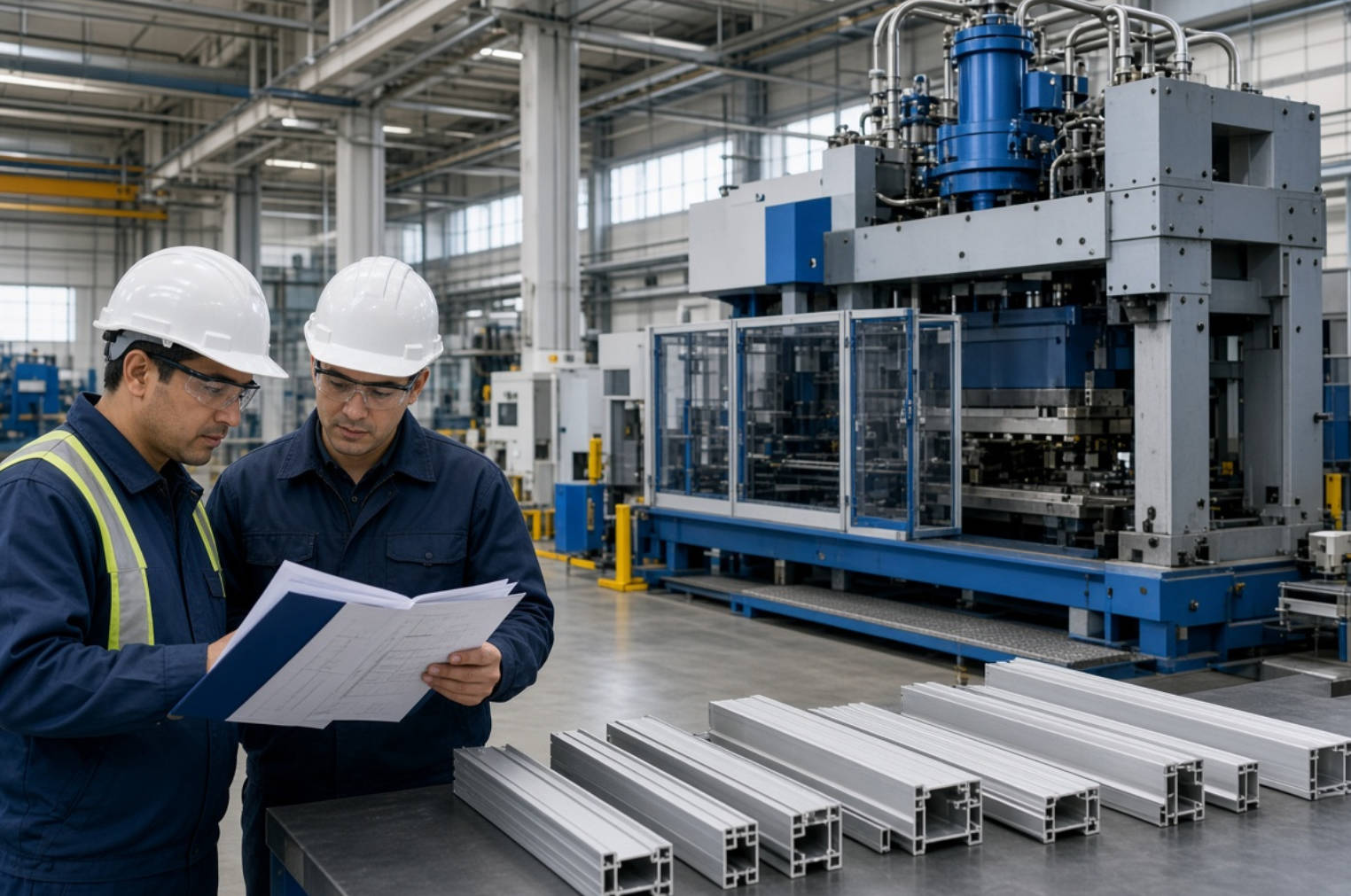
1. Match the Aluminum Extrusion Press to Your Profiles
Press tonnage is an important starting point, but it does not independently establish production suitability.
An aluminum extrusion press quotation should connect equipment selection to your actual product requirements:
- Alloy grades and required tempers.
- Profile drawings, including hollow and solid sections.
- Circumscribing circle diameter and minimum wall thickness.
- Profile weight per meter and finished lengths.
- Billet diameter, length, and material condition.
- Required output and expected product mix.
- Critical dimensional, surface, and mechanical requirements.
Request a Profile-by-Profile Capability Matrix
Ask the supplier to review representative profiles, including your most demanding sections. For each, request the proposed billet size, tooling assumptions, estimated production rate, and technical limitations.
Distinguish preliminary estimates from contractual guarantees. Any guarantee should identify the approved drawing revision, alloy, die configuration, and operating conditions.
Our purchasing principle: a quotation should explain why the proposed press fits the application—not simply list its nominal force.
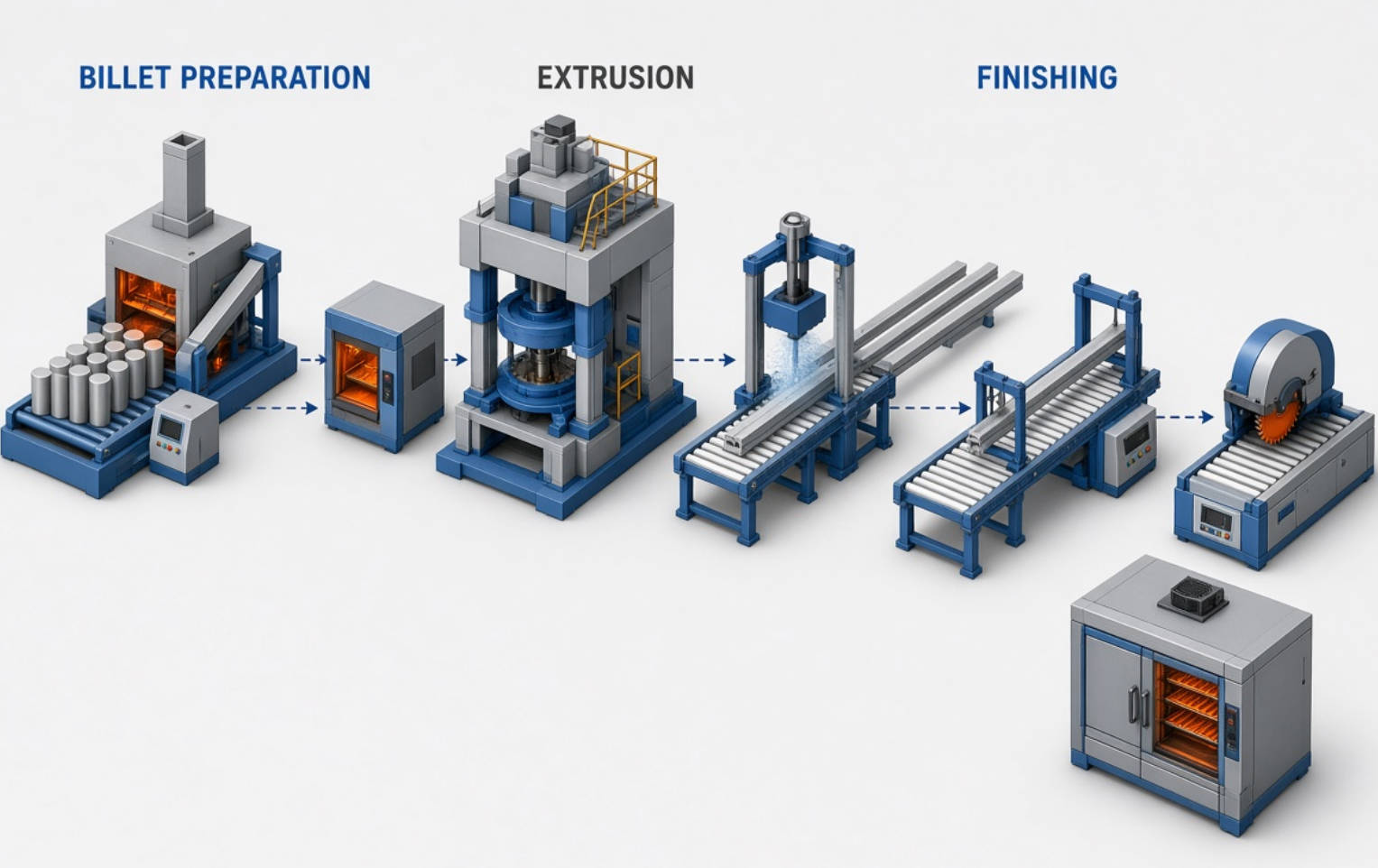
2. Define the Complete Extrusion Line Supply Scope
"Complete extrusion line" is not a sufficiently precise contractual description.
Request an itemized equipment list with quantities, specifications, interfaces, and clear included-or-excluded status.
| Equipment or service | Details the quotation should specify |
| Extrusion press | Rated force, billet range, control system, hydraulic configuration |
| Billet preparation | Heating system, hot shear or saw, loading arrangement |
| Die preparation | Die oven capacity, temperature control, handling equipment |
| Downstream equipment | Quenching, puller, runout table, cooling, stretching, sawing |
| Heat treatment | Whether aging equipment and process support are included |
| Utilities | Connected loads, operating demand, cooling-water and air requirements |
| Installation | Foundations, unloading, positioning, wiring, piping, commissioning |
| Documentation | Drawings, manuals, electrical diagrams, software backups |
Assign Responsibility at Every Interface
Require a responsibility matrix identifying who supplies, installs, connects, and tests each interface.
For example, supplying a cooling-water connection does not necessarily mean supplying the cooling tower, pumps, treatment equipment, or external piping.
This exercise helps expose costs that a headline machine price can conceal.
3. Make Extrusion Press Acceptance Criteria Measurable
Terms such as "high precision," "high efficiency," and "excellent yield" should become defined tests before the purchase contract is signed.
Specify both the factory acceptance test, or FAT, and site acceptance test, or SAT.
| Acceptance item | What to agree in writing |
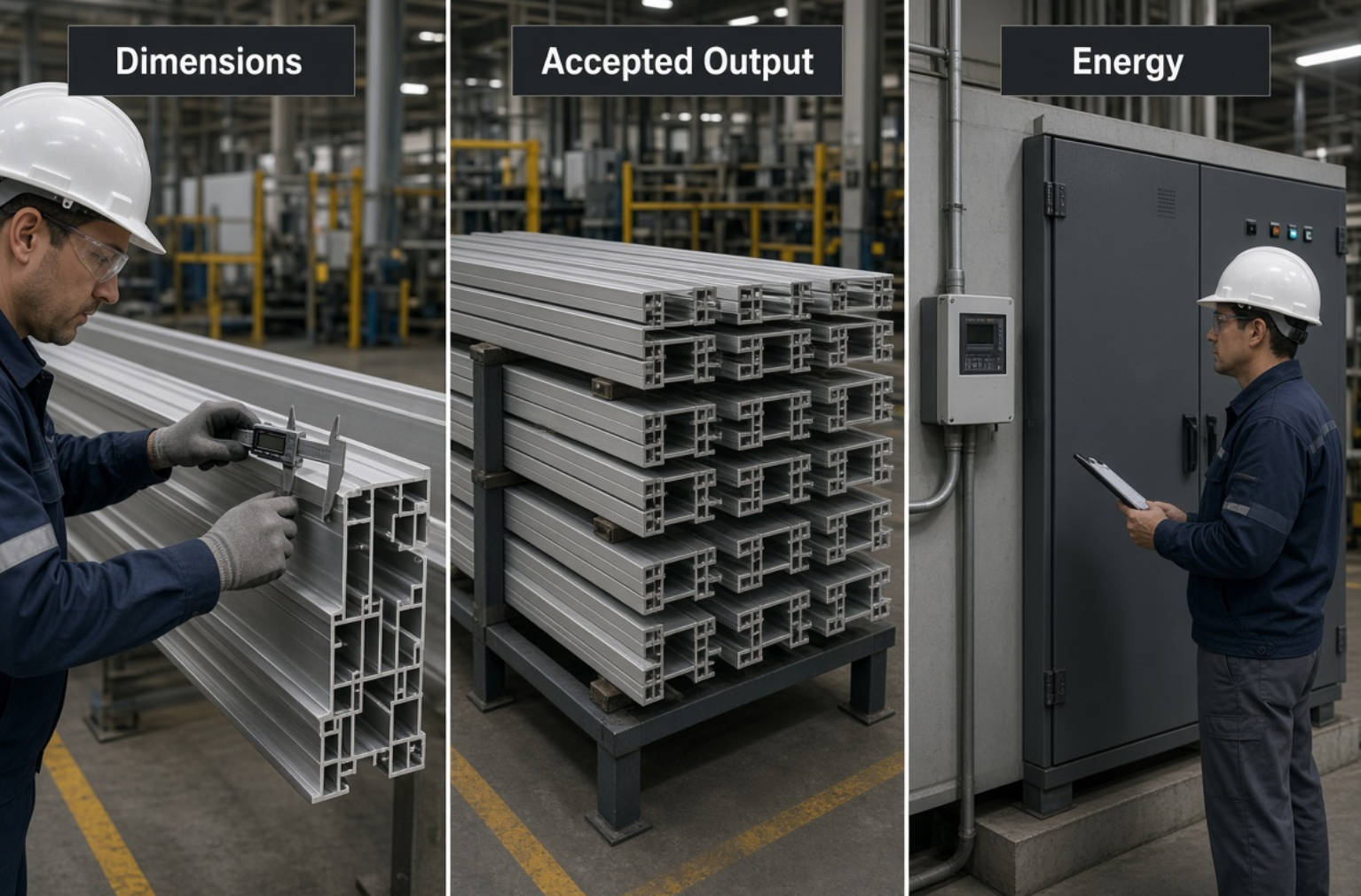
| Profile dimensions | Approved drawings, applicable standard, measurement method |
| Surface condition | Inspection conditions and agreed defect acceptance limits |
| Productivity | Accepted kilograms per hour on specified reference profiles |
| Material yield | Accepted output divided by a defined material-input quantity |
| Energy consumption | Metered equipment boundary and accepted-output basis |
| Repeatability | Number of billets, runs, or production hours |
| Nonconformities | Correction deadline, retesting procedure, associated costs |
Separate Machine Capability From Finished-Profile Quality
Finished-profile quality also depends on billet condition, tooling, temperatures, quenching, stretching, and heat treatment.
The agreement should therefore define these inputs and allocate responsibility for them.
For dimensional tolerances, identify the applicable standard and edition. EN 755-9 addresses general extruded-profile dimensional and form tolerances; EN 12020-2 addresses precision profiles within its specific scope, including the relevant alloy restrictions. Neither should be treated as a universal tolerance promise.
4. Compare Energy Consumption on the Same Basis
A motor's rated power is not a production energy guarantee.
Request specific energy consumption expressed against accepted output, with the measurement boundary clearly stated:
Specific electricity consumption=Metered electricity consumption in kWh/Accepted profile output in tonnes
Clarify whether the figure covers only the press or also billet heating, die ovens, cooling, handling, and aging.
Where gas heating is used, report fuel consumption separately with its unit and conversion assumptions.
The quotation should also define:
- Whether warm-up and idle periods are included.
- The reference alloy, profile, and billet size.
- The test duration and production conditions.
- How rejected material affects the output denominator.
These details make competing energy claims more meaningful.
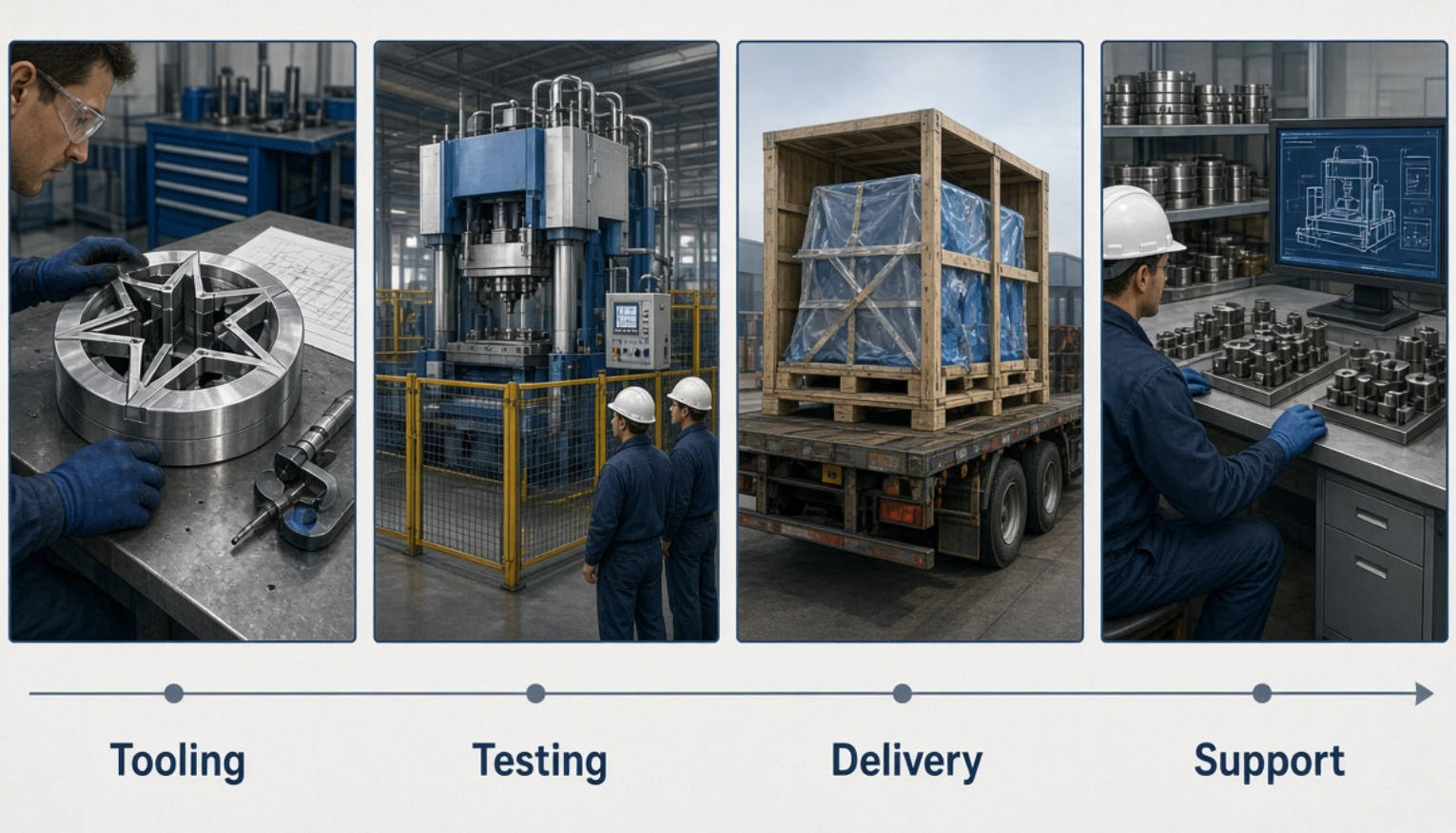
5. Include Dies and Tooling Development Milestones
An equipment shipment date is not the same as a production-readiness date.
If dies are included, request:
1. Drawing approval deadlines.
2. Die design and manufacturing responsibilities.
3. First-trial dates and trial-material requirements.
4. Included correction rounds and their limits.
5. Profile approval criteria and target dates.
6. Die ownership, storage, and replacement terms.
Where a separate die supplier is involved, identify who coordinates trials and resolves process-versus-tooling disagreements.
A useful safeguard is to track equipment readiness and tooling readiness separately, then link both to the commissioning plan.
6. Put Spare Parts and Service Commitments in Writing
"Lifetime technical support" does not define how quickly production will recover after a stoppage.
Request a recommended commissioning kit and a separately priced critical-spares package. Ask the supplier to distinguish standard purchased components from proprietary parts.
The quotation should specify:
- Warranty duration, starting event, coverage, and exclusions.
- Remote-support hours, languages, and escalation contacts.
- Initial response targets and diagnostic procedures.
- On-site attendance conditions, travel costs, and availability.
- Stock locations and estimated replacement-part lead times.
- Operator and maintenance training scope.
- Access arrangements for backups, parameters, and remote diagnostics.
A response commitment is not a repair-time guarantee. Keep those obligations separate.
7. Clarify Delivery, Payment, and International Trade Terms
The commercial section should identify currency, quotation validity, payment milestones, taxes, packaging, and shipping assumptions.
For international orders, state the selected Incoterms® rule, named place or port, and edition.
These rules allocate delivery-related responsibilities, costs, and risk. They do not replace separate provisions for payment, ownership transfer, performance acceptance, or contractual remedies.
Ask when the delivery clock begins: deposit receipt, technical approval, or another defined event. Also document buyer dependencies, change-order procedures, and consequences of delay.
8. Evaluate the Quotation Using Two Practical Checks
Normalize the Installed Cost
Compare equipment price plus required options, freight, import costs, installation, utilities, tooling, commissioning, and initial spares.
Then assess recurring energy, maintenance, consumables, and downtime exposure separately. Keep uncertain assumptions visible rather than presenting them as guaranteed savings.
Apply a Technical Gate Before Comparing Price
First confirm application suitability, supply completeness, acceptance criteria, and support arrangements.
Only then compare commercial offers. An unresolved technical deviation should remain visible in the evaluation—not disappear inside a weighted price score.
Request a Profile-Based Quotation From Yejing
Foshan Yejing Machinery Manufacturing Co., Ltd. brings 36 years of experience in extrusion-equipment development, design, and manufacturing. Its company-provided background includes more than 3,000 presses produced, a 66,000 m² manufacturing base, and processing, assembly, and commissioning capabilities for 600–9,000-ton-class presses.
To request a profile-based quotation, send Yejing your drawings, alloys, target output, quality requirements, factory layout, utilities, and destination country. Request a proposal identifying the equipment scope, exclusions, acceptance plan, tooling schedule, and service commitments.
Frequently Asked Questions
1. Can I choose an extrusion press by tonnage alone?
No. Review the profile geometry, alloy, billet size, tooling, downstream equipment, and required output together.
2. Should dies be included in the quotation?
Their status should always be explicit. Identify quantities, trial responsibilities, correction allowances, ownership, and any separate charges.
3. How should production capacity be guaranteed?
Use accepted output over an agreed test period, tied to specified profiles, materials, tooling, and operating conditions.
4. What is the difference between FAT and SAT?
FAT evaluates agreed requirements at the supplier's facility. SAT verifies agreed performance after installation at the buyer's site.
5. Which hidden costs should buyers check first?
Check foundations, utility infrastructure, unloading, installation labor, tooling trials, technician travel, import charges, and initial spare parts.
References
1. - Company information supplied for this article: Foshan Yejing Machinery Manufacturing Co., Ltd. background brief. Source of the company experience, production-volume, facility-size, and manufacturing-capability figures; not independently audited for this article.
2. - [BSI, BS EN 12020-1:2022 — Technical conditions for inspection and delivery, preview hosted by ANSI]. Establishes the stated alloy scope for precision extruded profiles. [webstore.ansi]
3. - [Extrusion Tolerances Explained: EN 755-9 and EN 12020-2, Solid Group Metal]. Technical background on tolerance categories, drawing requirements, and the distinction between the two standards; consult the applicable licensed standard for contractual limits. [solidgroupmetal]
4. - [International Chamber of Commerce, Incoterms® 2020]. Official background on allocating delivery obligations, costs, and risk. [iccwbo]
5. - [ICC Academy, What Incoterms® Don't Cover: Why the Contract of Sale Matters]. Explains why payment, ownership, and broader contractual remedies require separate agreement. [academy.iccwbo]


