Content Menu
● New vs. Used Aluminum Extrusion Press: Key Differences
● Purchase Price vs. Total Cost of Ownership
>> Compare Installed Costs, Not Advertised Prices
>> Measure Cost per Saleable Tonne
● Production Capacity, Precision, and Profile Quality
>> Rated Tonnage Is Only the Starting Point
>> Verify Repeatability Under Production Conditions
● Energy Efficiency: Compare Measured Performance
● Maintenance, Spare Parts, and Service Support
>> Used Equipment Requires Traceable History
>> New Equipment Still Needs Contractual Clarity
● Automation and Complete Extrusion Line Compatibility
● Safety, Documentation, and International Installation
● A Five-Year Cost Comparison: An Illustrative Scenario
● A Practical Used Extrusion Press Inspection Plan
● Which Extrusion Press Is Better for Your Plant?
>> When a New Aluminum Extrusion Press Makes More Sense
>> When a Used Aluminum Extrusion Press Makes More Sense
● Plan Your Extrusion Investment With Yejing
● Frequently Asked Questions
>> 1. Is a Used Aluminum Extrusion Press Suitable for a New Factory?
>> 2. How Much Cheaper Is a Used Extrusion Press?
>> 3. Can an Older Extrusion Press Be Automated?
>> 4. Does a New Press Always Produce Better Profiles?
>> 5. Should I Buy the Press and Auxiliary Equipment Together?
>> 6. What Is the Biggest Warning Sign When Buying Used?
● References
A new aluminum extrusion press is usually the stronger choice for plants prioritizing predictable output, customized automation, and long-term technical support. A used aluminum extrusion press can be a sensible investment when capital is limited, production requirements are stable, and the machine's condition is independently verified.
The right decision is not simply "new versus old." It is about purchasing reliable production capacity at an acceptable lifetime cost.
At Foshan Yejing Machinery Manufacturing Co., Ltd., our manufacturing perspective starts with one question: what must the complete extrusion line consistently deliver? Comparing machines through that lens reveals more than purchase prices alone.
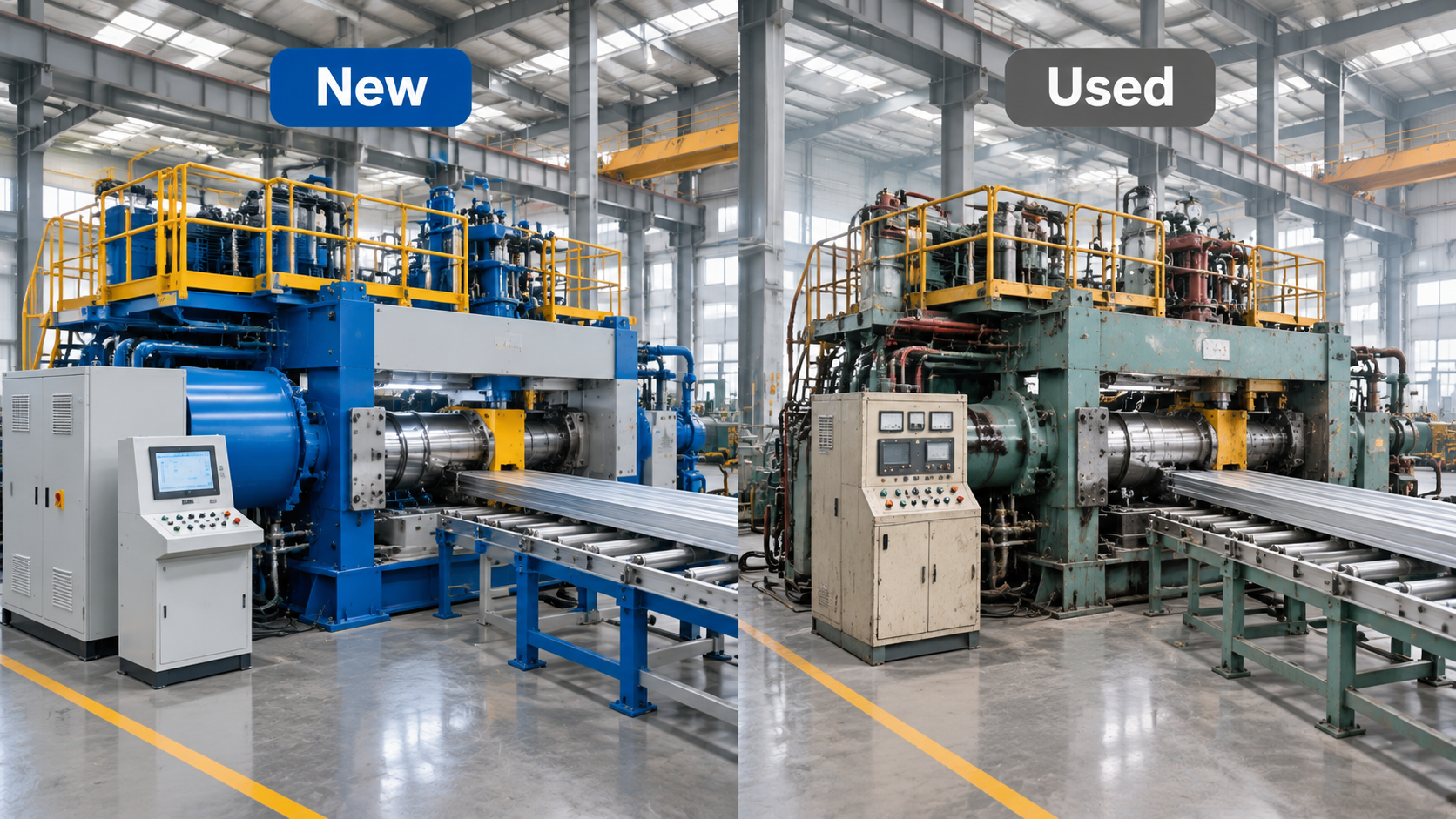
New vs. Used Aluminum Extrusion Press: Key Differences
For an initial comparison, evaluate both options against the same production specification.
| Decision factor |
New extrusion press |
Used extrusion press |
| Initial investment |
Generally higher |
Often lower before refurbishment |
| Configuration |
Specified around current requirements |
Limited by existing design |
| Mechanical condition |
Newly manufactured; acceptance testing still essential |
Depends on loading history and maintenance |
| Controls |
Can specify supported hardware and connectivity |
May require obsolete-component replacement |
| Energy performance |
Can incorporate demand-matched hydraulics |
Depends on original system and upgrades |
| Installation schedule |
Includes manufacturing lead time |
Includes inspection, dismantling, and possible rebuilding |
| Technical support |
Defined through the supply contract |
Depends on seller and original manufacturer |
| Expansion potential |
Can accommodate planned integration |
Must verify interfaces and practical limitations |
Neither column guarantees a better outcome. A poorly specified new machine can disappoint, while a well-maintained used machine can perform effectively within a suitable application.
Purchase Price vs. Total Cost of Ownership
Compare Installed Costs, Not Advertised Prices
A used aluminum extrusion press price may exclude substantial work needed before production begins.
Request an itemized budget covering:
- Purchase price and applicable duties.
- Dismantling, lifting, transport, and insurance.
- Foundations, utilities, and installation.
- Hydraulic, electrical, and mechanical repairs.
- Controls integration and safety upgrades.
- Tooling adaptation, commissioning, and training.
For a new press, clarify exactly which auxiliary systems are included. A press-only quotation is not directly comparable with a complete aluminum extrusion production line.
Measure Cost per Saleable Tonne
The most useful financial metric is often cost per saleable tonne, rather than equipment cost alone.
Calculate lifetime ownership cost by adding acquisition, installation, financing, energy, maintenance, labor, and expected downtime costs, then subtracting estimated resale value. Divide that result by expected saleable production over the same period.
Use consistent assumptions for both machines. In particular, distinguish gross extruded weight from profiles that actually meet customer specifications.
A lower purchase price does not compensate automatically for recurring scrap, slower changeovers, or missed deliveries.
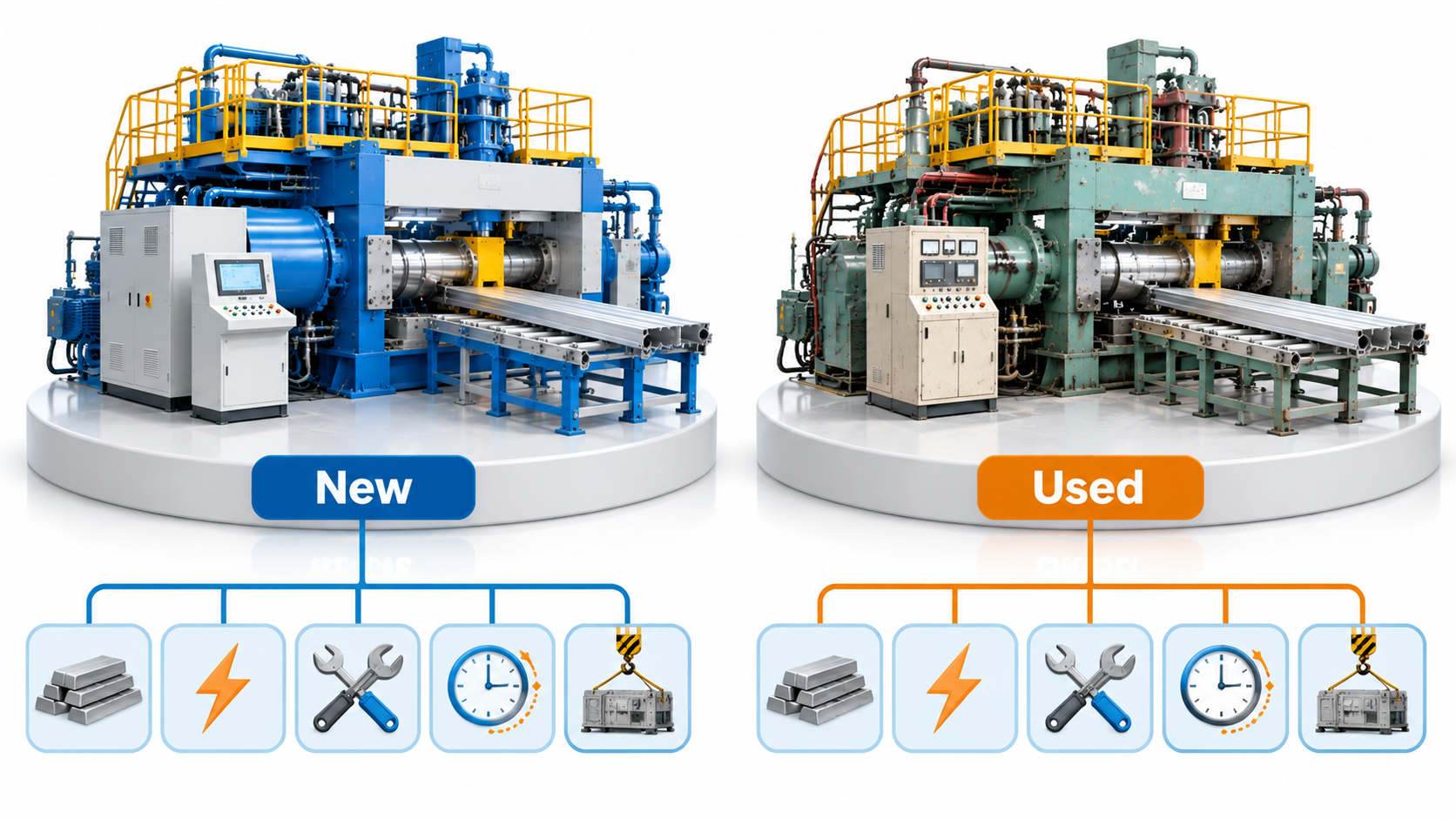
Production Capacity, Precision, and Profile Quality
Rated Tonnage Is Only the Starting Point
Two presses with identical nominal force may not suit the same product mix.
Check billet diameter and length, container dimensions, usable stroke, extrusion speed range, and tooling compatibility. Evaluate these against your alloy grades, profile geometry, wall thickness, and tolerance requirements.
Do not assume that selecting a larger press solves every production problem. Die design, billet temperature, lubrication practices, and downstream handling also influence results.
For either purchase, require an application review based on representative profile drawings—not just a tonnage recommendation.
Verify Repeatability Under Production Conditions
A used extrusion press should be assessed for alignment, structural condition, hydraulic stability, and control response.
Potential concerns include worn guides, cylinder leakage, damaged sealing surfaces, and undocumented structural repairs. These require qualified inspection rather than conclusions drawn from age or appearance.
For new equipment, translate quality expectations into measurable acceptance criteria. Specify the trial profiles, operating conditions, dimensional checks, and production duration.
A freshly painted used machine is not necessarily refurbished. Likewise, a new machine is not proven until it passes an agreed production test.
Energy Efficiency: Compare Measured Performance
Modern variable-speed hydraulic systems can match pump output more closely to machine demand, reducing unnecessary operation and associated heat generation. However, actual savings depend on the hydraulic architecture and operating cycle.
Avoid applying a generic energy-saving percentage to every new aluminum extrusion press.
Instead, request comparable measurements:
1. Electrical consumption across a defined production run.
2. Saleable output during that run.
3. Billet alloy, dimensions, and starting temperature.
4. Extrusion speed and non-extruding cycle time.
5. Whether heaters, cooling systems, and auxiliaries are included.
Compare press-only consumption separately from whole-line consumption. A used press with upgraded hydraulics may perform competitively, while a new press operated inefficiently may miss expectations.
The meaningful question is not whether a machine includes an efficiency feature. It is how much energy your actual production requires.
Maintenance, Spare Parts, and Service Support
Used Equipment Requires Traceable History
Before buying a second-hand aluminum extrusion press, request maintenance logs, operating records where available, major repair details, and original technical documentation.
Ask specifically about:
- Frame or tie-rod repairs.
- Main cylinder rebuilding.
- Pump and valve replacements.
- Hydraulic oil contamination incidents.
- Electrical modifications.
- Availability of control-system backups.
Missing records do not prove that a machine is defective. They increase uncertainty and should influence inspection scope, contingency allowances, and price.
New Equipment Still Needs Contractual Clarity
New machinery does not eliminate maintenance or service risk.
Confirm warranty exclusions, response arrangements, spare-parts availability, remote-support conditions, and responsibility for travel expenses. Request a recommended critical-spares list before commissioning.
For overseas buyers, documentation quality and troubleshooting support can matter as much as warranty duration. Establish who will support the equipment after installation, not merely who will sell it.
Automation and Complete Extrusion Line Compatibility
A press operates within a connected production system that may include billet heating, handling, quenching, pulling, stretching, cutting, and aging.
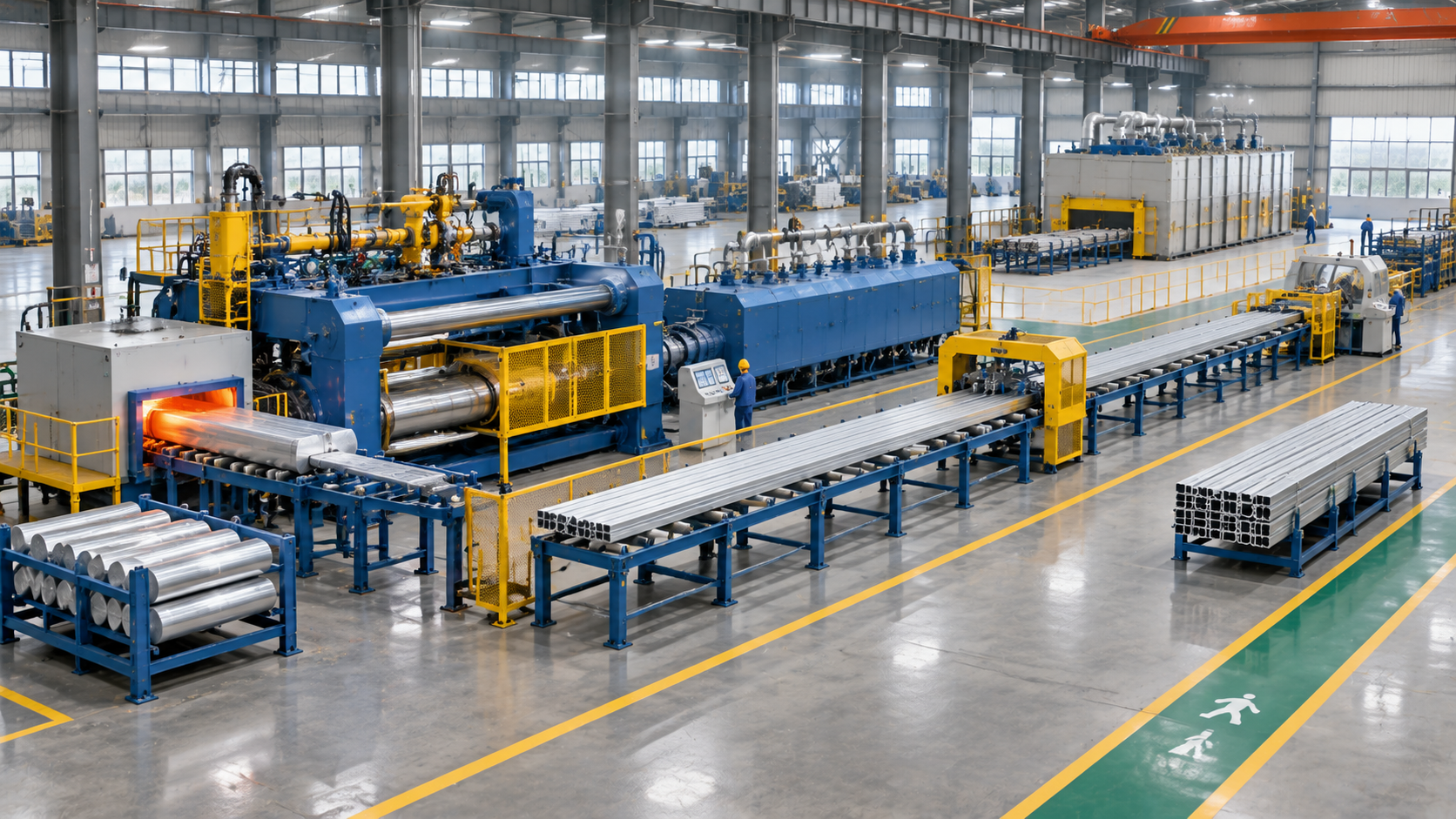
A new extrusion press offers the opportunity to specify these interfaces together. A used machine requires careful verification of existing signals, cycle sequences, software access, and mechanical compatibility.
Our preferred evaluation starts with the line's limiting operation. If cooling or profile handling constrains output, buying a faster press alone may deliver little improvement.
Before approving either option, map the complete production sequence and identify where material waits. Then estimate capacity using the entire line, not an isolated machine specification.
Safety, Documentation, and International Installation
Neither age nor a certification plate establishes that a machine is safe for its intended installation.
Review guarding, emergency stops, interlocks, hydraulic energy isolation, maintenance access, and interactions with adjacent machinery.
Requirements vary by destination. For example, UK guidance places safety responsibilities on suppliers of second-hand work equipment and identifies circumstances where substantial modification can trigger additional conformity obligations.
For international procurement:
- Obtain a destination-specific compliance review.
- Request machine-specific declarations and technical documentation.
- Verify the scope of any certification claim.
- Assess the safety implications of rebuilding or line integration.
- Confirm manuals and training are suitable for local users.
Do not treat an ISO 9001 certificate as proof that a particular installed production line meets every applicable machinery-safety requirement.
A Five-Year Cost Comparison: An Illustrative Scenario
Consider two hypothetical options with identical planned production requirements. These figures demonstrate a method; they are not quotations, market averages, or customer results.
| Cost component |
New press |
Used press |
| Installed and commissioned investment |
$1,200,000 |
$750,000 |
| Annual energy, maintenance, and downtime allowance |
$180,000 |
$290,000 |
| Five-year operating allowance |
$900,000 |
$1,450,000 |
| Five-year total before financing and resale |
$2,100,000 |
$2,200,000 |
The new press requires $450,000 more initially but has an assumed annual operating advantage of $110,000. Simple payback on that premium is approximately 4.1 years.
The conclusion changes if utilization falls or the used machine performs better than assumed. Recalculate using conservative, expected, and high-demand scenarios.
Avoid double-counting downtime: use a consistent method for lost contribution, recovery overtime, or outsourced production rather than automatically adding all three.
A Practical Used Extrusion Press Inspection Plan
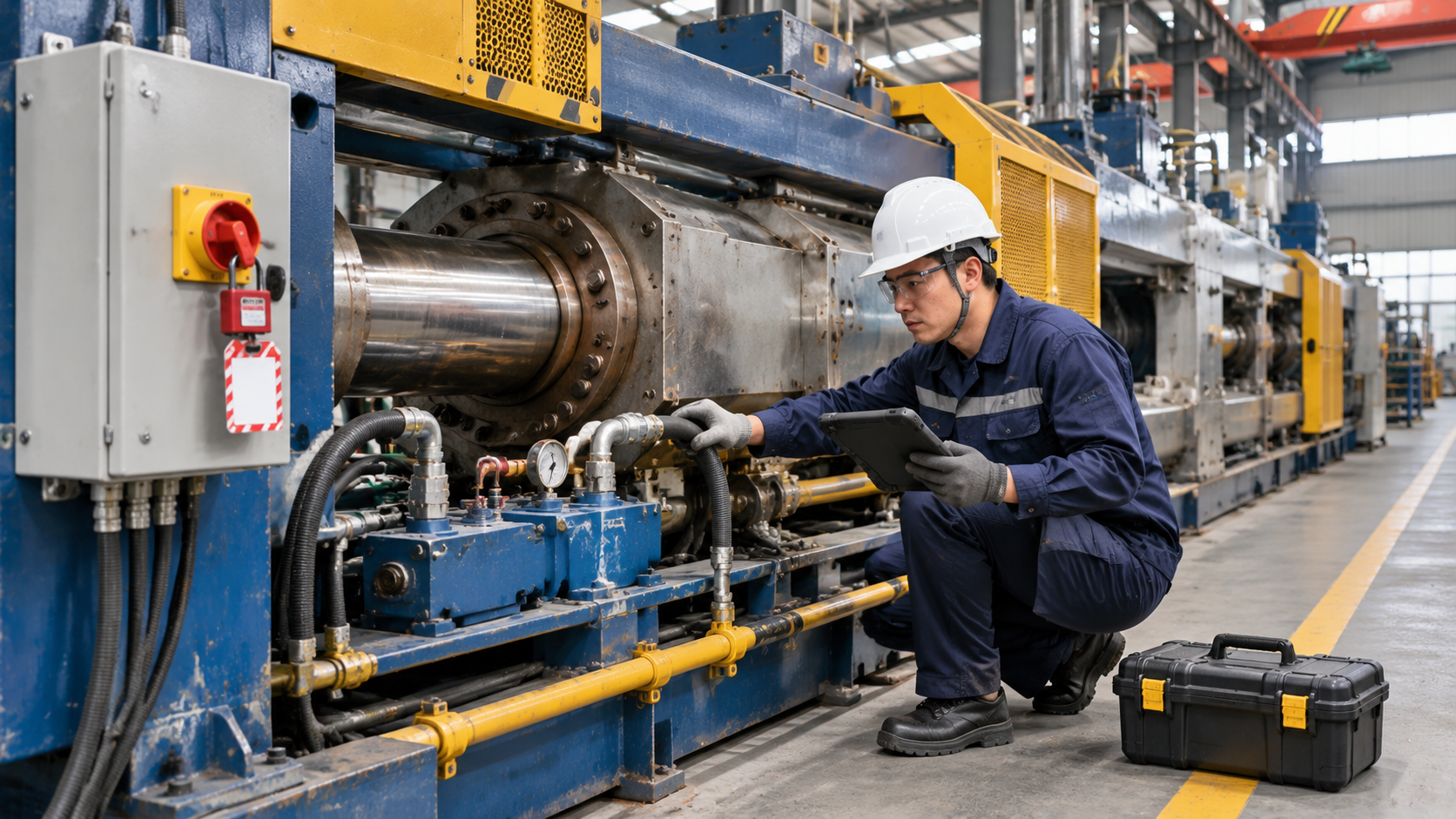
For a serious used-machine purchase, use a staged decision process.
1. Review documentation. Verify the serial number, drawings, ownership information, maintenance records, and supplied equipment list.
2. Inspect the structure. Have qualified specialists assess alignment, visible damage, repair history, and whether targeted nondestructive testing is warranted.
3. Assess hydraulics. Check leakage, oil condition, operating pressure, temperature behavior, and component availability.
4. Audit controls. Confirm access credentials, software backups, electrical drawings, and replacement options for discontinued hardware.
5. Witness production. Run representative material and record output, cycle behavior, energy consumption, and quality.
6. Define commercial protections. Agree on included repairs, acceptance criteria, dismantling responsibilities, and payment milestones.
If the press cannot run, classify performance as unverified. Price the uncertainty explicitly instead of treating a short demonstration or seller assurance as equivalent evidence.
Which Extrusion Press Is Better for Your Plant?
When a New Aluminum Extrusion Press Makes More Sense
A new press is often the stronger candidate when you need:
- Application-specific configuration.
- High utilization and predictable scheduling.
- Integrated automation and production data.
- Defined commissioning responsibility.
- A platform aligned with future expansion.
Its value depends on selecting the right specification and supplier—not simply purchasing the newest equipment.
When a Used Aluminum Extrusion Press Makes More Sense
A used press can be appropriate when your product requirements match an available machine, qualified maintenance resources are accessible, and inspection confirms acceptable condition.
It may also support a limited-duration project or secondary production role.
However, availability does not guarantee faster startup. Compare the date of first accepted production after transport, rebuilding, installation, and commissioning—not just the shipping date.
Plan Your Extrusion Investment With Yejing
According to company-provided information, Foshan Yejing Machinery Manufacturing Co., Ltd. brings 36 years of experience, more than 3,000 presses produced, and a 66,000-square-meter manufacturing base.
Our capabilities cover the machining, assembly, and commissioning of 600–9,000-tonne presses, supported by more than 100 processing and assembly machines. We provide extrusion presses, auxiliary equipment, and integrated production-line solutions for domestic and international customers.
Send Yejing your profile drawings, alloy grades, target annual output, shift pattern, available floor space, and destination country. Request a configuration proposal with defined supply boundaries, utility requirements, acceptance tests, and service arrangements.
Compare that proposal against any used-machine alternative on the same technical and financial basis.
Frequently Asked Questions
1. Is a Used Aluminum Extrusion Press Suitable for a New Factory?
Yes, provided its capabilities match the product plan and its condition is verified. Budget for installation, repairs, safety work, and technical support before committing.
2. How Much Cheaper Is a Used Extrusion Press?
There is no universal discount. Age, condition, capacity, included auxiliaries, refurbishment scope, and location affect cost. Compare installed, production-ready quotations rather than advertised prices.
3. Can an Older Extrusion Press Be Automated?
Potentially. Feasibility depends on structural condition, hydraulics, electrical systems, software access, and line interfaces. A controls upgrade alone does not renew worn mechanical components.
4. Does a New Press Always Produce Better Profiles?
No. Profile quality also depends on dies, alloy condition, temperatures, cooling, and operator practices. Verify performance through representative production trials and agreed acceptance criteria.
5. Should I Buy the Press and Auxiliary Equipment Together?
An integrated package can simplify coordination and responsibility. Separate procurement may work, but clearly assign responsibility for interfaces, line performance, safety assessment, and commissioning.
6. What Is the Biggest Warning Sign When Buying Used?
Unverifiable condition combined with missing documentation deserves particular caution. Refusal to permit independent inspection or clarify major repairs should trigger further investigation before payment.
References
1. Foshan Yejing Machinery Manufacturing Co., Ltd. Company background supplied for this article: experience, cumulative production, manufacturing area, equipment resources, capacity range, and international operations. These figures are company-provided, not independently audited here.
2. Foshan Yejing Machinery Manufacturing Co., Ltd. "Products." Manufacturer information on extrusion presses, supporting systems, and integrated application solutions. [Product portfolio]. [yjing-extrusion]
3. U.S. Department of Energy, Europump, and Hydraulic Institute. *Variable Speed Pumping: A Guide to Successful Applications.* General principles of demand-matched pumping and lifecycle evaluation; not an extrusion-specific savings guarantee. [Technical guide]. [www1.eere.energy]
4. Power & Motion. "Variable Speed Hydraulic Pumps Enable Efficient Machine Operation," October 13, 2025. Industry discussion incorporating Bosch Rexroth technical commentary on hydraulic energy demand, heat, and control. [Technical article]. [powermotiontech]
5. UK Health and Safety Executive. "Second-hand (re-supplied) products." Guidance on supplier responsibilities and equipment entering the UK market. Jurisdiction-specific guidance, not a universal legal standard. [Official guidance]. [hse.gov]
6. UK Health and Safety Executive. "Refurbished and modified machinery." Guidance on substantial rebuilding and safety implications for integrated assemblies. [Official guidance]. [hse.gov]
7. UK Health and Safety Executive. "Equipment and machinery frequently asked questions." Purchasing considerations, safe-use information, and second-hand equipment responsibilities. [Official guidance]. [hse.gov]


