Content Menu
● Aluminum Extrusion Press Package: Core Equipment vs. Complete Production Line
● What Equipment Is Included in an Aluminum Extrusion Press Package?
>> 1. Extrusion Press and Hydraulic Power System
>> 2. Billet Heating and Cutting Equipment
>> 3. Die Heating and Extrusion Tooling
>> 4. Quenching and Profile Cooling
>> 5. Puller and Run-Out Table
>> 6. Cooling Bed, Stretcher, and Finish Saw
>> 7. Aging Oven and Basket Handling
● What Is Often Excluded from an Extrusion Equipment Package?
● Three Expert Checks Before Approving a Package
>> Check 1: Match the Entire Line to Your Product Mix
>> Check 2: Compare Saleable Output, Not Maximum Speed
>> Check 3: Define Acceptance Before Manufacturing
● Planning Your Aluminum Extrusion Press Package with Yejing
● Frequently Asked Questions
>> 1. Does an aluminum extrusion press package include production dies?
>> 2. Is an aging oven included in a complete extrusion line?
>> 3. Can I purchase only the press?
>> 4. Is a higher-tonnage press always better?
>> 5. What information is needed for an accurate quotation?
>> 6. What should commissioning include?
● References
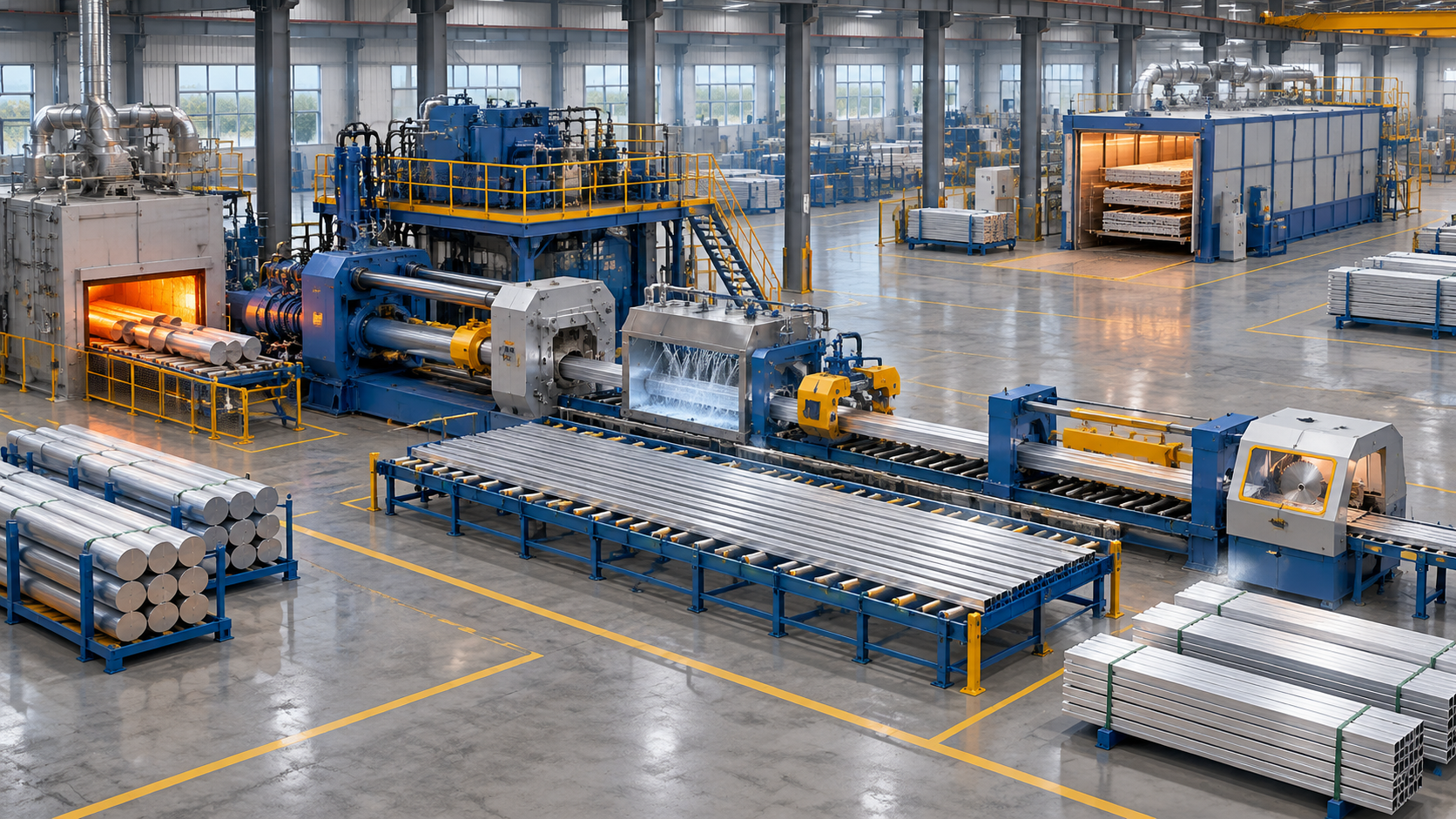
An aluminum extrusion press package may include only the press and its operating systems, or extend to billet heating, tooling, cooling, pulling, stretching, cutting, aging, and integrated controls. The exact equipment depends on the supplier's quotation—not the word "package."
At Foshan Yejing Machinery Manufacturing Co., Ltd., we approach this question from the production line outward: what equipment must work together to turn your selected billets into profiles that meet your specifications?
For buyers, the priority is a clearly defined scope. A lower press price does not necessarily mean a lower investment if essential auxiliary equipment, installation work, or production support remains outside the contract.
Aluminum Extrusion Press Package: Core Equipment vs. Complete Production Line
Before comparing quotations, distinguish three purchasing scopes.
| Package scope | Equipment generally covered | What buyers should clarify |
| Press-only package | Press structure, hydraulic system, electrical controls, and specified operating mechanisms | Heating, downstream handling, tooling, and installation exclusions |
| Press with auxiliary equipment | Press plus selected heating, cooling, pulling, or handling equipment | Which production stages remain outside the supply |
| Complete extrusion production line | Coordinated equipment from billet preparation through specified downstream operations | Aging, utilities, civil works, finishing, and acceptance responsibilities |
These are practical purchasing categories, not universally standardized definitions. Even a "complete line" requires an itemized equipment schedule.
What Equipment Is Included in an Aluminum Extrusion Press Package?
1. Extrusion Press and Hydraulic Power System
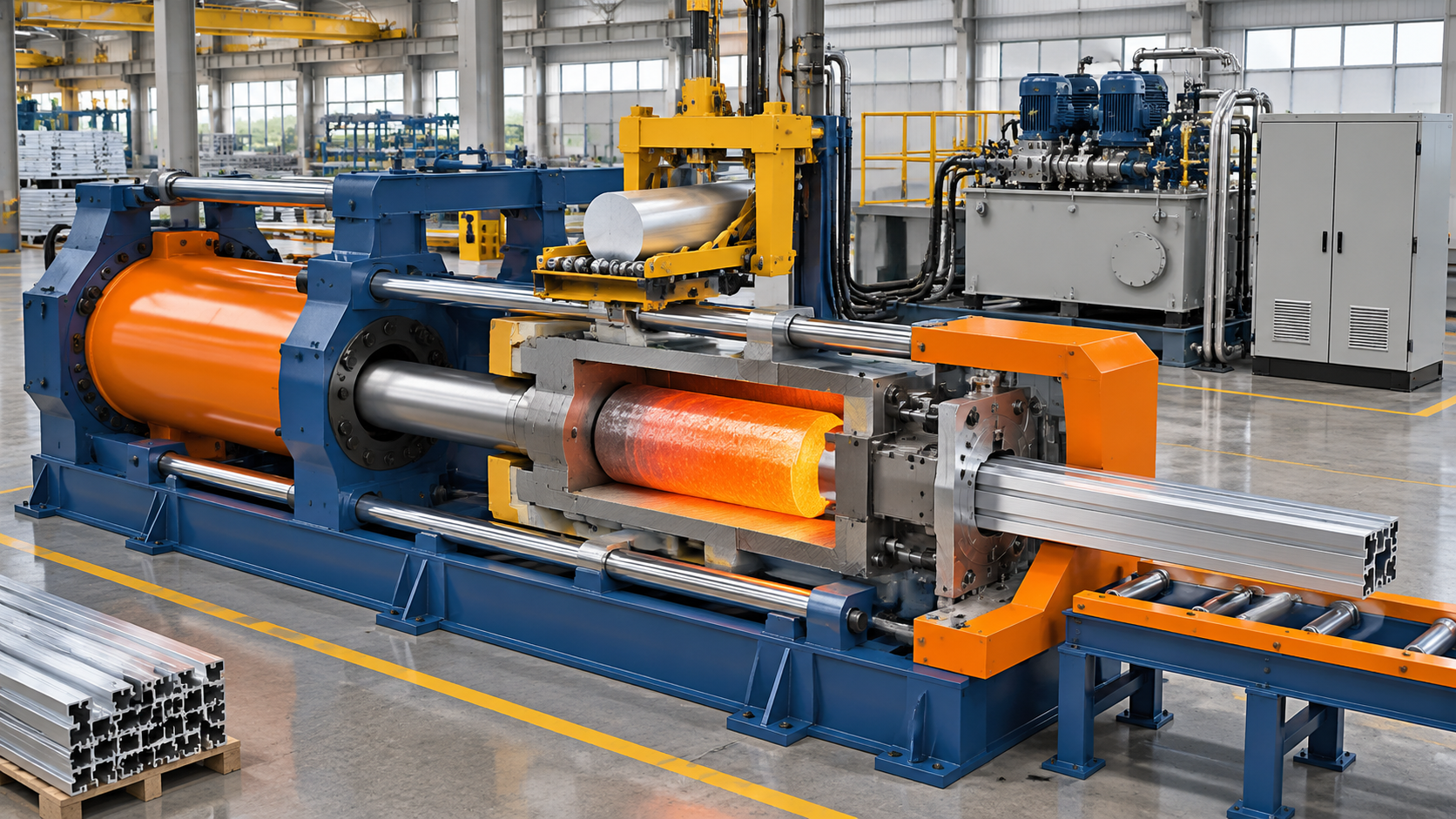
The press forces heated, solid aluminum through a die to create the required cross-section.
Its scope commonly covers:
- Main frame, cylinders, container, and extrusion stem.
- Billet-loading mechanism.
- Die slide or die-changing arrangement.
- Butt shear and discard-handling provisions.
- Hydraulic pumps, valves, reservoir, filtration, and cooling.
- Electrical cabinets and operator controls.
Check the technical schedule rather than assuming every component is standard.
Press selection should address billet dimensions, alloy, profile geometry, extrusion speed, and operating cycle—not tonnage alone.
2. Billet Heating and Cutting Equipment
Billet preparation may require a log-loading table, heating furnace, hot log shear or saw, and transfer equipment.
The arrangement depends on whether production starts with long logs or pre-cut billets. It must also match the press-loading design.
A useful specification defines billet diameter, length range, heating capacity, temperature-control requirements, and cutting method. Loading compatibility deserves particular attention: different press configurations can impose different billet-end requirements.
3. Die Heating and Extrusion Tooling
An extrusion die determines the profile cross-section. A die oven prepares tooling for operation.
However, a supplied die heater does not automatically mean production dies are included.
Ask suppliers to identify:
- Number and type of production dies.
- Die dimensions and oven capacity.
- Die rings, bolsters, and supporting tooling.
- Dummy blocks and maintenance tools.
- Responsibility for die trials and corrections.
For a broad product range, tooling should be a separate, clearly priced workstream.
4. Quenching and Profile Cooling
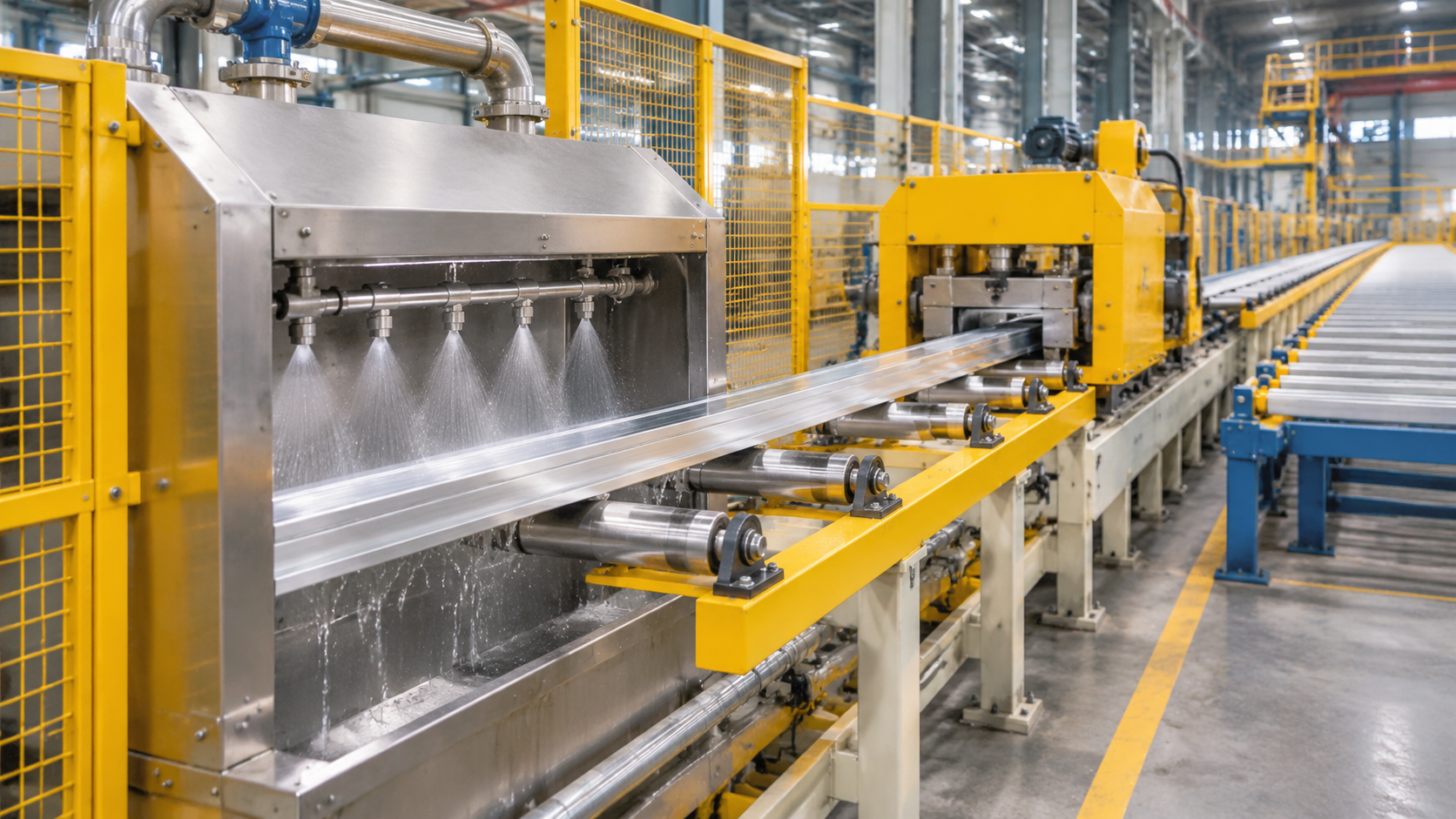
Profiles leave the die hot. Depending on alloy, geometry, and required properties, cooling may use air, mist, water spray, or other specified arrangements.
Quenching is more than a handling step. Its rate and uniformity influence mechanical properties, residual stress, and distortion.
Specify the intended alloy-and-temper combinations, profile dimensions, and quality requirements before selecting cooling equipment. Avoid treating one cooling configuration as suitable for every product.
5. Puller and Run-Out Table
The puller guides the emerging profile along the run-out table. Supporting equipment transports and protects the hot extrusion.
Possible configurations include single or double pullers, transfer mechanisms, and hot-cutting arrangements.
Ask how the system accommodates extrusion speed, profile length, section shape, and production interruptions. Handling surfaces and transfer methods also matter when visible surface quality is important.
6. Cooling Bed, Stretcher, and Finish Saw
Downstream handling commonly includes a cooling bed, stretcher, measuring system, and finish-cutting saw.
Stretching helps correct longitudinal bow and establish straightness. The saw then cuts profiles to the required lengths.
Confirm:
- Maximum profile length and weight.
- Stretcher force and gripping range.
- Saw cutting envelope and length tolerance.
- Scrap removal and collection.
- Surface-protection provisions.
A press capable of extruding a profile does not automatically guarantee that downstream equipment can handle it.
7. Aging Oven and Basket Handling
Artificial aging develops the required properties in relevant heat-treatable alloys.
An aging system may include ovens, baskets, loading equipment, and temperature-recording functions. It may also be quoted separately from the press line.
Check usable load dimensions, batch capacity, temperature uniformity requirements, and handling arrangements. Oven capacity should support the expected production mix rather than simply match a nominal press size.
What Is Often Excluded from an Extrusion Equipment Package?
The most expensive misunderstandings often occur outside the main equipment list.
Common items requiring separate confirmation include:
| Potential exclusion | What to establish before ordering |
| Foundations and civil works | Drawing supply, construction responsibility, and inspection requirements |
| Utilities | Electrical supply, gas, compressed air, and cooling-water boundaries |
| Installation | Supervision only or complete mechanical and electrical installation |
| Consumables | Hydraulic oil, lubricants, saw blades, and initial operating supplies |
| Inspection equipment | Dimensional, hardness, tensile, and temperature-measurement equipment |
| Finishing systems | Anodizing, coating, fabrication, and packaging |
| Delivery services | Freight, insurance, unloading, duties, and inland transport |
Request a scope matrix showing each item as supplier-supplied, buyer-supplied, optional, or excluded.
Three Expert Checks Before Approving a Package
Check 1: Match the Entire Line to Your Product Mix
Consider a hypothetical buyer planning architectural profiles initially and more demanding industrial sections later.
Selecting a larger press alone may not provide that flexibility. Quenching, stretching, handling, tooling, and aging capacity must also support the future products.
Prepare representative drawings and identify alloys, tempers, tolerances, surface requirements, and target volumes. Use these products to evaluate the package.
Check 2: Compare Saleable Output, Not Maximum Speed
Maximum extrusion speed is not the same as finished-product output.
Billet heating, die changes, non-extrusion time, cooling, cutting, aging, and rejection rates all affect usable production.
Ask suppliers to explain the assumptions behind output estimates. Compare quotations using the same representative products, working hours, and acceptance conditions.
Check 3: Define Acceptance Before Manufacturing
Agree on factory and site acceptance procedures before placing the order.
The plan should identify trial materials, dies, operating conditions, measurement methods, and responsibilities. Where applicable, assess:
1. Stable operation and equipment coordination.
2. Profile dimensions and surface condition.
3. Agreed production-cycle performance.
4. Safety functions and interlocks.
5. Training, documentation, and spare-parts delivery.
Product properties should be evaluated after the specified processing route, not inferred from a successful press demonstration alone.
Planning Your Aluminum Extrusion Press Package with Yejing
With 36 years of experience and more than 3,000 presses produced, Foshan Yejing Machinery Manufacturing Co., Ltd. provides extrusion presses, auxiliary equipment, and intelligent production-line solutions.
Our manufacturing background includes a 66,000-square-meter production base and more than 100 machining and assembly machines. Our integrated-control offering also supports coordinated line operation, production-data recording, and enterprise-system connectivity, subject to the agreed configuration.
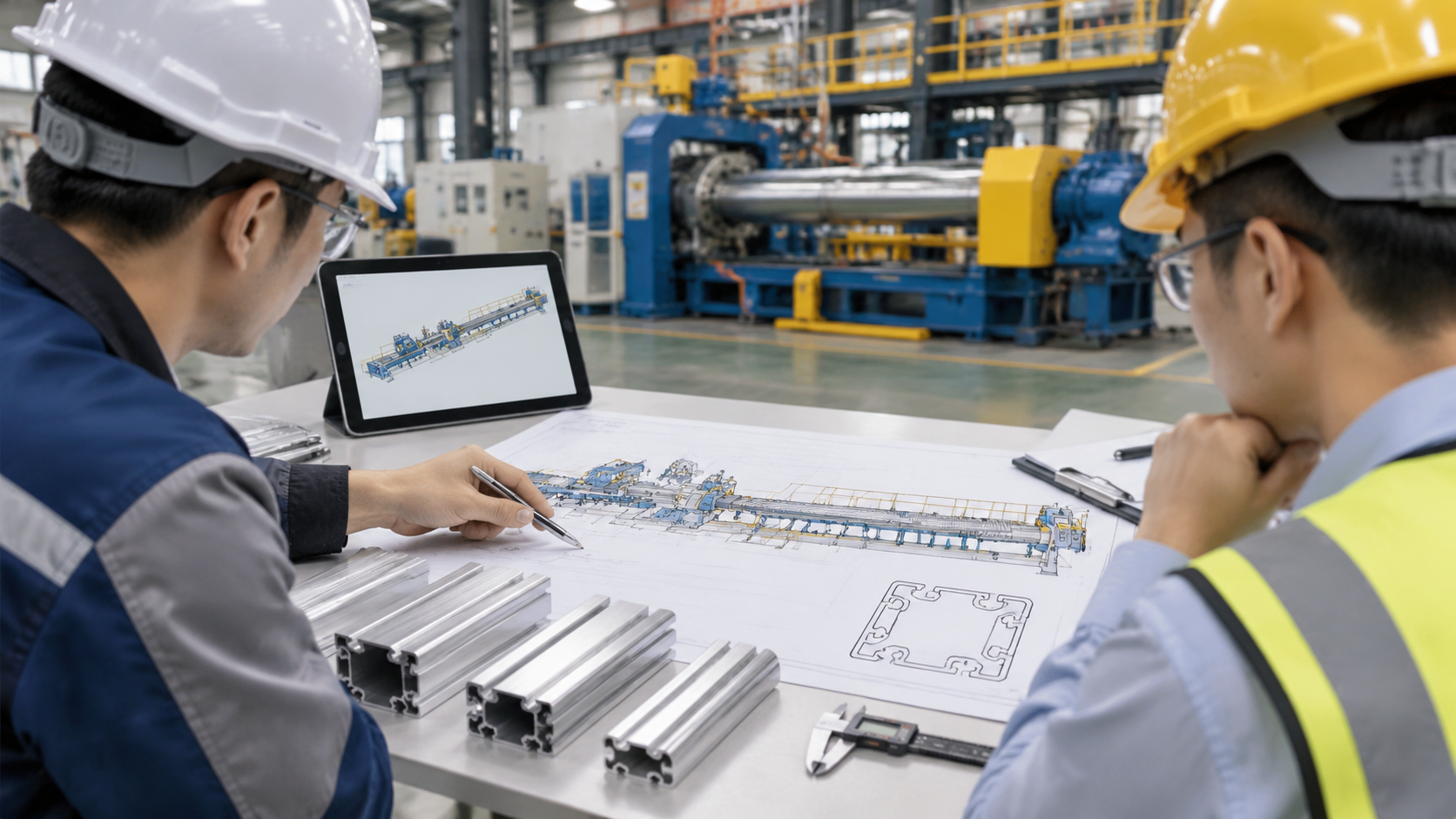
Send Yejing your profile drawings, alloy-and-temper requirements, target output, billet dimensions, and factory layout. Request an itemized proposal identifying equipment, options, utility requirements, installation boundaries, and acceptance criteria—so you can evaluate a production solution rather than an isolated machine.
Frequently Asked Questions
1. Does an aluminum extrusion press package include production dies?
Not necessarily. Confirm die quantities, profile designs, supporting tooling, trial requirements, and correction responsibilities separately.
2. Is an aging oven included in a complete extrusion line?
It may be included or separately quoted. Check the equipment schedule and confirm whether existing ovens can support the proposed output.
3. Can I purchase only the press?
Yes. However, the new press must be compatible with existing heating, loading, cooling, handling, controls, and safety arrangements.
4. Is a higher-tonnage press always better?
No. Appropriate capacity depends on billet size, alloy, profile geometry, production requirements, and the capabilities of the complete line.
5. What information is needed for an accurate quotation?
Provide profile drawings, alloys, tempers, dimensional requirements, billet dimensions, target production, available utilities, factory layout, and desired automation level.
6. What should commissioning include?
Define installation checks, functional testing, agreed production trials, operator training, maintenance instruction, documentation, and outstanding-item resolution in the contract.
References
1. Aluminum Extruders Council. "Aluminum Extrusion Process Basics." Explains billet and tooling preheating, direct extrusion, and downstream processing. [aec]
2. Aluminum Extruders Council. "FAQs." Provides technical guidance on cooling methods, stretching, alloys, and heat treatment. [aec]
3. Aluminum Extruders Council-hosted technical article. "Understanding the Extrusion Press Line for Meeting Automotive Market Requirements," Light Metal Age, June 2023. Supports the discussion of thermal management, quenching, stretching, aging, and line coordination. [aec]
4. Yejing. "Company Profile." Corporate source for establishment in 1990 and production of more than 3,000 extrusion presses. Additional company figures in this article follow the company background supplied for this brief. [yjing]
5. Yejing. "Intelligent Extrusion Production Line." Describes coordinated control of billet heating, hot log shearing, extrusion, pulling, run-out handling, and die heating, with production-data recording and enterprise-system connectivity. [yjing]
6. Yejing. "New Short-Stroke Extruder." Explains loading configurations and their differing billet-cutting requirements. Package-comparison checklists and purchasing recommendations in this article are editorial synthesis, not reported customer-project results. [yjing]


