Content Menu
● What Makes Window Frame Profile Extrusion Demanding?
● How an Aluminum Extrusion Press Produces Window Profiles
>> Billet Heating and Die Preparation
>> Extrusion, Cooling, and Handling
>> Straightening, Cutting, and Aging
● How to Select an Aluminum Extrusion Press for Window Frame Profiles
>> Start with a Representative Profile Portfolio
>> Evaluate Tonnage and Billet Diameter Together
>> Compare Cycle Performance, Not Just Maximum Speed
● Choosing Alloy and Temper for Aluminum Window Profiles
>> Connect Temper to Verified Properties
>> Define Surface Expectations Before Trials
● Building a Complete Aluminum Window Profile Extrusion Line
● Thermal Break Window Profiles Need Additional Planning
>> Design the Metal Sections for Later Assembly
>> Separate Frame Performance from Press Performance
● A Practical Acceptance Plan Before You Buy
>> 1. Select Meaningful Trial Profiles
>> 2. Define Quality and Output Together
>> 3. Record the Complete Trial Conditions
>> 4. Agree on Handover Responsibilities
● Measure Saleable Output and Energy on the Same Basis
● Use Process Data to Investigate Defects
● Why Work with Foshan Yejing Machinery?
>> Request a Profile-Based Equipment Proposal
● Frequently Asked Questions
>> 1. What size extrusion press is suitable for window frame profiles?
>> 2. Can one press produce both window and door profiles?
>> 3. Why is 6063 commonly selected for window profiles?
>> 4. Does higher tonnage automatically increase productivity?
>> 5. Can the press manufacture thermal break windows directly?
>> 6. How should buyers verify energy-saving claims?
● References
Choosing an aluminum extrusion press for window frame profiles is not simply a question of tonnage. The right investment must match your profile geometry, alloy, surface requirements, production volume, and downstream processing. A powerful press alone cannot compensate for an unsuitable die, inconsistent cooling, or a handling system that damages visible surfaces.
At Foshan Yejing Machinery Manufacturing Co., Ltd., we approach equipment selection as a complete production-line decision. With 36 years of experience and more than 3,000 extrusion presses produced, our focus is helping manufacturers turn window-profile drawings into a practical equipment specification.
This guide explains what to evaluate, where production problems originate, and how to compare proposals beyond their headline specifications.
What Makes Window Frame Profile Extrusion Demanding?
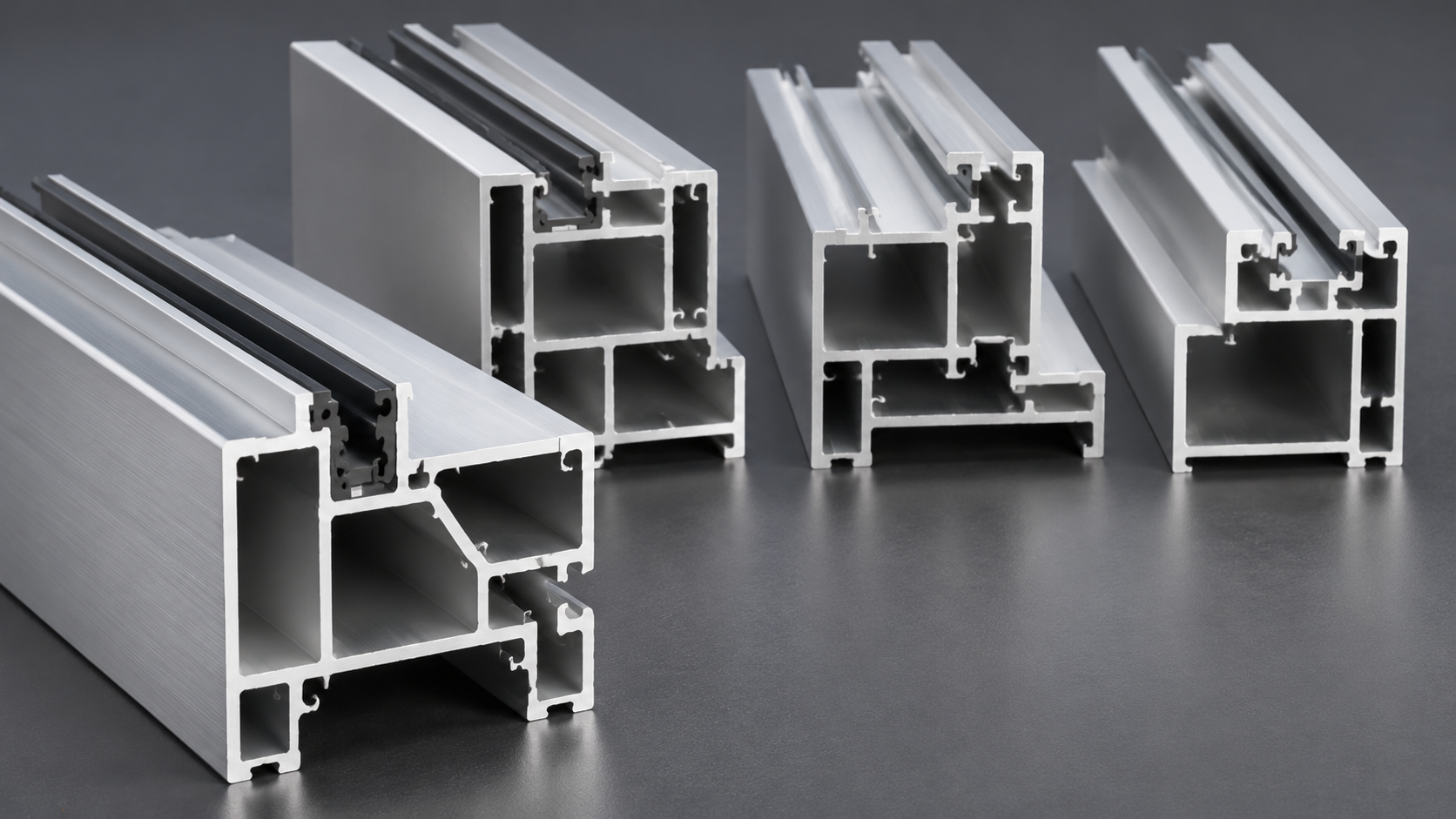
Window profiles combine decorative surfaces with functional details. A single section may include glazing channels, gasket grooves, screw ports, drainage features, and interfaces for thermal insulation strips.
These features must remain consistent along the profile and across production batches. Otherwise, problems can emerge during cutting, corner joining, hardware installation, or final assembly.
An aluminum window profile extrusion line therefore needs to support:
- Repeatable dimensions at critical assembly interfaces.
- Controlled straightness and twist.
- Consistent properties for the specified alloy and temper.
- Surface quality suitable for the intended finish.
- Stable production across different dies and order sizes.
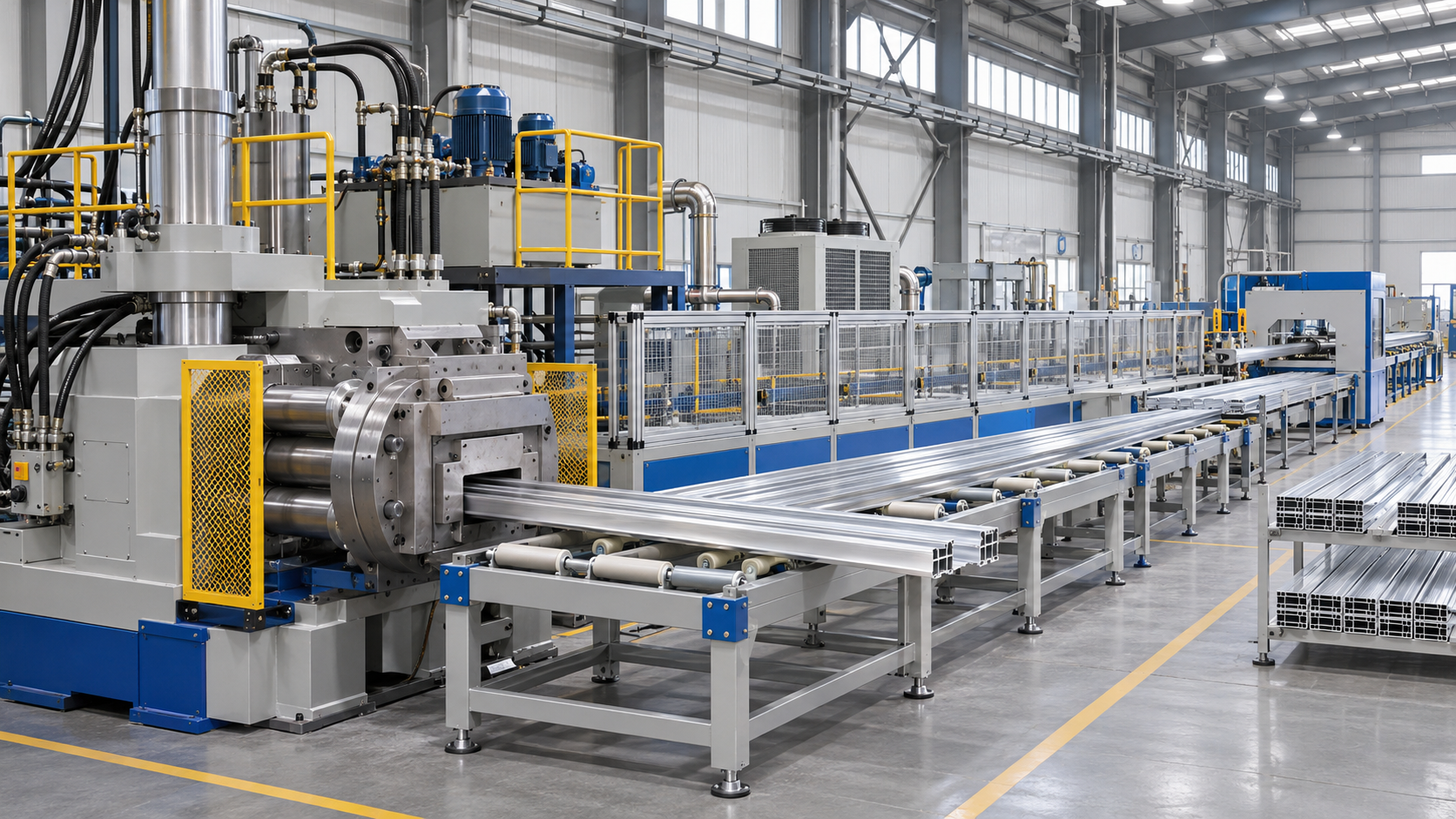
Our starting point is the finished profile—not the largest press a factory can accommodate.
How an Aluminum Extrusion Press Produces Window Profiles
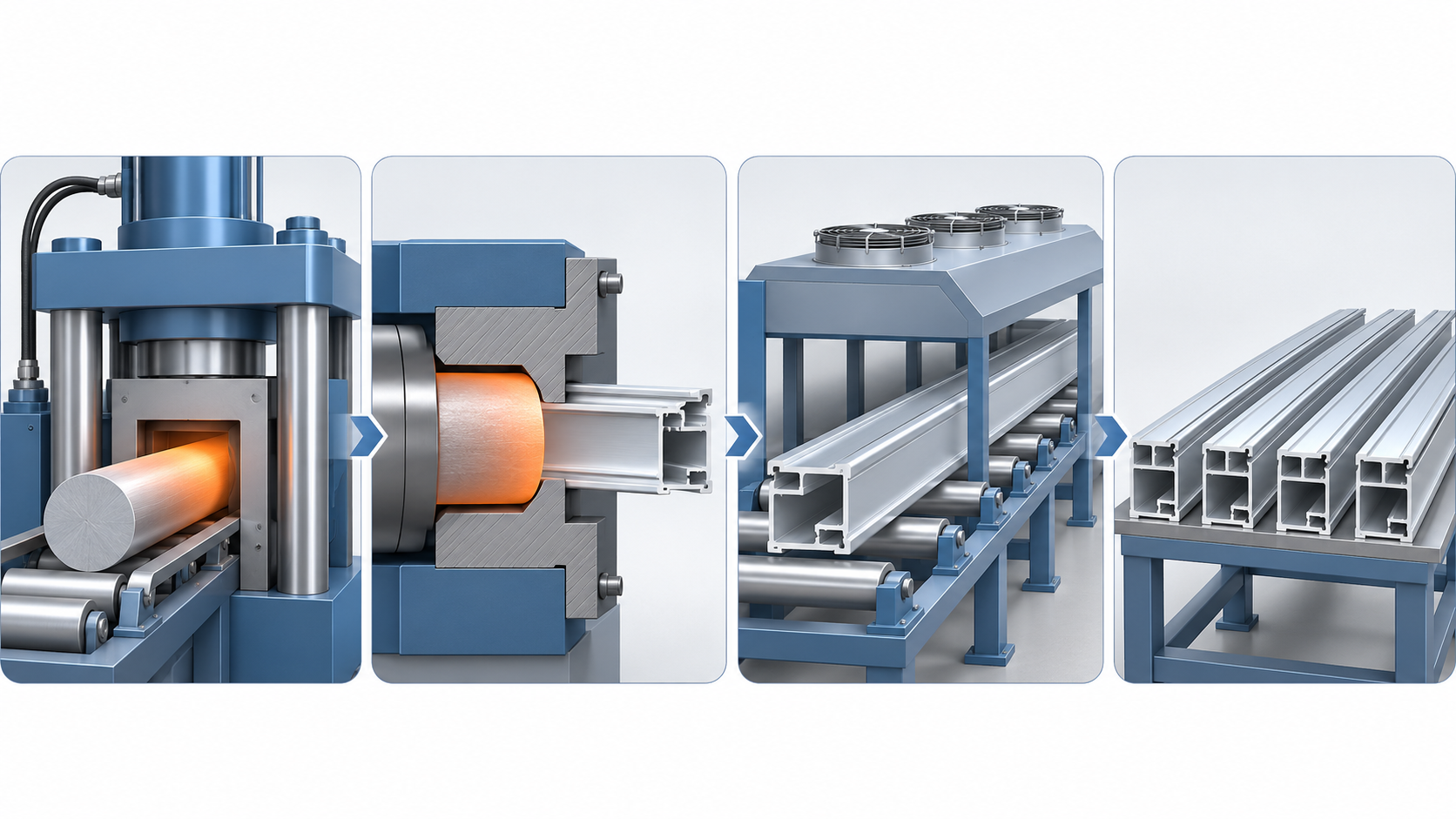
An extrusion press uses hydraulic force to push heated aluminum billet through a shaped die. The emerging section follows the die opening, producing a continuous profile that is subsequently cooled, straightened, cut, and aged as required.
Billet Heating and Die Preparation
Heating prepares the billet for deformation. Die and container conditions also influence how the metal flows.
There is no universal temperature setting for every window profile. The appropriate process depends on alloy, section geometry, extrusion speed, equipment configuration, and required properties.
A useful equipment proposal should explain how temperatures are controlled and recorded, rather than merely stating a maximum furnace temperature.
Extrusion, Cooling, and Handling
As the section exits the die, the puller and run-out system must support it without introducing unnecessary tension, scratches, or distortion.
Cooling requires similar coordination. The selected quench arrangement must suit the alloy, temper, and profile geometry.
The key purchasing question is whether these systems work together throughout the intended production range.
Straightening, Cutting, and Aging
After cooling, profiles are straightened and cut to the required lengths. Artificial aging may then develop the specified mechanical properties.
Inspection should reflect the finished delivery condition. A profile that looks acceptable immediately after extrusion still needs to satisfy the agreed requirements after subsequent processing.
How to Select an Aluminum Extrusion Press for Window Frame Profiles
Start with a Representative Profile Portfolio
Do not size a line around one simple section. Supply drawings covering your regular products and your most challenging planned designs.
Include:
- Overall width and height.
- Cross-sectional area and weight per meter.
- Minimum wall thickness.
- Hollow chambers and narrow openings.
- Required length and surface finish.
- Critical dimensions and tolerances.
- Monthly demand by profile family.
This gives the equipment supplier a defensible basis for recommending press force, billet size, tooling arrangements, and downstream capacity.
Evaluate Tonnage and Billet Diameter Together
Press tonnage describes available force, but it does not independently establish whether a profile can be produced efficiently.
Billet diameter, die design, alloy, temperature, and section complexity all influence the production window.
One useful relationship is:
Extrusion ratio=Billet cross-sectional area/Total extruded cross-sectional area
For a multi-opening die, the denominator includes the combined area of the extruded sections.
This ratio supports process evaluation; it is not a substitute for detailed engineering. Ask suppliers to explain their assumptions and validate difficult profiles through an agreed technical review or trial.
Compare Cycle Performance, Not Just Maximum Speed
Maximum extrusion speed is not the same as sustained production output.
Billet loading, butt shearing, die changes, cooling, cutting, and unplanned stops all affect saleable production.
When reviewing a specification, clarify whether "speed" means ram speed or profile exit speed. Also distinguish installed power from measured energy consumption. Neither a motor rating nor a peak speed establishes the operating cost per accepted tonne.
Choosing Alloy and Temper for Aluminum Window Profiles
Alloy 6063 is widely used for architectural profiles because it combines good extrudability, corrosion resistance, and a surface response suited to decorative finishing.
However, specifying "6063" alone does not fully define the product.
Connect Temper to Verified Properties
T5 and T6 describe different processing conditions. In simplified terms, T5 involves cooling from an elevated-temperature shaping process followed by artificial aging; T6 involves solution heat treatment followed by artificial aging.
Where appropriate, controlled press quenching can form part of the route used to achieve specified properties.
The practical requirement is to agree on the applicable material specification and verify the finished product through suitable testing. Do not treat an aging-oven setting or hardness reading alone as proof that every requirement has been satisfied.
Define Surface Expectations Before Trials
Visible window frames need a clear cosmetic acceptance standard.
Identify which faces remain exposed after installation and how samples will be assessed after anodizing or coating. Agree on acceptable reference samples where possible.
This makes surface quality a measurable production requirement rather than a subjective discussion after delivery.
Building a Complete Aluminum Window Profile Extrusion Line
The press should be specified alongside the equipment that feeds it and handles its output.
| Production stage | Equipment to evaluate | Main purchasing question |
| Billet preparation | Heating furnace and cutting system | Can billet conditions remain consistent? |
| Extrusion | Press, die heating, and handling equipment | Can the system support the profile portfolio? |
| Exit handling | Puller and run-out table | Can profiles move without avoidable damage? |
| Cooling | Appropriate quench equipment | Does cooling suit the alloy and temper? |
| Straightening | Stretcher | Can critical geometry be maintained? |
| Cutting and aging | Saw, handling system, and aging oven | Can downstream capacity match production? |
| Process management | Controls and data collection | Can settings and quality records be traced? |
Not every order requires the same automation level. The objective is a balanced line with clearly defined equipment interfaces and responsibilities.
Thermal Break Window Profiles Need Additional Planning
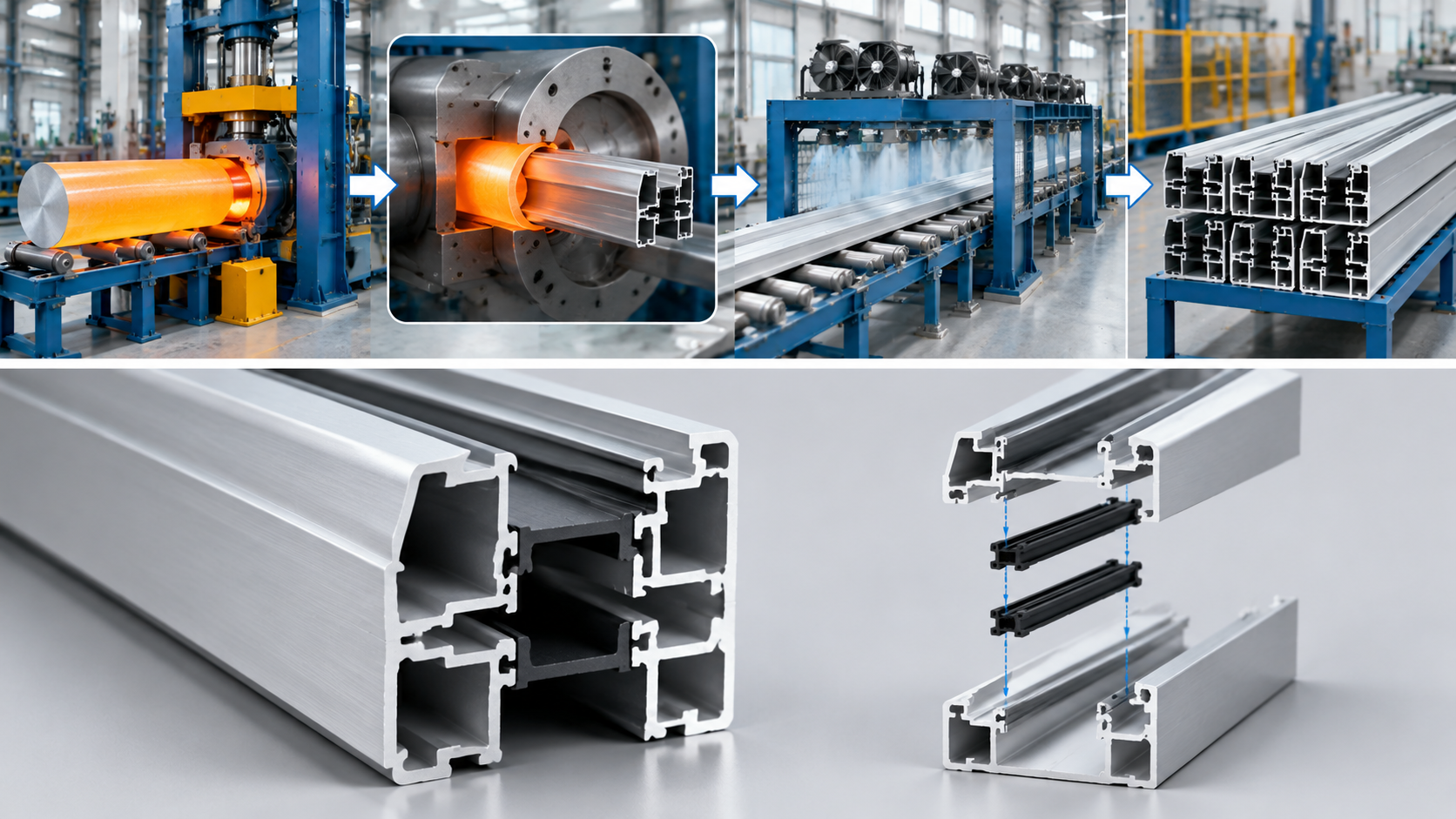
An aluminum extrusion press produces the metal sections used in a thermally broken frame. It does not create the complete insulating connection by itself.
Thermal break construction joins separate aluminum components through a low-conductivity material, commonly polyamide.
Design the Metal Sections for Later Assembly
The extrusion drawing must account for the interfaces used in thermal break assembly.
Depending on the selected system, subsequent operations may include knurling, strip insertion, and rolling or crimping.
Dimensions at these interfaces deserve particular attention because extrusion consistency affects later assembly.
Separate Frame Performance from Press Performance
A press does not independently determine a finished window's thermal performance.
That outcome also depends on the frame design, insulating connection, glazing, seals, and completed assembly.
For purchasing purposes, specify extrusion requirements separately from thermal break assembly and finished-window testing.
A Practical Acceptance Plan Before You Buy
A written acceptance plan helps convert general promises into reviewable results.
1. Select Meaningful Trial Profiles
Choose a small portfolio representing actual production challenges: for example, a thin-wall section, a hollow profile, and a surface-sensitive frame component.
Avoid relying only on an easy demonstration die.
2. Define Quality and Output Together
Specify what counts as an accepted profile. Establish the relevant dimensional, straightness, surface, and mechanical-property requirements.
Then measure output against those requirements. High gross production has limited value if significant material cannot be sold.
3. Record the Complete Trial Conditions
Document alloy, billet dimensions, tooling, process settings, cooling conditions, run duration, and downstream operations.
Without these details, comparing trials or reproducing results becomes difficult.
4. Agree on Handover Responsibilities
Define operator training, installation support, documentation language, spare parts, and the division between factory and site acceptance.
Also specify which utilities, foundations, lifting arrangements, and local services the buyer must provide.
Measure Saleable Output and Energy on the Same Basis
Two simple metrics make supplier comparisons more useful.
Saleable yield=Accepted finished profile mass/Billet input mass×100%
For illustration, 10,000 kg of billet producing 8,500 kg of accepted profiles represents an 85% saleable yield. This is a calculation example, not a performance claim for a particular machine.
Energy comparisons need an equally clear boundary. State whether measurements include only the press or also billet heating, cooling, handling, compressed air, and aging.
Compare similar products under comparable conditions. Otherwise, an attractive energy figure may describe a different production task rather than a more efficient solution.
Use Process Data to Investigate Defects
Yejing's intelligent production-line controls centralize equipment operation and support process-data storage and connection with enterprise management systems.
The value lies in using those records to investigate variation.
| Observed issue | Areas worth investigating |
| Dimensional drift | Die condition, temperature stability, and process changes |
| Scratches | Contact surfaces, debris, puller alignment, and handling |
| Twist or bow | Metal-flow balance, cooling, pulling, and straightening |
| Property variation | Alloy records, quenching, aging, and testing |
| Reduced output | Loading delays, die changes, downstream queues, and stops |
These are investigation categories, not automatic diagnoses. Change settings through controlled trials and confirm the outcome with inspection.
Why Work with Foshan Yejing Machinery?
Yejing combines extrusion press manufacturing with auxiliary equipment and integrated production-line solutions.
Founded in 1990, the company has produced more than 3,000 presses and supplied customers in more than 30 countries, including Australia, South Korea, Turkey, and Brazil.
Its company profile reports ISO 9001:2015 certification and CE-related conformity credentials. Buyers should request current documents applicable to the proposed equipment and destination market.
For a custom window-profile project, our priority is to connect profile requirements, production targets, equipment configuration, and service arrangements in one technical proposal.
Request a Profile-Based Equipment Proposal
Send Yejing your profile drawings, alloy and temper requirements, target monthly output, finish specifications, factory layout, and destination country.
Request a proposal covering the press, billet system, tooling interfaces, cooling, handling, aging, utilities, and acceptance plan. This creates a stronger purchasing basis than a tonnage-and-price quotation alone.
Frequently Asked Questions
1. What size extrusion press is suitable for window frame profiles?
There is no single correct tonnage. Selection depends on profile dimensions, geometry, alloy, billet diameter, tooling, and production targets. A representative drawing portfolio is the best starting point.
2. Can one press produce both window and door profiles?
Potentially, yes. Each proposed section must fit the press, tooling, cooling, and handling capabilities. Confirm the complete product range during engineering review.
3. Why is 6063 commonly selected for window profiles?
It offers good extrudability, corrosion resistance, and surface characteristics suited to architectural applications. The final alloy and temper must still satisfy the product specification.
4. Does higher tonnage automatically increase productivity?
No. Productivity also depends on cycle time, profile complexity, cooling, handling, changeovers, and accepted yield. Evaluate the complete line against representative products.
5. Can the press manufacture thermal break windows directly?
It produces the aluminum sections. Thermal break assembly and finished-window fabrication require additional processes and equipment.
6. How should buyers verify energy-saving claims?
Request measured consumption with a defined equipment boundary, product mix, operating period, and accepted output. Installed power alone does not establish energy efficiency.
References
1. Foshan Yejing Machinery Manufacturing Co., Ltd. "Company Profile." Source for founding year, cumulative press production, export markets, and reported certification credentials. [yjing]
2. Yejing. "Technical Parameters." Published examples of press force, billet dimensions, speed, non-extrusion time, and installed power; specifications are subject to configuration changes. [yjing]
3. Yejing. "Intelligent Extrusion Production Line." Source for centralized controls, process-data storage, and enterprise-system connectivity. [yjing]
4. Hydro. "Aluminum Extrusion Process." Technical overview of billet heating, extrusion, cooling, straightening, cutting, aging, and finishing. [hydro]
5. Hydro. "Technical Datasheet—Extruded Products, Alloy EN AW-6063." Source for architectural applications and temper definitions. [hydro]
6. Hydro. "ENA Industry Specifications." Technical context for press quenching, process controls, aging, and mechanical-property verification. [hydro]
7. Hydro. "Thermal Break" and "Machining and Fabrication." Sources for insulating connections between aluminum sections and polyamide-bar crimping. [hydro]


