Content Menu
● 1. How Will You Size the Aluminum Extrusion Press for Our Profiles?
>> What Makes Our Hardest Profile Difficult to Run?
● 2. What Saleable Output Can the Aluminum Extrusion Line Deliver?
>> Worked Example: Why Faster Press Output May Not Win
● 3. What Is Included in the Extrusion Production Line Quote?
>> What Does the Plant Need to Provide Before Installation?
● 4. How Will You Prove Performance Before Shipment and After Installation?
● 5. What Evidence Supports Machinery Safety and Compliance?
● 6. What Will the Press Cost to Own, and Who Will Support It?
● 7. Can the Extrusion Press Manufacturer Show Comparable Installations?
● 8. How Can You Compare Extrusion Press Suppliers Before Signing?
● Request a Drawing-Based Proposal from Yejing Machinery
● Frequently Asked Questions
>> 1. What should I send an extrusion press supplier for an accurate quote?
>> 2. Is a higher-tonnage extrusion press always a better choice?
>> 3. Should I buy a standalone press or a complete extrusion line?
>> 4. Can I use my own dies during the factory acceptance test?
>> 5. How do I compare energy use between two extrusion press quotes?
>> 6. When should I agree on the spare-parts package?
● References
Before choosing an extrusion press supplier, ask three questions: Can this press make our most demanding profiles? How will we verify quality and output before accepting the line? Who will support us when production stops? An aluminum extrusion press supplier should answer with a sizing rationale, a written test plan, and clear service commitments—not just a tonnage rating and a quotation.
From a machine builder's perspective, the most useful conversation starts with your profile drawings, not our equipment catalog. Two plants targeting the same annual tonnage may need different lines because their alloy mix, die changes, cooling requirements, and finished lengths differ. Use the questions below to turn those differences into requirements that every bidder must address.
1. How Will You Size the Aluminum Extrusion Press for Our Profiles?
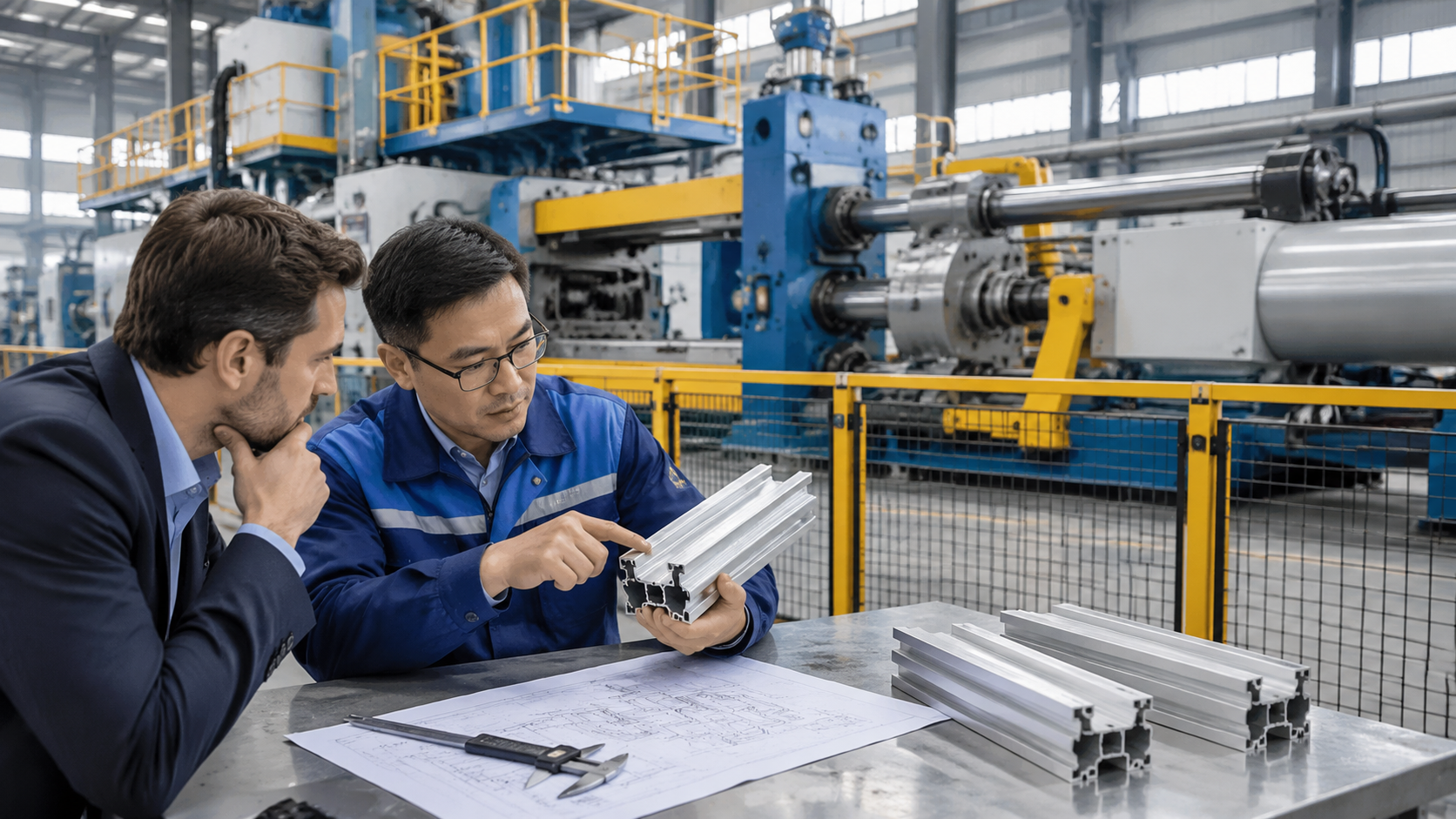
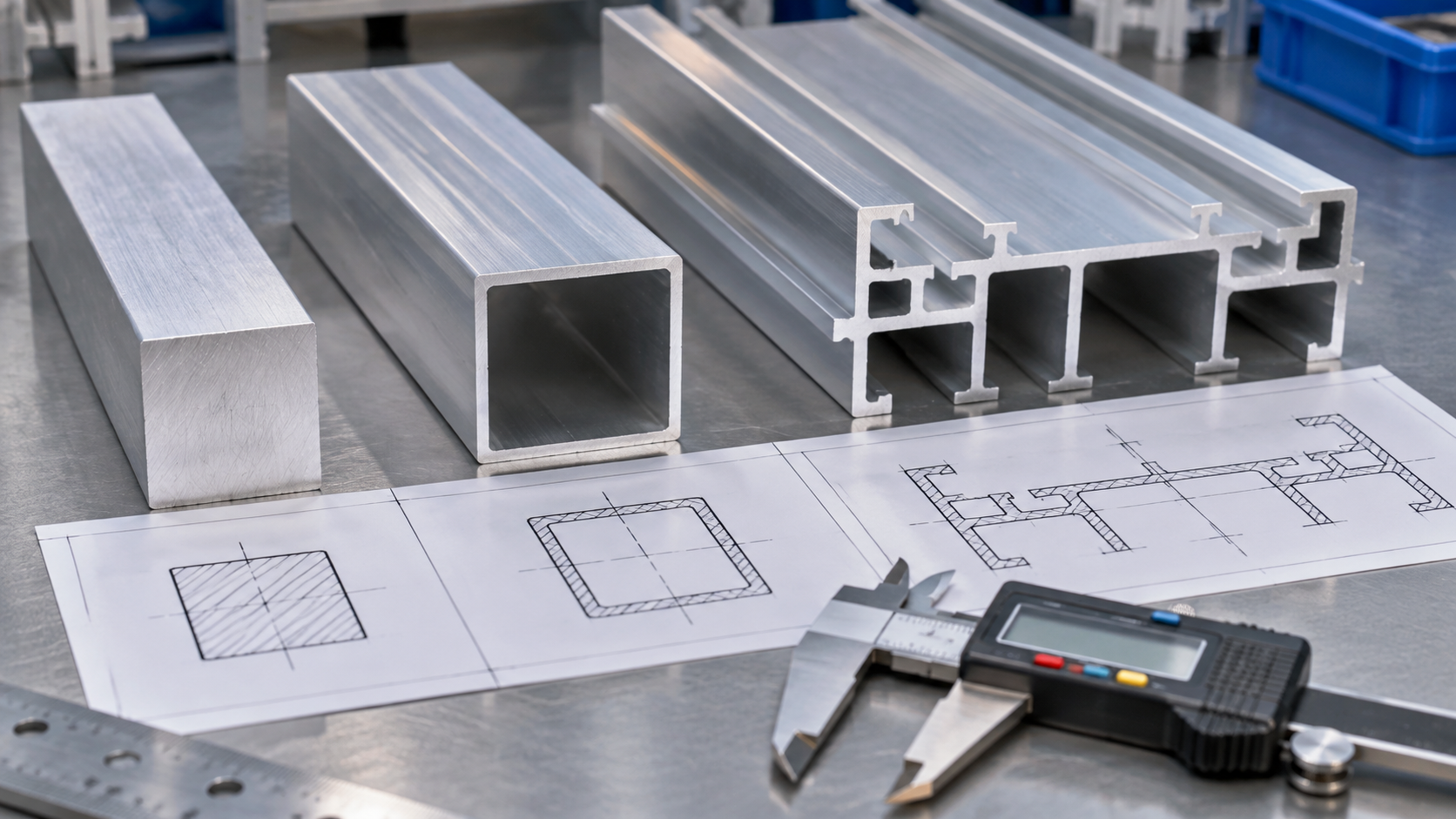
Ask the supplier to recommend a press using three representative products: your highest-volume profile, your hardest profile to extrude, and a profile you plan to introduce. Share cross-sectional drawings, alloy and temper, minimum wall thickness, dimensional tolerances, surface requirements, cut lengths, and expected volumes.
Request a sizing note that explains the proposed press force, billet diameter and usable length range, container size, die envelope, and expected operating margin on the hardest profile. Ask the supplier to identify which profile controls the recommendation and whether the quoted force is expressed in metric ton-force or another unit.
What Makes Our Hardest Profile Difficult to Run?
The limiting factor may not be force. A thin-walled hollow profile may be constrained by surface quality or dimensional stability. A wider profile may fit the press tooling but be difficult to handle or cool evenly downstream. Ask the supplier where it expects the first production constraint and how it would verify that assumption. If the answer depends on a die trial, treat it as an open item rather than a confirmed capability.
2. What Saleable Output Can the Aluminum Extrusion Line Deliver?
Ask for saleable output in kilograms per scheduled production hour for an agreed product mix. Define it as the mass that passes agreed quality checks divided by the full scheduled test time, including the changeovers and routine stops specified in the test plan. Maximum ram speed, kilograms extruded, and kilograms accepted for shipment measure different things.
| Ask the supplier for |
What to define before comparing quotes |
| Saleable output |
Profile mix, test duration, inspection criteria, and time counted |
| Material yield |
Accepted product mass divided by billet input; treatment of scrap and rework |
| Die-change time |
Start at the last accepted piece of one run; stop at the first accepted piece of the next |
| Energy consumption |
Electricity and fuel per saleable tonne; equipment included in metering |
| Line bottleneck |
The process step that limits output for each representative profile |
Worked Example: Why Faster Press Output May Not Win
Suppose Line A extrudes 1,200 kg per scheduled hour at 82% saleable yield. It delivers 984 kg of accepted product. Line B extrudes 1,100 kg at 92% yield and delivers 1,012 kg. On those illustrative assumptions, the slower line produces 28 kg more saleable product each hour. The figures are not industry benchmarks. They show why both bids must use the same clock, scrap accounting, and inspection criteria.
3. What Is Included in the Extrusion Production Line Quote?
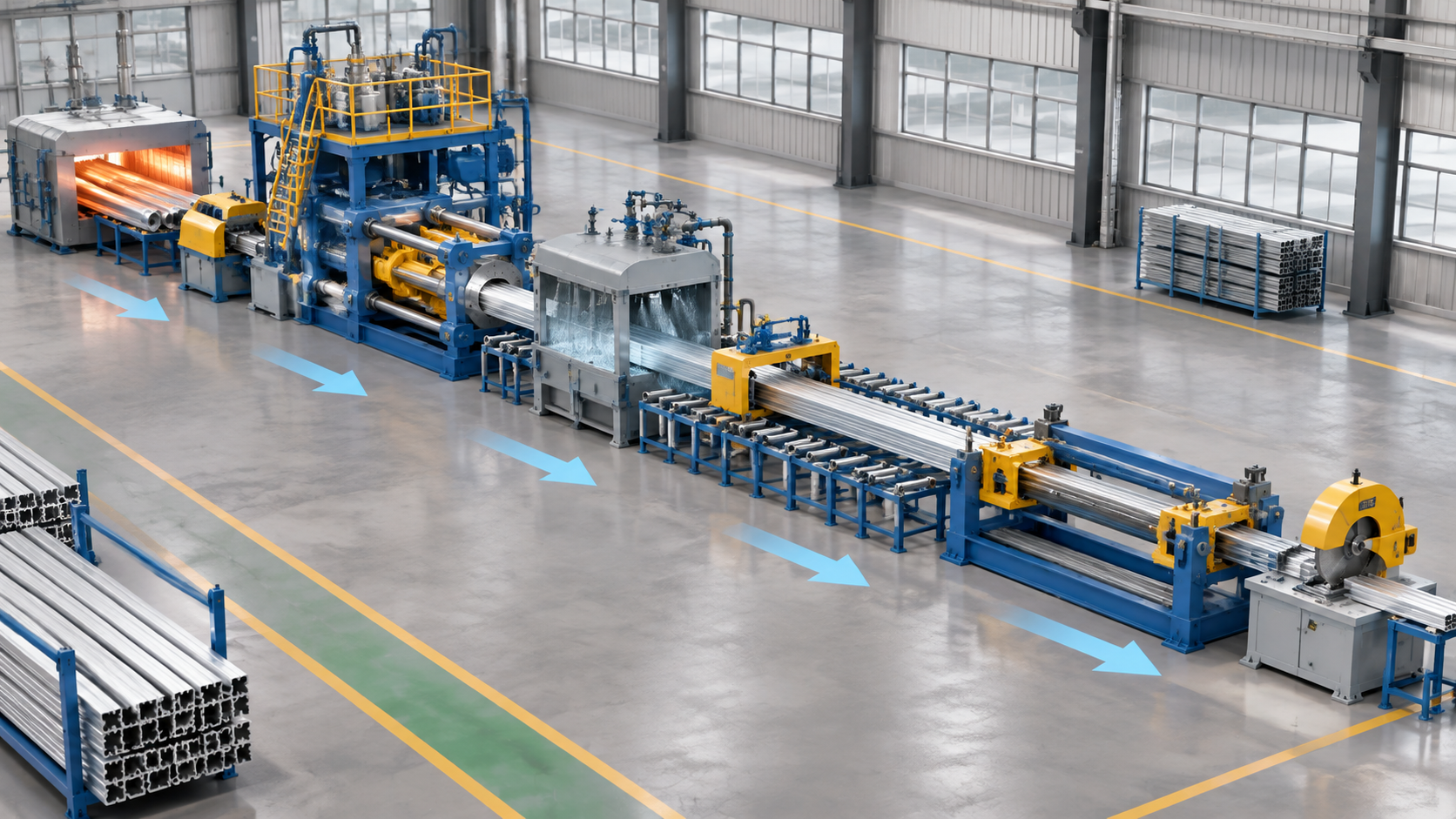
Ask for an itemized scope covering billet heating and shearing, die heating, the press, quenching, pullers, runout handling, stretching, sawing, and aging where applicable. For each item, mark it as included, optional, buyer-supplied, or excluded. Do the same for tooling, hydraulic oil, installation consumables, and startup spares.
For a turnkey aluminum extrusion line, ask who owns the interfaces between machines. Who resolves the problem if the press meets its cycle target but the puller or saw cannot keep up? For a press replacement, request an interface drawing showing centerline height, transfer points, control signals, safety interlocks, and the connection to existing downstream equipment.
What Does the Plant Need to Provide Before Installation?
Request a preliminary layout, foundation loads, rigging clearances, maintenance access, and utility requirements. Separate peak demand from normal consumption and specify both the required supply conditions and connection points. Assign ownership for foundations, unloading, lifting, power, water, compressed air, and any fuel supply. Put those responsibilities into the quotation so two bids can be compared on installed scope, not just equipment price.
4. How Will You Prove Performance Before Shipment and After Installation?
Agree on a test protocol before placing the order. A factory acceptance test (FAT) takes place before shipment. A site acceptance test (SAT) takes place after installation, with the agreed equipment and utilities connected. Ask which tests can be completed at the supplier's factory and which must wait until the line is integrated at your plant.
1. Set the test conditions. Identify the billet, alloy, die, target temper, run duration, and measurement methods. State who supplies the dies and material and who witnesses the tests.
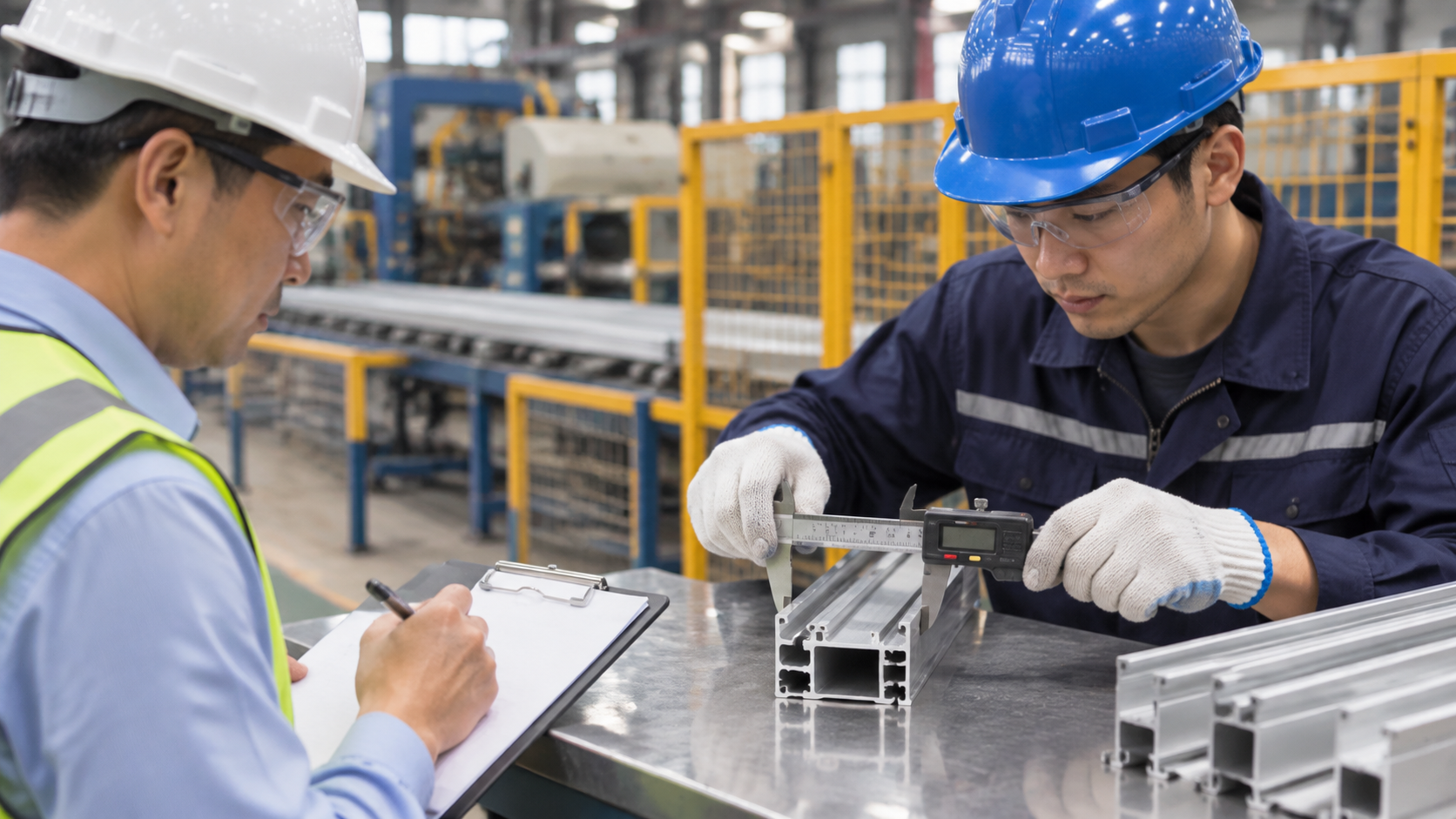
2. Set pass criteria. Agree on saleable output, yield, dimensional and surface checks, and any required mechanical-property results. Specify when samples will be taken and whether final checks occur after aging.
3. Test handoffs and recovery. Include agreed checks for line synchronization, alarms, safety functions, and controlled restart, not just a run with everything working normally.
4. Define retest and sign-off rules. Record who fixes each failure, when it will be retested, and which issues must close before shipment or final acceptance.
If only dry cycling is possible at the factory, record it as a functional check. A dry cycle cannot demonstrate that your alloy, die, and downstream process will produce acceptable profiles at the quoted rate. Keep those performance criteria open until a suitable production trial.
5. What Evidence Supports Machinery Safety and Compliance?
Ask who is responsible for the conformity of the press and, if you are purchasing an integrated line, who is responsible for conformity of the complete assembly. Request a document schedule covering the applicable declaration, operating and maintenance instructions, electrical drawings, and the validation records the supplier will provide for agreed safety functions. Review guarding and access for die changes, cleaning, and maintenance—not just normal production.
For EU projects, confirm the expected date the machinery will be placed on the market. Regulation (EU) 2023/1230 applies from 20 January 2027 and replaces Machinery Directive 2006/42/EC. Confirm which framework applies to the delivered scope and who will issue the relevant declaration. An ISO 9001 quality management certificate does not establish conformity for a specific machine or line.
6. What Will the Press Cost to Own, and Who Will Support It?
Compare installed cost and recurring costs on the same basis. Ask for scheduled service tasks, expected replacement intervals or the conditions that trigger replacement, recommended spare quantities, and current part lead times. Include freight, installation, commissioning, training, utilities, routine maintenance, and planned downtime. If an energy-saving feature changes the purchase price, ask for a measured comparison under matched loads and agreed metering boundaries.
Then give each bidder a practical service scenario: "The line is down and our maintenance team suspects a failed drive. Who answers, when can they start diagnosis, and how quickly can a replacement reach us?" Distinguish the initial response target from time to on-site support or parts dispatch. Ask when the warranty begins and whether labor, travel, freight, and consumables are covered. Confirm that your maintenance team receives manuals, spare-parts lists, and agreed access to control backups.
7. Can the Extrusion Press Manufacturer Show Comparable Installations?
Ask for references that match your application, not just your country or press tonnage. A useful reference has a similar alloy mix, profile complexity, automation scope, or retrofit challenge. With the customer's permission, ask what delayed startup, how long it took operators to run independently, and how the supplier handled the first significant service issue.
On a factory visit, compare what the supplier designs, machines, assembles, and tests in-house with what it buys from other vendors. Ask to see a comparable press under assembly, a sample inspection record, and a commissioning checklist. If an outside vendor supplies the controls or puller, confirm who handles warranty claims and integration faults.
8. How Can You Compare Extrusion Press Suppliers Before Signing?
Send each bidder the same request for quotation (RFQ) and require a written response to every requirement. A simple scorecard works better when it separates evidence from promises:
- Demonstrated: The bidder provides a relevant test result or comparable operating reference.
- Testable: The bidder commits to a measurable result in an agreed acceptance test.
- Unverified: The bidder gives a claim without a measurement method or written commitment.
Treat unresolved safety responsibilities, missing equipment interfaces, and undefined acceptance criteria as gates, not points that a low price can offset. When a supplier takes exception to a requirement, record the alternative, cost impact, and owner before comparing final bids.
Request a Drawing-Based Proposal from Yejing Machinery
Foshan Yejing Machinery Manufacturing Co., Ltd. designs and manufactures aluminum extrusion presses, auxiliary equipment, and integrated production lines. According to company figures, Yejing has 36 years of experience, has manufactured more than 3,000 presses, and operates a 66,000 m² production base. Its stated machining, assembly, and commissioning capabilities cover press classes from 600 to 9,000 tons, and its equipment has reached more than 30 countries.
Send Yejing your profile drawings, alloy and temper list, target saleable output, and plant layout. Request a proposal with a press-sizing rationale, itemized line scope, utility schedule, and draft acceptance plan. If you are replacing a press, include the existing billet diameter, line centerline height, and the downstream equipment you intend to keep.
Frequently Asked Questions
1. What should I send an extrusion press supplier for an accurate quote?
Send representative profile drawings, annual volumes by product family, alloys and tempers, tolerances, surface requirements, and cut lengths. Include the destination, plant layout, and existing equipment if applicable. Identify which requirements are fixed and which the supplier can optimize.
2. Is a higher-tonnage extrusion press always a better choice?
No. More force does not remove a bottleneck in quenching, handling, or sawing. Ask for the operating margin on your hardest profile and compare installed costs and utilization before paying for capacity you may not use.
3. Should I buy a standalone press or a complete extrusion line?
A standalone press can make sense when existing equipment has sufficient capacity and compatible interfaces. An integrated line is worth evaluating when several stations need replacement or when you want one supplier responsible for coordinating equipment and controls.
4. Can I use my own dies during the factory acceptance test?
Ask before ordering. Confirm die dimensions, tooling compatibility, shipping dates, and who supplies the billet. If the supplier cannot run your dies before shipment, agree which performance tests will move to site acceptance.
5. How do I compare energy use between two extrusion press quotes?
Request electricity in kWh and fuel use in a stated unit, each per saleable tonne. Compare results for the same profile mix and test window. Check whether billet heating, quenching, handling, and aging are inside or outside each measurement boundary.
6. When should I agree on the spare-parts package?
Agree on it before placing the order. Separate commissioning spares from critical operating spares. For each critical part, request the part number, supplier, lead time, and available substitute so your maintenance team can decide what to stock.
References
1. Aluminum Extruders Council, Aluminum Extrusion Process Basics. Background on billet and die preparation, press operation, quenching, and aging. [aec]
2. Australian Aluminium Council, Aluminium Extrusion Manual, 28 February 2023. Technical background on direct extrusion, tooling, and the relationship between quenching and product requirements. [aluminium.org]
3. International Electrotechnical Commission, IEC 62381:2024 — Automation Systems in the Process Industry: Factory Acceptance Test, Site Acceptance Test, and Site Integration Test. Framework adapted here for defining test scope and responsibilities; not presented as an extrusion press performance standard. [webstore.iec]
4. European Commission, Machinery, and EUR-Lex, Regulation (EU) 2023/1230. Sources for the EU transition date and machinery conformity documentation. [single-market-economy.ec.europa]
5. Yejing Machinery, Products, and Alulinking, Yejing Company Profile. Product scope and published company profile. The experience, facility size, and manufacturing range are figures supplied by Yejing for this article, not independently audited figures. [yjing-extrusion]


