Content Menu
● What Equipment Does an Aluminum Extrusion Line Include?
● How the Aluminum Extrusion Process Works
>> 1. Select the Alloy and Prepare the Billet
>> 2. Heat the Billet and Extrusion Die
>> 3. Push the Billet Through the Extrusion Die
>> 4. Guide and Quench the Emerging Profile
>> 5. Stretch and Cut the Profiles
>> 6. Age, Inspect, and Release the Product
● How to Select the Right Aluminum Extrusion Line
>> Start With a Product Matrix
>> Match Press Capacity to the Application
>> Balance the Entire Production Route
● Practical Troubleshooting: Connect Defects to Process Evidence
● What Intelligent Extrusion-Line Automation Should Deliver
● Measure Performance Before Accepting the Line
>> Use Saleable Output, Not Press Speed Alone
>> Agree on Representative Acceptance Trials
● Why Work With Yejing on a Complete Extrusion Line?
● Plan Your Aluminum Extrusion Line Around the Finished Product
● Frequently Asked Questions
>> 1. What is an aluminum extrusion line?
>> 2. Does aluminum melt during extrusion?
>> 3. How do I choose extrusion press tonnage?
>> 4. Can one line produce different aluminum profiles?
>> 5. What is the difference between quenching and aging?
>> 6. What should I include in a quotation request?
● References
An aluminum extrusion line transforms heated aluminum billets into profiles through coordinated heating, extrusion, quenching, stretching, cutting, and aging. For manufacturers, understanding how an aluminum extrusion line works is essential to selecting equipment that delivers consistent quality—not simply impressive press capacity.
At Foshan Yejing Machinery Manufacturing Co., Ltd., our approach starts with the finished product: its alloy, cross-section, tolerances, mechanical properties, and production volume. These requirements should determine the equipment configuration, rather than forcing every product through the same machine specification.
This guide explains the complete aluminum extrusion process, the equipment behind each stage, and the questions buyers should ask before investing.
What Equipment Does an Aluminum Extrusion Line Include?
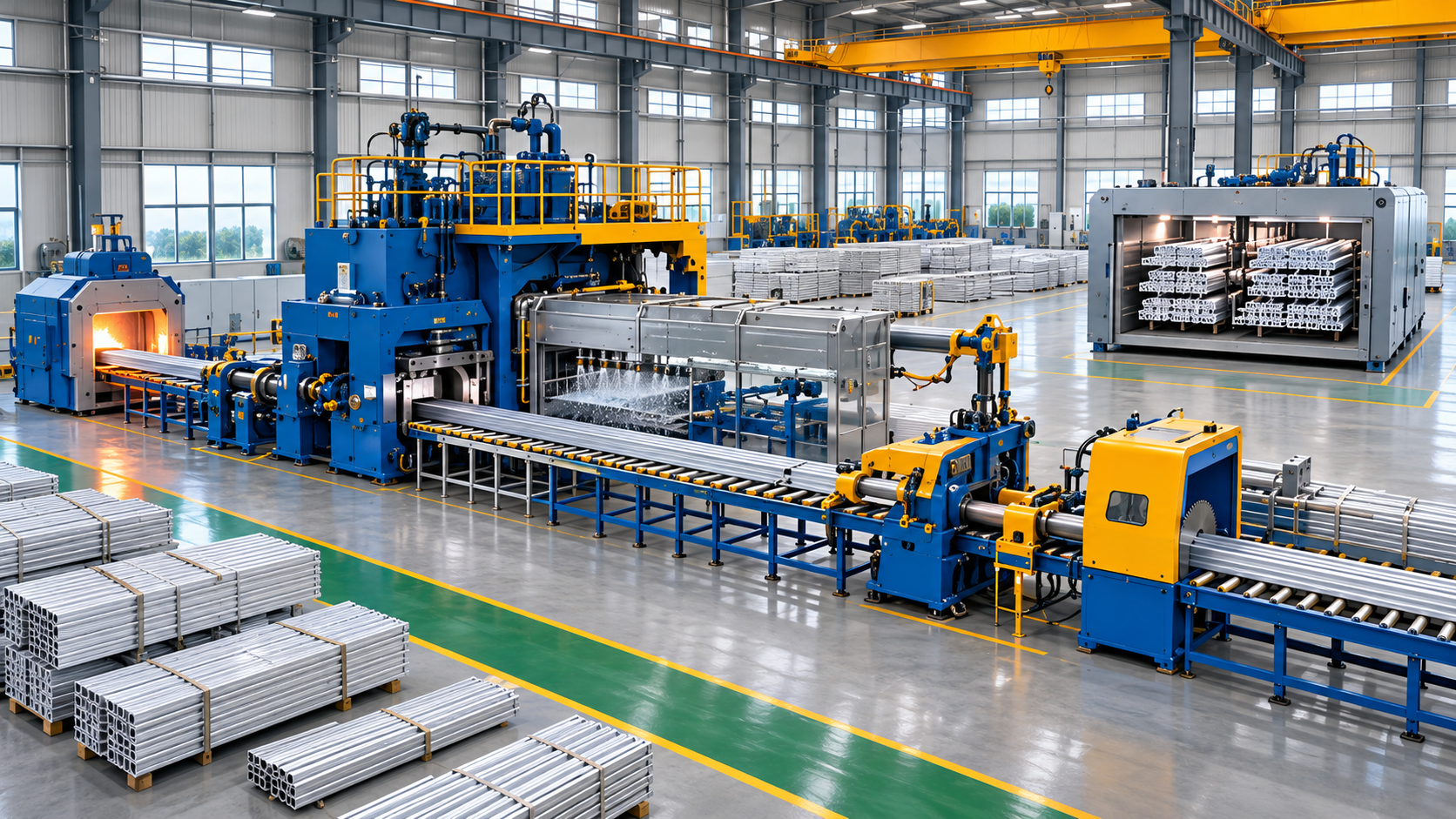
A complete aluminum extrusion production line connects metal preparation, forming, thermal treatment, and material handling.
| Production stage | Main equipment | Primary control objective |
| Billet preparation | Billet heater and cutting system | Consistent billet temperature and length |
| Tool preparation | Die heating oven | Suitable, repeatable tooling temperature |
| Extrusion | Hydraulic extrusion press | Controlled metal flow through the die |
| Profile handling | Runout table and puller | Support without excessive deformation |
| Quenching | Air, mist, or water cooling system | Required properties with manageable distortion |
| Straightening | Profile stretcher | Controlled straightness and deformation |
| Cutting | Finish saw and length stop | Accurate lengths and acceptable cut quality |
| Aging | Aging oven | Repeatable time-temperature treatment |
These machines must work as one system. A powerful press cannot compensate for insufficient cooling capacity, an undersized handling table, or an aging oven that restricts production.
How the Aluminum Extrusion Process Works
1. Select the Alloy and Prepare the Billet
The process begins before the billet reaches the furnace.
Alloy selection affects extrusion behavior, strength, corrosion resistance, surface finishing, and thermal-treatment requirements. Common extrusion alloys include 6063 and 6061, but they should not be treated as interchangeable production recipes.
Check incoming material identification, chemistry documentation, billet dimensions, and surface condition. Maintain traceability between billet batches and finished profiles so that quality investigations can follow the material history.
2. Heat the Billet and Extrusion Die
Aluminum is softened for extrusion, not melted.
Industry guidance describes typical billet-heating temperatures above approximately 375°C and up to about 500°C, depending on the alloy. This is a general reference range, not a universal operating instruction.
Actual settings depend on billet size, alloy, profile geometry, tooling, and the intended extrusion speed.
Die temperature also matters. Unstable thermal conditions can change metal flow and increase process variation. Heating recipes should therefore address both the billet and the tooling.
For heat-treatable alloys, billet temperature alone does not prove that the required metallurgical condition has been achieved. Exit temperature and subsequent cooling remain critical.
3. Push the Billet Through the Extrusion Die
Inside the extrusion press, a hydraulic ram forces the softened billet through a shaped steel die.
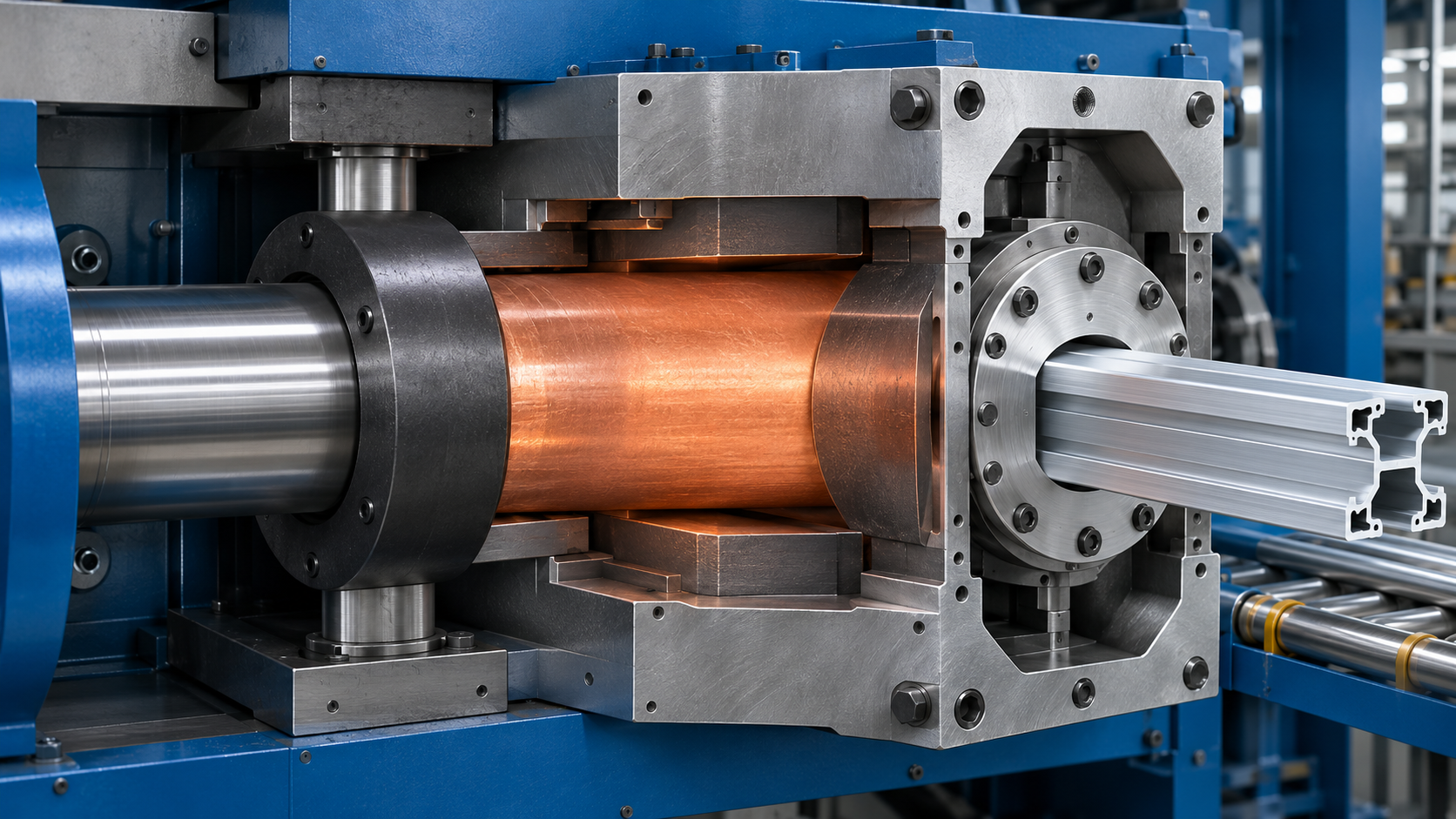
The die defines the profile cross-section. However, profile quality also depends on tooling design, press alignment, temperature, extrusion speed, and material flow.
Press force is therefore only one selection criterion. A suitable press must accommodate the intended billet, tooling package, profile envelope, and production requirements.
In direct extrusion, a remaining billet butt is separated rather than forced entirely through the die. Butt handling, loading, and die changes all contribute to the production cycle.
4. Guide and Quench the Emerging Profile
The hot profile needs support as it leaves the die.
A puller guides its movement along the runout system. Pulling force and speed must suit the profile; excessive tension can distort a section that is still hot and relatively weak.
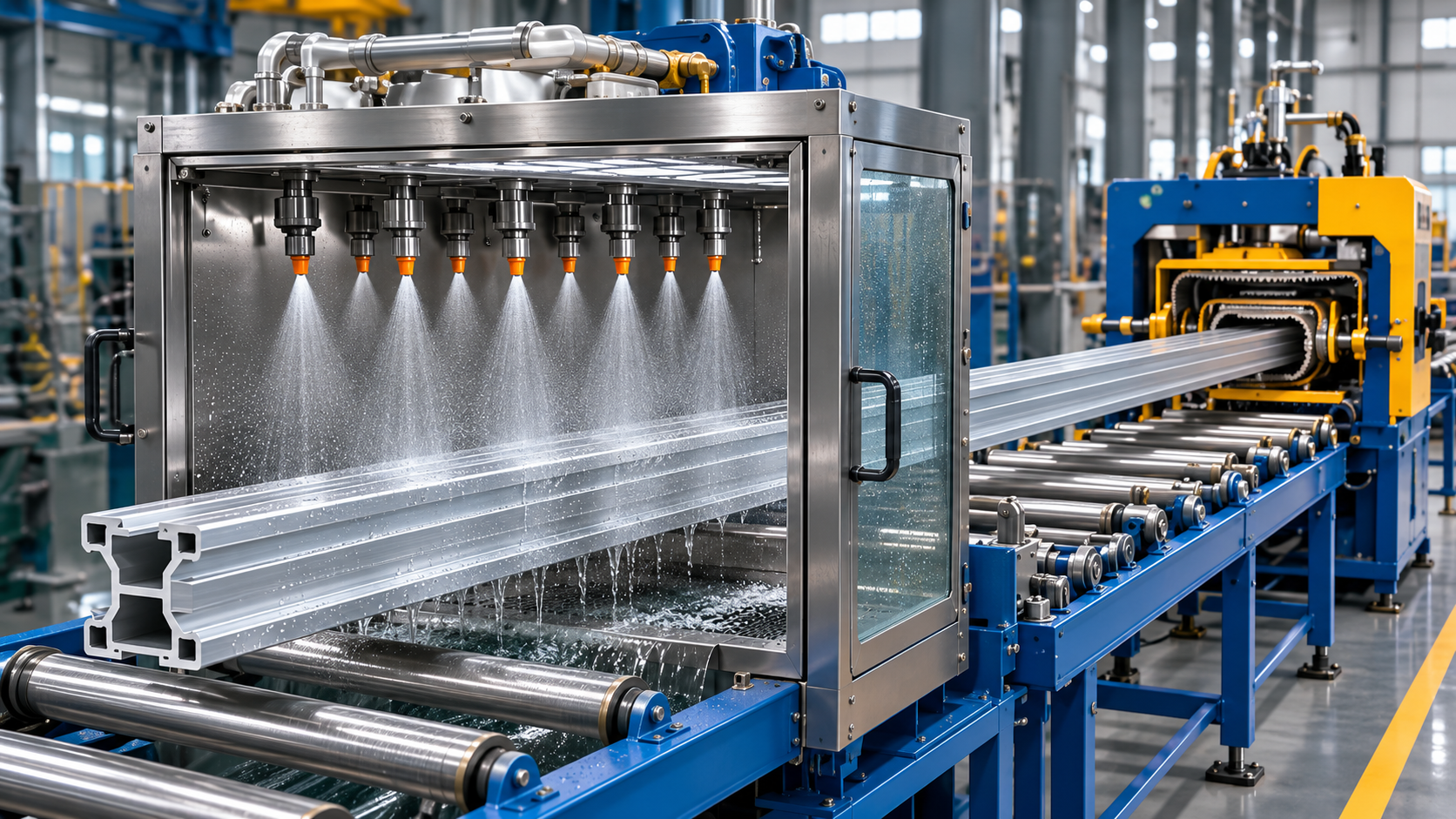
Quenching controls the profile's cooling history. Depending on the alloy and required properties, the system may use forced air, mist, water spray, or another suitable arrangement.
The challenge is balancing cooling intensity with dimensional stability. Uneven cooling can increase distortion, while insufficient cooling can compromise the properties achievable after aging.
"More water" is not a complete process specification. Cooling distribution, delay after extrusion, profile geometry, and repeatability also matter.
5. Stretch and Cut the Profiles
After sufficient cooling, the stretcher applies controlled deformation to improve straightness and influence residual-stress distribution.
Stretching should follow a qualified recipe rather than an operator's visual judgment alone. Excessive stretching can alter dimensions or affect subsequent processing.
The profile is then cut to the required length. Saw accuracy, blade condition, clamping, and support influence cut squareness, burrs, and material loss.
Some lines also use hot cutting during runout handling. The cutting sequence should match the line layout and product requirements.
6. Age, Inspect, and Release the Product
Artificial aging develops the required properties in appropriate heat-treatable alloys through a controlled time-temperature cycle.
Quenching and aging are related, but they are not the same operation. Aging should not be expected to compensate for an unsuitable earlier thermal history.
Oven loading, temperature uniformity, and cycle records affect consistency. Not every aluminum alloy requires artificial aging, and treatment should follow the specified alloy and temper.
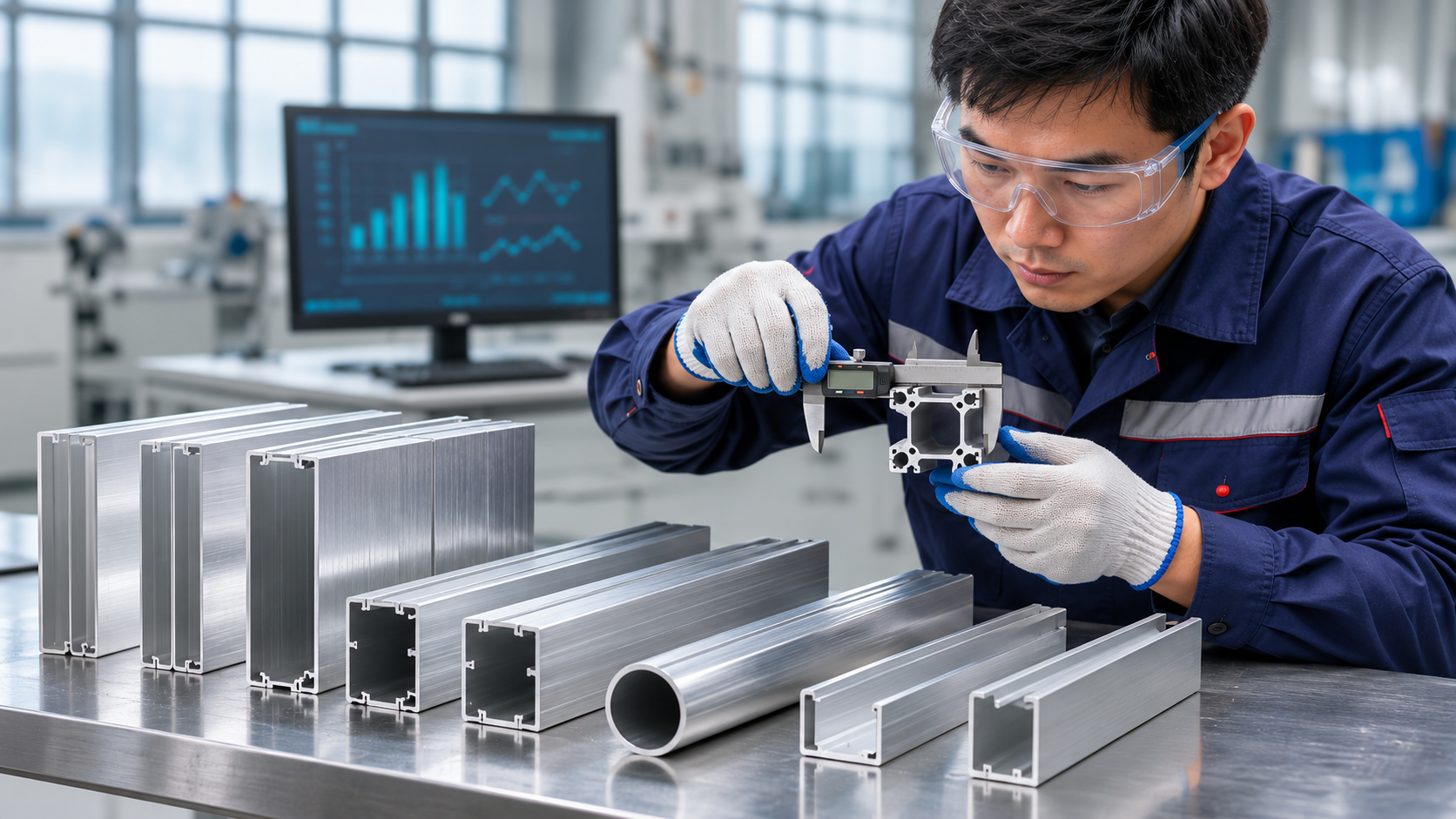
Final release may include dimensional inspection, surface examination, hardness checks, or tensile testing, depending on the applicable product specification.
How to Select the Right Aluminum Extrusion Line
Start With a Product Matrix
Before requesting quotations, prepare a representative product list covering:
- Alloy and required temper.
- Profile drawings and maximum circumscribing dimensions.
- Minimum wall thickness and section complexity.
- Finished length, straightness, and tolerance requirements.
- Monthly volume and expected product mix.
- Surface-finish and downstream fabrication requirements.
This information gives suppliers a meaningful basis for equipment selection. A quotation based only on annual tonnage leaves important technical assumptions unresolved.
Match Press Capacity to the Application
The 600–9,000-ton range describes Yejing's stated press processing, assembly, and commissioning capability. It does not mean that any press within that range suits every profile.
Required force depends on factors including alloy, billet diameter, extrusion ratio, geometry, temperature, and friction. These variables require engineering evaluation.
Also examine die space, billet length, cycle time, maintainability, and the press's compatibility with downstream equipment.
A larger press may provide additional capability, but oversizing without a product-based justification can increase investment and operating requirements.
Balance the Entire Production Route
Ask suppliers to identify the expected bottleneck for your actual product mix.
For example, faster extrusion may deliver little benefit if the cooling table remains occupied or the aging oven cannot process the resulting volume.
Compare complete-line capacity, not isolated machine speeds. Include billet preparation, non-extrusion time, cooling, stretching, sawing, and batch handling in the assessment.
Practical Troubleshooting: Connect Defects to Process Evidence
A useful investigation links the defect to recorded conditions rather than changing several settings simultaneously.
| Observed problem | Areas to investigate | Evidence to collect |
| Bow or twist | Cooling balance, die flow, handling, stretching | Exit conditions, cooling settings, dimensional results |
| Inconsistent mechanical properties | Alloy identity, quench performance, aging cycle | Material records, thermal history, test results |
| Surface damage | Tooling, contamination, supports, handling | Defect location, photographs, tooling history |
| Length variation or poor cuts | Saw setup, stops, blade condition, clamping | Measurement records and blade inspection |
| Output below expectations | Cycle losses, stoppages, downstream congestion | Time-stamped downtime and production records |
These are investigation routes, not definitive diagnoses. Similar defects can have different causes.
A practical sequence is to confirm the measurement, isolate the affected production window, review the process history, and test one justified change at a time. Record the outcome before updating the approved recipe.
What Intelligent Extrusion-Line Automation Should Deliver
Automation is valuable when it makes production more repeatable, visible, and recoverable.
For an intelligent aluminum extrusion production line, evaluate whether the controls can:
- Store controlled recipes for different products.
- Record press, temperature, cooling, and aging data.
- Connect production records with billet and finished-product batches.
- Show actionable alarms and stoppage history.
- Manage access to critical settings.
- Support data backup and restoration.
A large touchscreen does not establish process capability. Ask the supplier to demonstrate recipe management, fault recovery, and record retrieval using a realistic production scenario.
Clarify which functions are included, optional, or dependent on integration with existing factory systems. Remote support arrangements should also define authorization and cybersecurity responsibilities.
Measure Performance Before Accepting the Line
Use Saleable Output, Not Press Speed Alone
A fast machine can still generate excessive scrap or frequent interruptions.
Useful performance indicators include:
- Saleable kilograms per operating hour.
- Accepted output divided by billet input.
- Unplanned downtime by cause.
- Die-change and product-changeover time.
- Energy consumed per saleable tonne.
- First-pass acceptance rate.
Define measurement boundaries before comparing suppliers. Energy figures are not directly comparable if one quotation includes only press electricity while another includes heating, compressed air, cooling, and aging.
Agree on Representative Acceptance Trials
A purchasing specification should explain how performance will be demonstrated.
Select representative profiles rather than testing only an easy section. Record the alloy, billet dimensions, die condition, required properties, and inspection method.
Distinguish factory acceptance testing from site acceptance testing. The latter should account for installation, local utilities, operator training, and agreed production conditions.
Document responsibilities for commissioning, spare parts, safety validation, and corrective action. Any output or efficiency guarantee should state its assumptions and exclusions.
Why Work With Yejing on a Complete Extrusion Line?
Yejing combines extrusion-press manufacturing with auxiliary equipment and integrated production-line solutions.
Our company background includes:
- 36 years of industry experience.
- More than 3,000 extrusion presses produced.
- A 66,000 m² production base.
- More than 100 processing and assembly machines.
- A dedicated research and development team.
- Equipment supplied to more than 30 countries, including Australia, South Korea, Turkey, and Brazil.
Company information also identifies ISO 9001 certification, CE-related credentials, and registration as a European Union information-center supplier.
For procurement, request current certificates and confirm their scope. ISO 9001 concerns the quality-management system; relevant CE documentation should match the equipment supplied. Neither replaces product-specific acceptance testing.
The practical value of a manufacturing partner lies in translating drawings and production targets into a coordinated, maintainable line.
Plan Your Aluminum Extrusion Line Around the Finished Product
A successful line starts with clear product requirements and ends with verified production capability.
Send Yejing your profile drawings, alloys, target tempers, production volumes, finished lengths, and factory layout. Request a tailored proposal covering press selection, auxiliary equipment, automation scope, utilities, and acceptance criteria.
That creates a stronger basis for investment than comparing press tonnage or purchase price alone.
Frequently Asked Questions
1. What is an aluminum extrusion line?
It is an integrated system that heats aluminum billets, forces them through a die, and handles the resulting profiles through cooling, straightening, cutting, and applicable thermal treatment.
2. Does aluminum melt during extrusion?
No. Conventional hot extrusion deforms solid aluminum softened by heating. Temperature must remain appropriate for the alloy and process.
3. How do I choose extrusion press tonnage?
Provide the supplier with profile drawings, alloy, billet requirements, and production targets. Press selection requires engineering assessment, not a tonnage-to-profile-width rule.
4. Can one line produce different aluminum profiles?
Yes, within its tooling, force, thermal, handling, and dimensional limits. Different products may require different dies, recipes, cooling arrangements, and changeover procedures.
5. What is the difference between quenching and aging?
Quenching controls cooling after extrusion or solution treatment. Aging develops properties through subsequent time-dependent metallurgical changes, sometimes using a controlled oven cycle.
6. What should I include in a quotation request?
Include drawings, alloy and temper, tolerances, production volume, finished length, utilities, available space, automation expectations, and required acceptance tests.
References
1. Kautec, "How an aluminum extrusion line works: from billet to profile." Original article reviewed for its process sequence, equipment coverage, and integrated-line perspective. The rewritten article adds procurement, troubleshooting, traceability, and acceptance-testing guidance rather than reproducing its wording. [kautec]
2. Aluminum Extruders Council, "Aluminum Extrusion Process Basics." Supports the solid-state nature of extrusion, indicative billet-temperature range, hydraulic forming process, and post-extrusion treatment sequence. [aec]
3. Aluminum Extruders Council, *EPD Background Report: Aluminum Extrusion*. Supports the general manufacturing route from billet preheating and extrusion through cooling, stretching, cutting, and aging. Its illustrative operating conditions are not presented here as universal production recipes. [aec]
4. Aluminum Extruders Council-hosted technical article, "Understanding the Extrusion Press Line for Meeting Automotive…" Supports the discussion of thermal management, the quench-versus-distortion tradeoff, controlled stretching, handling systems, and aging capacity. [aec]
5. Aluminum Extruders Council, "Extrusion & Die Process Application." Technical-program summaries support the importance of processing history, quench-system capability, aging uniformity, and the multiple variables affecting final properties. These summaries are not treated as independently verified plant-performance results. [aec]
6. Aluminum Extruders Council, "Aluminum Extrusion FAQs." Supports distinctions concerning solid-state extrusion, cooling methods, stretching, and alloy-dependent aging behavior. [aec]


