Content Menu
● Aluminum Window Profile Extrusion: Start with Product Requirements
● How to Select Extrusion Press Tonnage for Window Profiles
>> Match Force with Billet Size and Profile Geometry
>> Check Extrusion Ratio Without Treating It as a Tonnage Calculator
● Evaluate Alloy, Thin Walls, and Window-System Fit
>> Confirm the Alloy and Temper First
>> Review Thin Walls and Hollow Sections
● Match the Press with the Complete Extrusion Line
● Calculate Saleable Output Before Comparing Prices
>> Separate Gross Throughput from Accepted Production
>> Compare Ownership Costs
● Specify Acceptance Tests Before Placing an Order
● Plan Your Window Profile Extrusion Line with Yejing
● Frequently Asked Questions
>> 1. What press tonnage is best for aluminum window profiles?
>> 2. Can one press produce both window and door profiles?
>> 3. Does a larger press guarantee better surface quality?
>> 4. Which tolerances should buyers specify?
>> 5. What should an extrusion-line quotation include?
● References
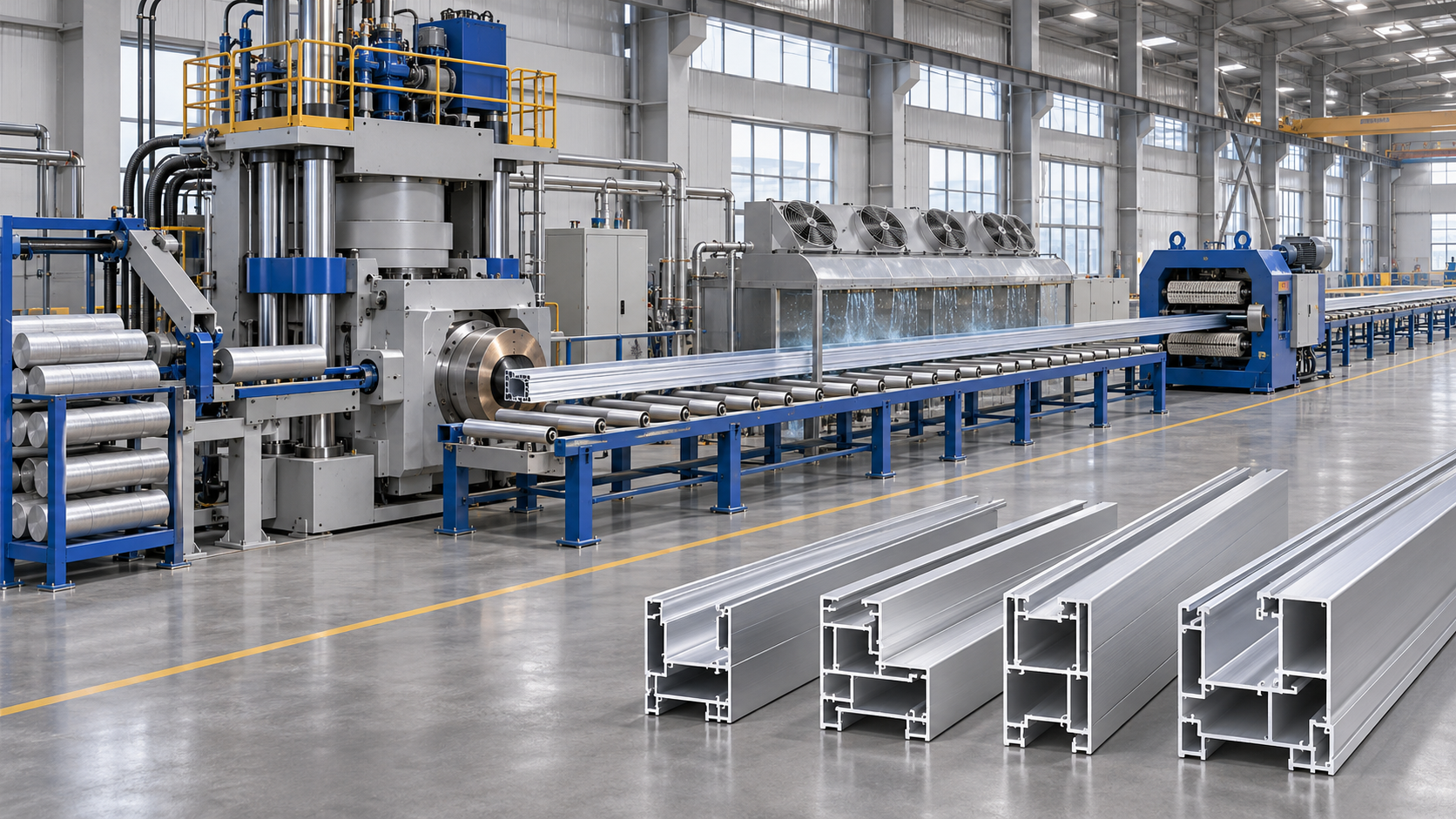
Choosing equipment for aluminum window profile extrusion starts with the profiles you intend to sell—not the largest press within your budget. Window frames, sashes, glazing beads, and sliding tracks place different demands on extrusion force, tooling, cooling, and dimensional control.
My starting point is straightforward: evaluate the complete production route before comparing machine prices. A press must do more than push aluminum through a die. It must support consistent surface quality, accurate assembly features, and commercially viable output.
This guide explains how to select an aluminum extrusion press for window profiles, compare suppliers, and define meaningful acceptance tests.
Aluminum Window Profile Extrusion: Start with Product Requirements
Before requesting quotations, prepare a representative profile portfolio. Include your highest-volume sections and your most difficult designs.
| Information to provide | Why it matters |
| Cross-sectional drawings | Reveal cavities, thin walls, and difficult features |
| Alloy and required temper | Establish processing and mechanical-property requirements |
| Circumscribing circle diameter | Helps assess profile-envelope and tooling compatibility |
| Minimum wall thickness | Identifies demanding metal-flow conditions |
| Weight per meter | Supports output and material-yield calculations |
| Critical dimensions | Defines assembly and inspection priorities |
| Monthly demand by profile | Prevents selection around an unrepresentative product |
| Required surface finish | Establishes visible-surface acceptance criteria |
For window systems, identify gasket grooves, screw channels, drainage features, and mating surfaces. A small dimensional deviation in these areas can create assembly problems even when the overall profile width is acceptable.
How to Select Extrusion Press Tonnage for Window Profiles
Match Force with Billet Size and Profile Geometry
Press tonnage describes available extrusion force, not guaranteed profile quality or production capacity.
Selection also depends on billet diameter, billet length, alloy, die construction, temperature, extrusion speed, and section geometry. Consequently, a recommendation based only on profile width or wall thickness is incomplete.
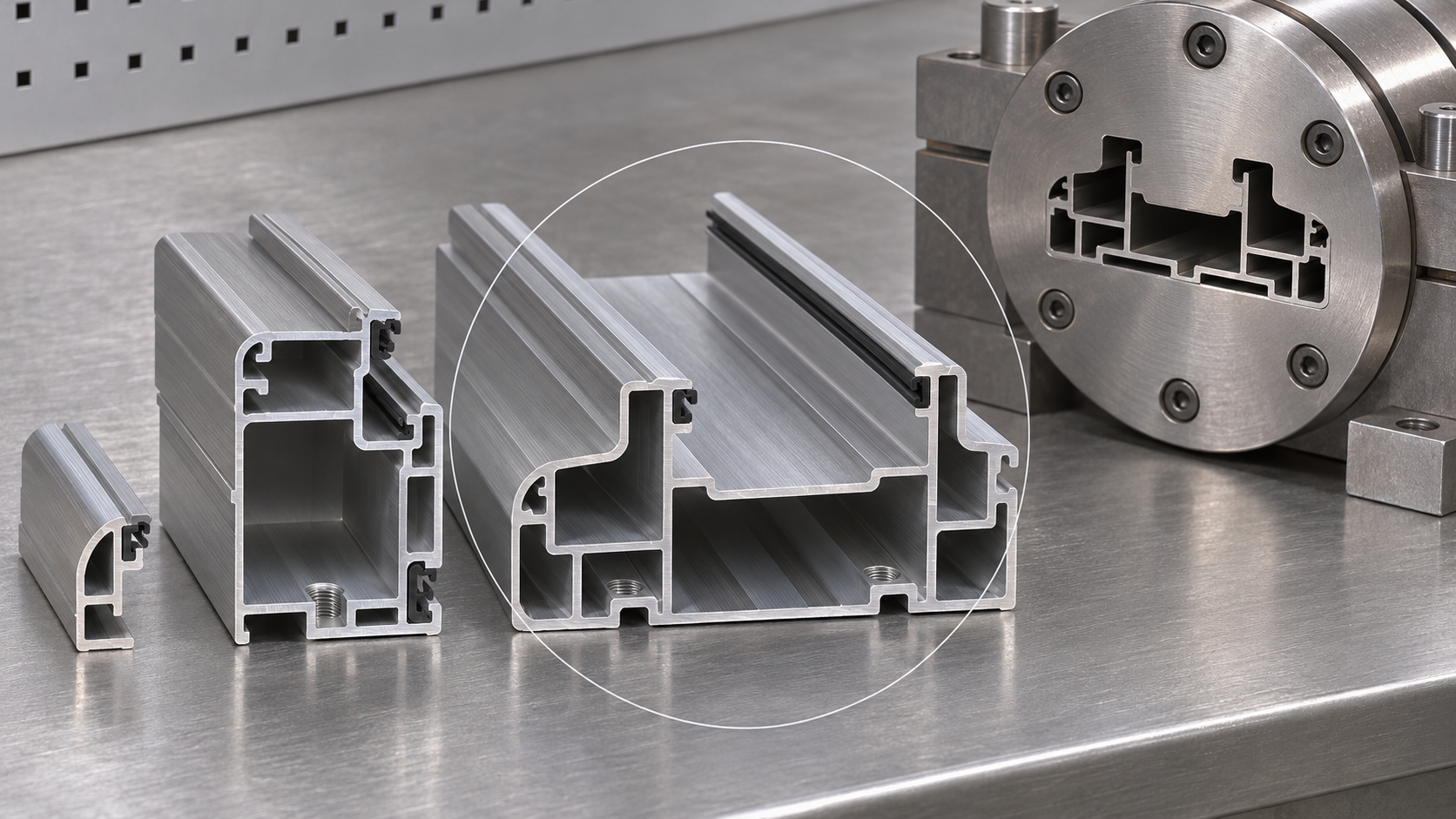
The circumscribing circle is the smallest circle enclosing the entire cross-section. It helps screen equipment compatibility, but it does not independently determine tonnage. Ask the supplier to confirm die diameter, tooling-stack dimensions, container configuration, and available force together.
Avoid accepting a universal "window-profile press size." A compact glazing bead and a large hollow frame require different assessments.
Check Extrusion Ratio Without Treating It as a Tonnage Calculator
The extrusion ratio compares billet cross-sectional area with the combined metal area of all extruded strands:
R=Billet cross-sectional area/Total extruded metal cross-sectional area
For multi-hole dies, include every strand in the denominator.
This ratio helps evaluate deformation and process feasibility. However, it does not capture die friction, alloy behavior, temperature, or tooling complexity. Ask for a drawing-based engineering assessment rather than relying on a single ratio or generic tonnage chart.
Evaluate Alloy, Thin Walls, and Window-System Fit
Confirm the Alloy and Temper First
Alloy 6063 is a relevant starting point for many architectural extrusion discussions because of its extrudability and suitability for complex sections. Nevertheless, the final alloy and temper must satisfy the window-system specification.
Do not treat T5 and T6 as interchangeable labels. Their processing routes and resulting property requirements differ. Confirm how extrusion conditions, cooling, and aging will support the specified finished product.
Review Thin Walls and Hollow Sections
Thin walls, deep channels, and uneven thickness transitions complicate metal flow and dimensional control.
Prefer reasonably uniform walls and gradual transitions where the design permits. Increasing press force alone will not correct an unsuitable die or an unnecessarily difficult profile.
For hollow window profiles, request a tooling review covering:
- Die strength and support.
- Metal-flow balance.
- Critical groove dimensions.
- Visible-surface requirements.
- Trial conditions and correction procedures.
For thermal-break systems, also define the dimensions needed for subsequent strip insertion and assembly. Extrusion acceptance should reflect those downstream requirements.
Match the Press with the Complete Extrusion Line
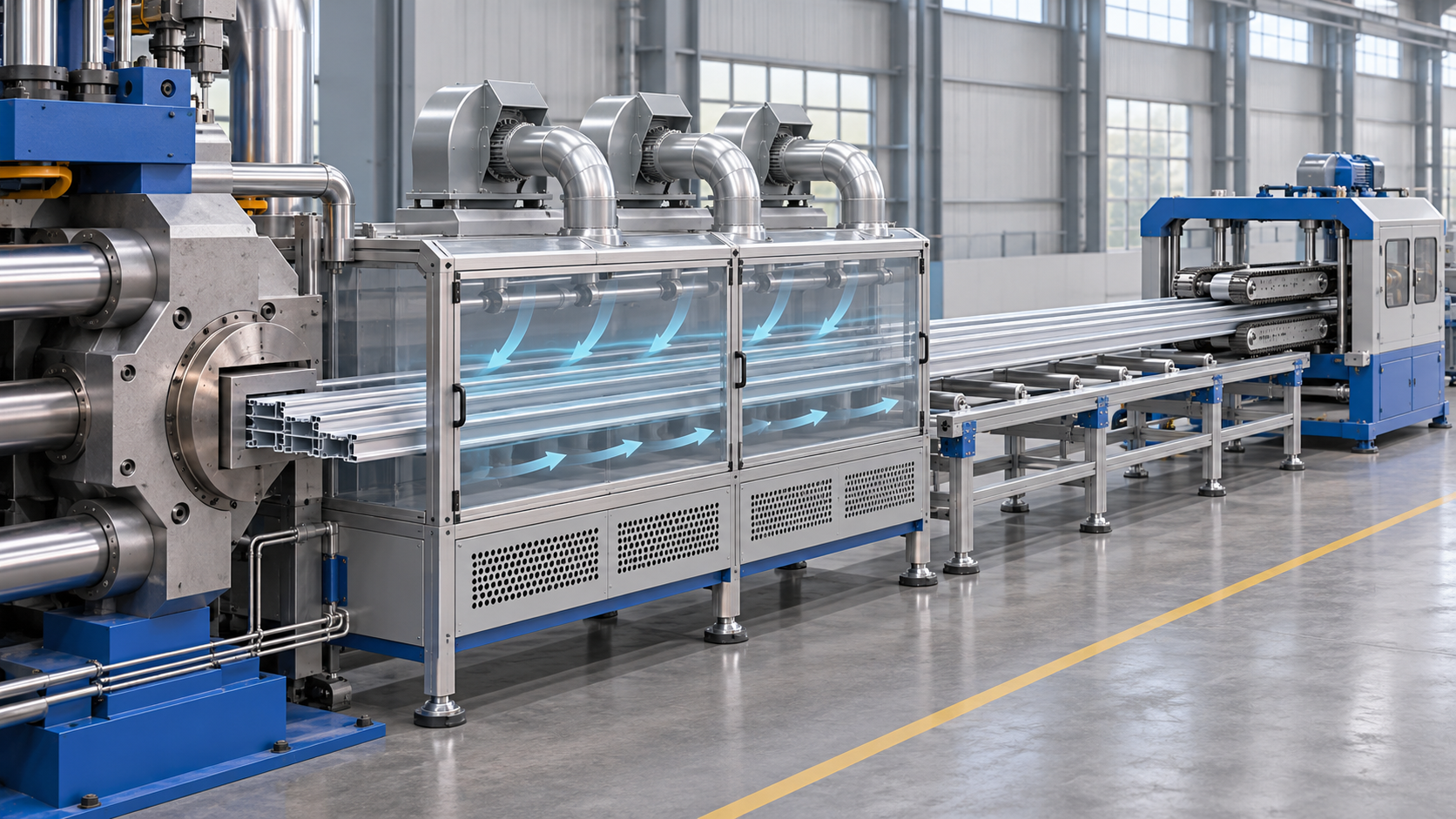
A capable press can still deliver disappointing production results when auxiliary equipment cannot keep pace.
| Equipment | Selection checkpoint |
| Billet heating system | Temperature consistency and feeding capacity |
| Die heater | Controlled preparation and sufficient die availability |
| Quenching equipment | Cooling appropriate to alloy, section, and temper |
| Puller and runout table | Coordination with extrusion speed and profile support |
| Stretcher and saw | Handling capacity, straightness control, and cut accuracy |
| Aging furnace | Capacity matched to the production schedule |
My preferred comparison is not maximum extrusion speed. It is accepted output across the complete line.
Likewise, evaluate automation by practical functions: recipe management, temperature records, alarms, production tracking, and operator access. Request a demonstration using a realistic production sequence.
Calculate Saleable Output Before Comparing Prices
Separate Gross Throughput from Accepted Production
Nameplate output is not the same as shipment-ready production.
Estimate output using billet mass, total cycle time, scheduled operating hours, availability, and saleable yield. Include billet loading, butt shearing, die changes, and downstream interruptions.
For illustration, a line processing 1,000 kg per hour at an 85% saleable yield produces 850 kg per hour of accepted material. This is a hypothetical calculation, not a reported equipment result.
Compare energy consumption on the same basis: energy per saleable tonne. Define whether measurements include only the press or also heating, cooling, handling, and aging.
Compare Ownership Costs
Evaluate purchase price alongside:
- Tooling and die-correction costs.
- Electricity and heating-fuel consumption.
- Scrap and rejected production.
- Maintenance access and spare parts.
- Installation, training, and commissioning.
- Service availability in your market.
A lower quotation is not necessarily better if it excludes essential equipment or realistic production support.
Specify Acceptance Tests Before Placing an Order
A useful acceptance plan connects equipment performance to your actual window profiles.
1. Select representative trial dies, including a demanding hollow section.
2. Fix the alloy, billet dimensions, and agreed processing conditions.
3. Define dimensional, surface, and mechanical-property requirements.
4. Record complete cycle time, accepted output, and rejected material.
5. Test handling, die changes, alarms, and safety functions.
6. Document results and responsibilities for unresolved items.
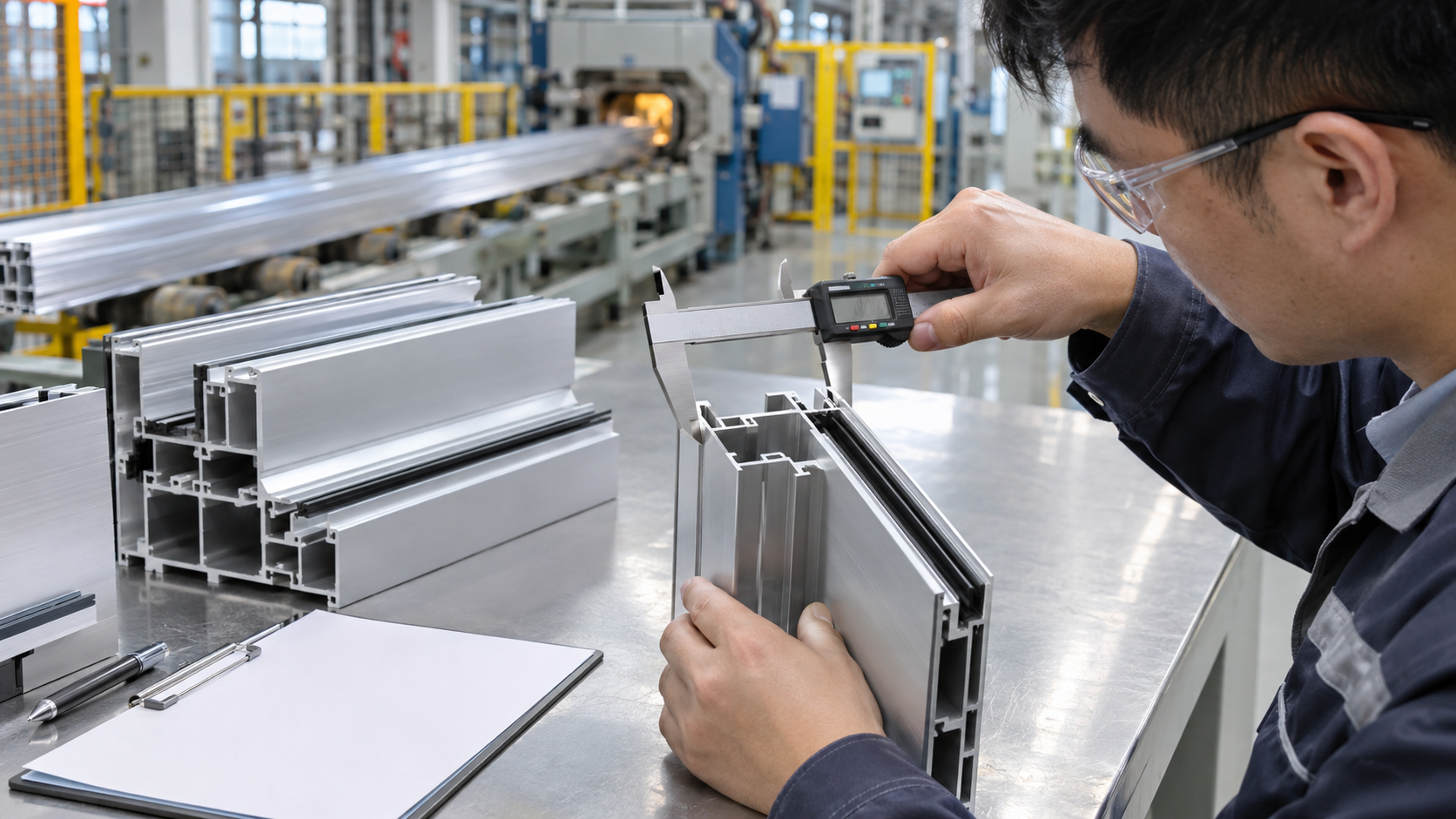
Specify measurement methods and sampling locations. Do not accept "high precision" as a substitute for drawing-based tolerances.
Plan Your Window Profile Extrusion Line with Yejing
Foshan Yejing Machinery Manufacturing Co., Ltd. brings 36 years of experience in extrusion-equipment development, design, and manufacturing. Its manufacturing record exceeds 3,000 presses, supported by an approximately 66,000 m² production base and more than 100 processing and assembly machines.
Yejing's processing, assembly, and commissioning capabilities cover 600–9,000-tonne presses. Its scope includes presses, auxiliary equipment, and integrated intelligent extrusion lines.
Send Yejing your profile drawings, alloy and temper specifications, monthly production targets, finishing requirements, and factory layout. Request a matched proposal covering press configuration, auxiliary equipment, utilities, acceptance testing, and service scope—not simply a tonnage quotation.
Frequently Asked Questions
1. What press tonnage is best for aluminum window profiles?
There is no universal answer. Selection requires profile drawings, billet dimensions, alloy, tooling details, and production targets. Confirm both geometric compatibility and process feasibility.
2. Can one press produce both window and door profiles?
Potentially, yes. The combined portfolio must fit the press, tooling, cooling, and handling capabilities. Evaluate demanding sections rather than assuming all architectural profiles are equivalent.
3. Does a larger press guarantee better surface quality?
No. Die condition, metal flow, temperature, speed, handling, and surface protection also influence appearance. Additional force does not replace coordinated process control.
4. Which tolerances should buyers specify?
Specify dimensions affecting assembly and function, together with straightness, twist, and flatness where relevant. Agree on the applicable tolerance standard and any tighter drawing-specific requirements.
5. What should an extrusion-line quotation include?
Request equipment scope, configuration, utilities, tooling interfaces, performance assumptions, acceptance criteria, installation responsibilities, training, warranty terms, and spare-parts support.
References
1. Aluminum Extruders Council. "Aluminum Extrusion Manual." Technical guidance on extrusion design, alloy extrudability, profile geometry, and manufacturing considerations. [tricityextrusion]
2. Bonnell Aluminum. "Designing Aluminum Extrusions." Guidance on alloy and temper selection, hollow sections, circumscribing circles, wall thickness, surface protection, and dimensional requirements. [bonnellaluminum]
3. Aluminum Extruders Council. "Aluminum Extrusion Tolerances." Explains standard and precision tolerances and the importance of agreement between designers and extruders. [aec]
4. Foshan Yejing Machinery Manufacturing Co., Ltd. Official company website. Source for establishment in 1990, more than 3,000 manufactured presses, production facilities, processing equipment, 600–9,000-tonne manufacturing capabilities, and integrated-line functions. Company figures are manufacturer-reported. [yjing-extrusion]


