Content Menu
● Why Machine Selection Defines Profit
● Understand the Door Frame Profile First
● Press Tonnage for Door Frames
● Calculate the Extrusion Ratio
● Estimate the Required Force
● Match Temperature and Alloy Control
● Choose Machine Features for Door Frames
● Plan the Whole Line, Not Just the Press
● A 7-Step Selection Method
● Common Mistakes to Avoid
● How We Support Buyers
● Get a Tailored Machine Recommendation
● Frequently Asked Questions
>> 1. What tonnage press do I need for aluminum door frame profiles?
>> 2. What is a good extrusion ratio for door frames?
>> 3. Which alloy is best for door frames?
>> 4. How much tonnage margin should I add?
>> 5. Should I buy a bigger press for future growth?
>> 6. What billet temperature should I use for 6063?
● References
Choosing the right machine for aluminum door frame profile extrusion comes down to five inputs. They are profile size, alloy, extrusion ratio, output target and automation level. For most 6063 door and window sections, a 800T–1450T press is the working range.
At Foshan Yejing Machinery Manufacturing Co., Ltd., we have built extrusion equipment for 36 years. Our 3,000+ presses have shipped to more than 30 countries. The same selection mistakes appear again and again. This guide explains how to avoid them.
Why Machine Selection Defines Profit
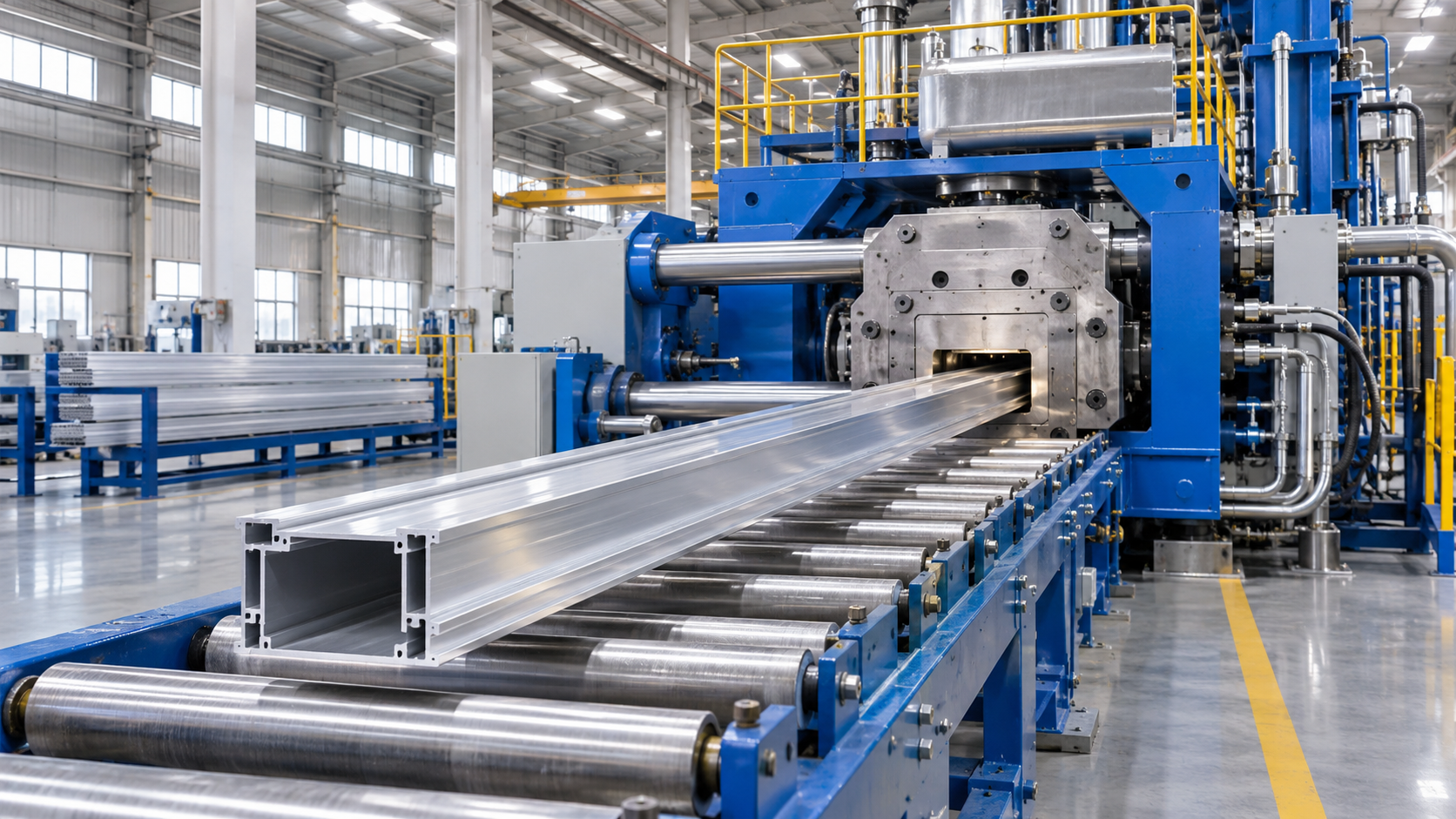
A press is a 20-year asset. It sets your product range, die cost, energy use and scrap rate. A press that is too small forces slow ram speeds and fails on wide, hollow frames. A press that is too large wastes capital and power.
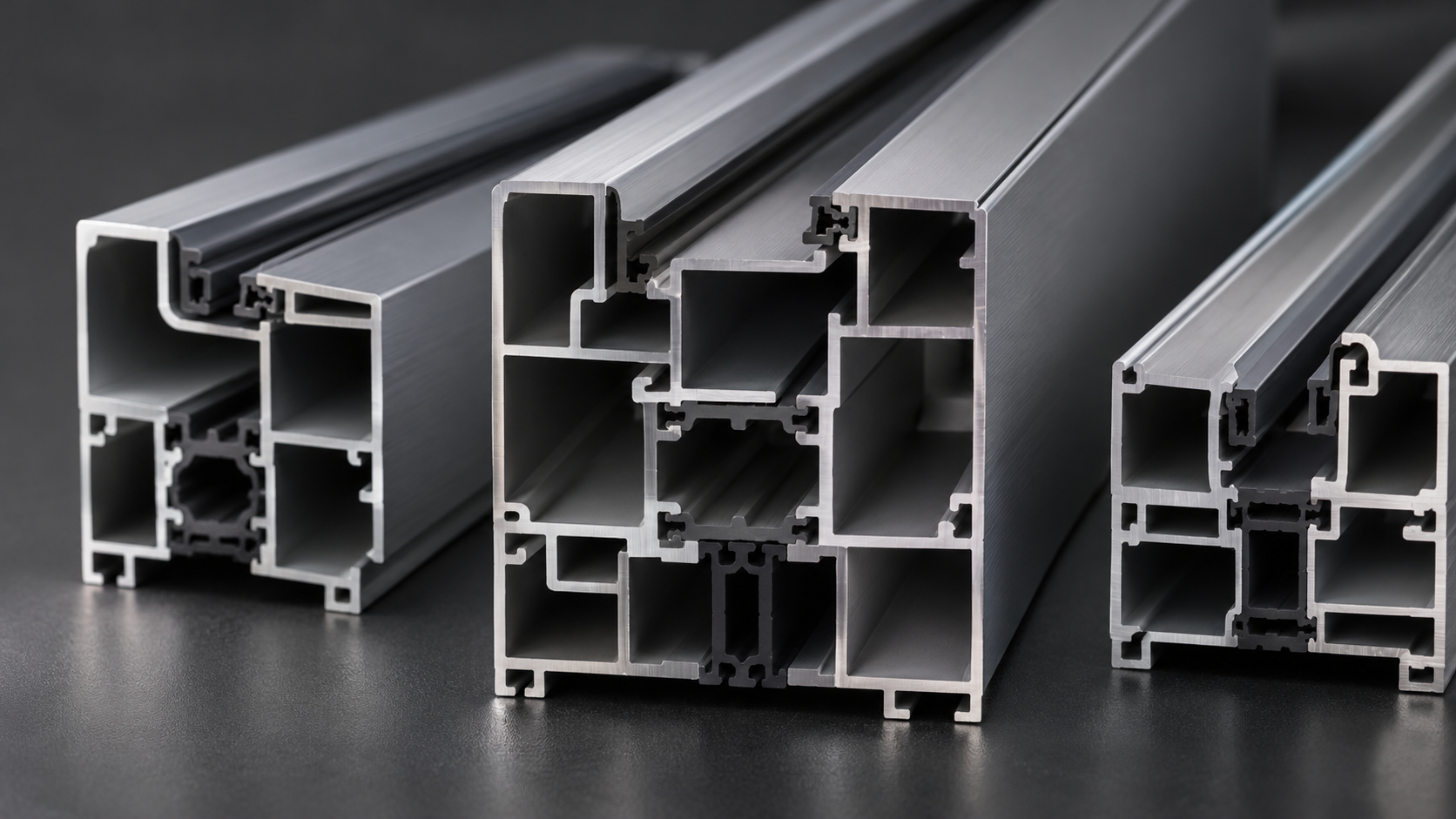
Door frame profiles look simple, but they are demanding in practice. They are usually hollow, multi-chamber sections with thin walls. They also need tight tolerances for thermal break insertion, gasket grooves and corner joints.
Understand the Door Frame Profile First
Start with the profile, not the press catalog. Gather these facts for your full product portfolio:
- Circumscribed circle diameter (CCD): the smallest circle that contains the section.
- Cross-sectional area: total area of all profiles in one die.
- Wall thickness: typical door frames run 1.4–2.0 mm for residential and thicker for heavy-duty systems.
- Solid or hollow: hollow sections need porthole or bridge dies and more pressure.
- Alloy and temper: most door frames use 6063-T5 or 6060-T5.
Industry sources note that 6063-T5 and 6060-T5 are the common choices for window and door systems. They offer excellent extrudability and a smooth surface, and they are stable during thermal break insertion. The profile's circumscribed circle must always fit inside the press's die capacity.
Press Tonnage for Door Frames
Tonnage is the first screening filter. It sets billet diameter, which sets the largest profile you can run.
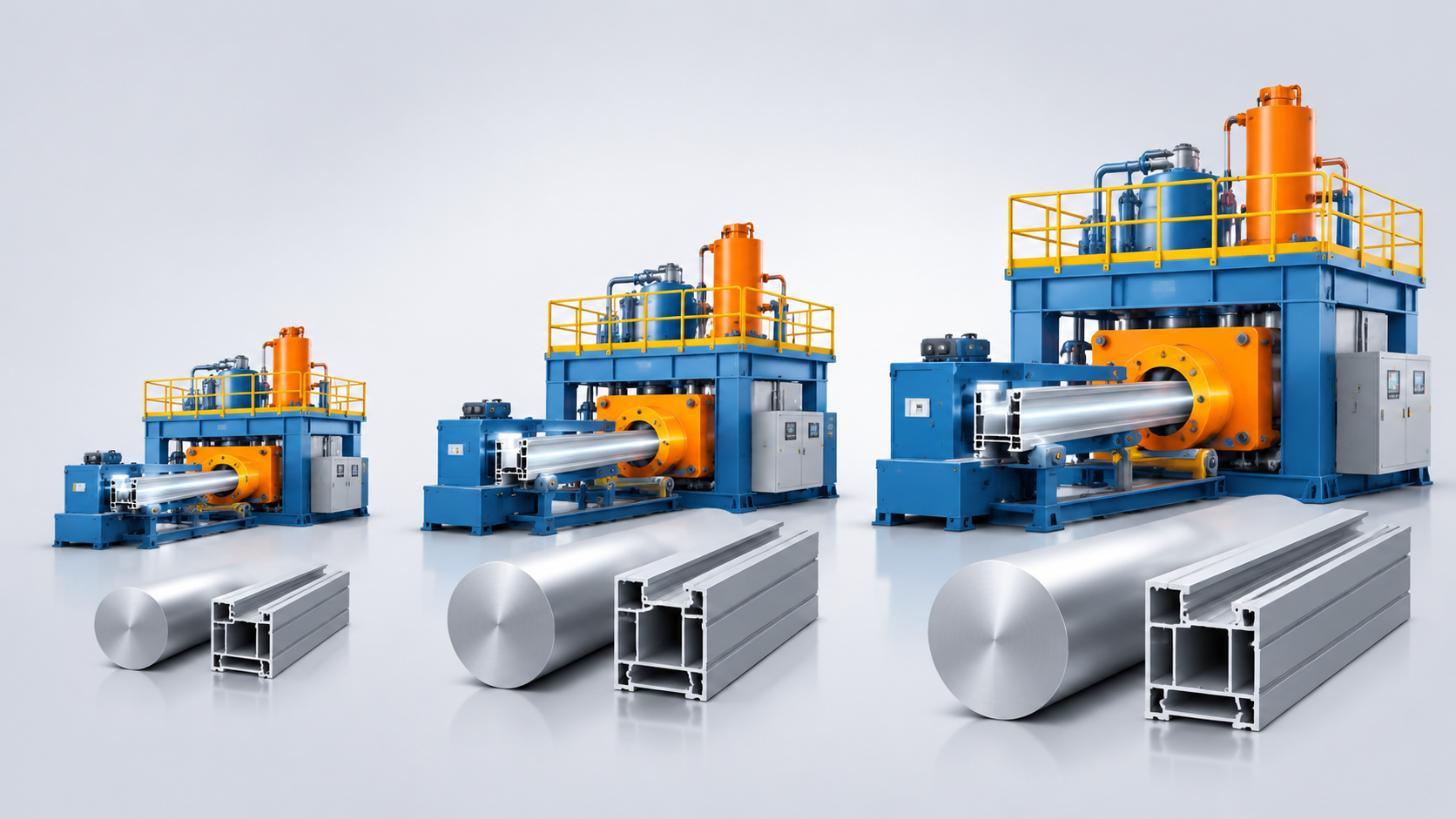
| Press tonnage | Typical billet diameter | Typical use |
| 600T | Up to about 90 mm | Small, simple profiles |
| 800T–1000T | 5 in (about 127 mm) | Standard door and window profiles |
| 1250T–1450T | 6 in (about 152 mm) | Wide door frames, curtain wall |
| 1800T–2500T | 7–10 in | Large architectural and industrial sections |
Published guides give consistent ranges. One guide says 800T or 1000T presses suit doors and windows, while 1250T and above suit curtain wall and industrial profiles. Another recommends 800–1450T for curtain wall, doors and windows in 6063. A third says typical household door and window profiles run well on a roughly 1000T press.
Watch your units. A "2000-ton" press may mean 2000 US tons (about 18 MN) or 2000 metric tons (about 19.6 MN). Always confirm the force in MN or kN in the quotation.
Calculate the Extrusion Ratio
The extrusion ratio is the most reliable calculation tool you have.
Extrusion ratio (λ) = billet cross-sectional area ÷ total profile cross-sectional area
Here is a worked example:
1. Choose a 6-inch (152 mm) billet. Area ≈ 18,146 mm².
2. Door frame profile area = 600 mm². Run it as a 2-cavity die for 1,200 mm² total.
3. λ = 18,146 ÷ 1,200 ≈ 15.
This is on the low side. Australian industry guidance states that optimum direct-extrusion ratios usually fall between 30 and 60. Other sources suggest practical ratios of 20:1 to 60:1 for 1000–1250T presses.
Use these decision rules:
- Below 30:1: a 1000–1250T press handles most 6063 profiles efficiently.
- 30:1 to 60:1: move to 1450–1800T for stable production.
- Above 60:1: plan for 2000T and above, especially for hollow, thin-wall designs.
A ratio that is too low causes poor metal bonding and weak weld seams in hollow sections. A ratio that is too high drives up pressure, billet temperature and die wear.
Estimate the Required Force
Once you know the billet size, estimate the force. A common rule of thumb for 6000-series alloys is a specific pressure of about 25–35 kg/mm² on the billet. Another source puts ordinary 6063 door and window extrusion at about 200–300 MPa.
Using our 6-inch example: 18,146 mm² × 30 kg/mm² ≈ 544 tons of working force. That is only the starting figure. Add a margin, because experienced suppliers advise choosing 15–20% more tonnage than the theoretical maximum. This keeps the hydraulic system away from its limit and extends pump and seal life.
Remember that a press rated at 1000T does not run at full force all day. Hollow dies, cold billets and long billets all raise breakthrough pressure. Billet length matters too. Longer billets raise pressure, and the practical effect depends on how the dummy block, butt shear and material flow behave.
Match Temperature and Alloy Control
Your machine must hold the process window. For 6063, the optimal billet temperature range is around 470–500°C. If it is too hot, you see surface tearing. If it is too cold, speed drops and pressure rises.
Look for these machine features:
- Billet heating furnace with accurate temperature control, and a hot-shear for taper heating.
- Container heating to keep thermal conditions stable.
- Die oven for uniform die preheating.
- Press-quench cooling (air or water-mist) so T5 properties are reached on the run-out table.
Choose Machine Features for Door Frames
Door frames are visible parts. Surface quality counts as much as dimensions. These features pay back quickly:
- Short-stroke or high-rigidity frame: keeps die alignment stable for thin walls.
- Quick die change: lowers downtime across many small orders.
- Constant-speed and isothermal control: reduces dimensional drift along the profile length.
- Servo-driven hydraulics: can cut energy use compared with fixed-pump systems.
- Automatic feeding and puller: reduces labor and surface scratches.
Large plants that handle many door, window and curtain wall orders often choose presses with automatic feeding, quick die change and high-speed extrusion. A smaller plant may start with a basic line and add automation later.
Plan the Whole Line, Not Just the Press
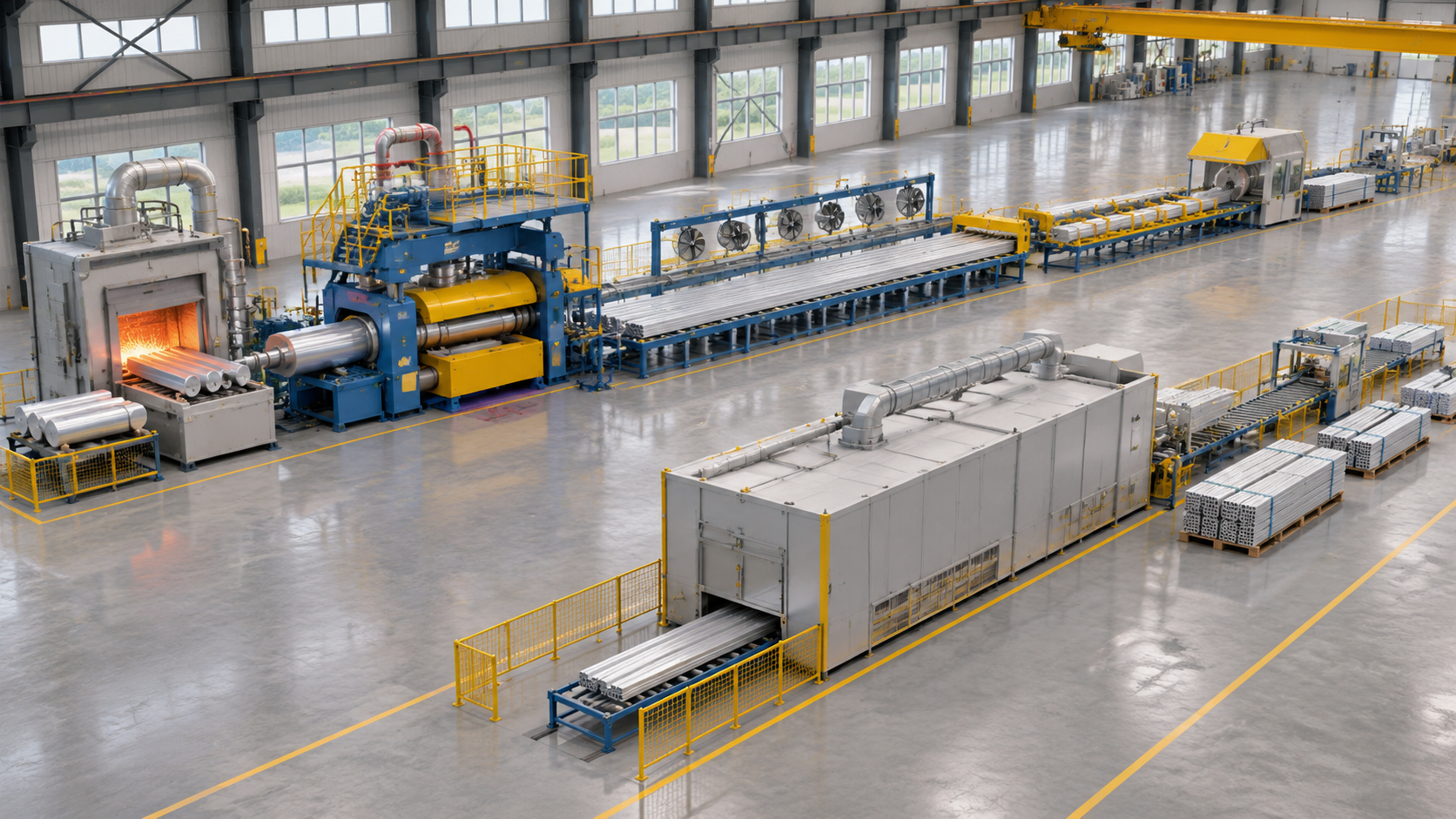
The press is only one part of the line. A balanced door frame line includes:
1. Billet furnace and hot shear.
2. Extrusion press and die oven.
3. Run-out table and puller.
4. Cooling system.
5. Stretcher and saw.
6. Aging oven (for T5/T6).
7. Handling, stacking and packing.
If the downstream equipment is slow, the press waits. We design complete turnkey lines, from press to aging furnace and intelligent control. This lets us match every stage to your target output in kg/hour.
Set a realistic output target in kilograms per hour, tons per month and annual operating hours. Production capacity should be evaluated this way before any press model is shortlisted.
A 7-Step Selection Method
Use this checklist when you evaluate suppliers:
1. List every profile you plan to produce, including future products.
2. Find the largest CCD and confirm it is below the press's die capacity.
3. Select the alloy and temper (usually 6063-T5).
4. Calculate the extrusion ratio for each profile and die layout.
5. Estimate the force and add a 15–20% margin.
6. Match output (kg/hour) to billet diameter and ram speed.
7. Review automation, energy use and after-sales support.
One published method lists a similar set: circumscribed circle, alloy resistance, ratio of 8–12 for basic cases, hollow or solid type, and daily output. The right specification is a window. It needs enough force for the hardest profile on the order book, plus a modest margin for future products, rather than the biggest machine the budget allows.
Common Mistakes to Avoid
- Buying on tonnage alone. Billet-to-container-to-die matching matters just as much.
- Ignoring hollow sections. They need higher ratios and more force.
- Skipping die planning. Good dies often improve output more than a bigger press does.
- Under-sizing the cooling and aging stages.
- Forgetting spare parts and service. Remote support, local engineers and spare-part availability protect uptime.
How We Support Buyers
Our factory covers 66,000 m² and runs more than 100 machining and assembly machines. We machine, assemble and commission presses from 600T to 9,000T. We hold ISO 9001 and CE certification, and we are a registered supplier with the EU information center. Our presses run in Australia, South Korea, Türkiye, Brazil and more than 25 other countries.
A typical project follows this path:
1. You send profile drawings, alloy and target output.
2. Our engineers calculate ratio, force and billet size.
3. We propose two or three press and line options with a cost comparison.
4. We build, test and ship the equipment.
5. We commission on site and train your operators.
Get a Tailored Machine Recommendation
Send us your profile drawings, alloy, target output and budget range. Our engineers will return a press and line proposal with ratio calculations. Contact Foshan Yejing Machinery Manufacturing Co., Ltd. today to request a quotation or a factory visit.
Frequently Asked Questions
1. What tonnage press do I need for aluminum door frame profiles?
Most 6063 door and window profiles run on 800–1450T presses. Choose the lower end for narrow, simple frames and the upper end for wide, hollow, multi-chamber sections.
2. What is a good extrusion ratio for door frames?
Aim for roughly 30–60 for direct extrusion, based on industry guidance. Very low ratios weaken weld seams in hollow profiles. Very high ratios raise pressure and die wear.
3. Which alloy is best for door frames?
6063-T5 is the most common. It extrudes easily, finishes smoothly and works well with anodizing and powder coating.
4. How much tonnage margin should I add?
Add 15–20% above your calculated maximum. This protects the hydraulic system and extends component life.
5. Should I buy a bigger press for future growth?
Only if your product plan supports it. A modest margin is wise, but the largest affordable press often wastes capital and energy.
6. What billet temperature should I use for 6063?
Keep billets at about 470–500°C, and control container and die temperatures to match.
References
1. [HTS-ALU – Thermal Break Aluminum Profile]
2. [Extruderpress – How to Choose the Right Tonnage for Your Aluminum Extrusion Machine]
3. [Machine4Aluminium – How to Choose the Tonnage of Aluminum Extrusion Press]
4. [Nenghong – Selection Guidance of Capacity Model of Aluminum Extrusion Press]
5. [Zoyvan – How to Choose Aluminum Extrusion Press Tonnage]
6. [Aluminium Extrusion Manual (Australian Aluminium Council)]
7. [Shengxin Aluminium – Extrusion Ratio for Aluminum]
8. [Arzir – Aluminium Extrusion Press Capacity Guide]
9. [Extruderpress – What Extrusion Press Tonnage Do You Need?]
10. [Castool – Extrusion Productivity: Billet Geometry/Container/Dummy Block]
11. [Shengxin Aluminium – Extrusion of Aluminum Profiles]
12. [SLX – Aluminum Extrusion Press Tonnage Selection Guide]


